
Can Hawaiʻi afford to cut the grocery tax?
In Hawaiʻi, the General Excise Tax (GET) touches every purchase you make, and that includes your grocery bill. Critics say it’s unfair to tax such a basic necessity, especially since the burden hits low-income families the hardest. But the flip side is that the GET also brings in hundreds of millions of dollars for the state every year—and a big chunk of that money is paid by tourists and wealthier residents.
While it’s true that removing the GET from grocery purchases would ease the cost of living burden for local families, such a proposal should be considered in tandem with plans to replace lost revenue and retain essential services. Ideally, these new revenues would come from taxes that take a larger share from the wealthy and corporations. This would make our overall state tax system more fair.
General Excise Tax: A Regressive Revenue Source
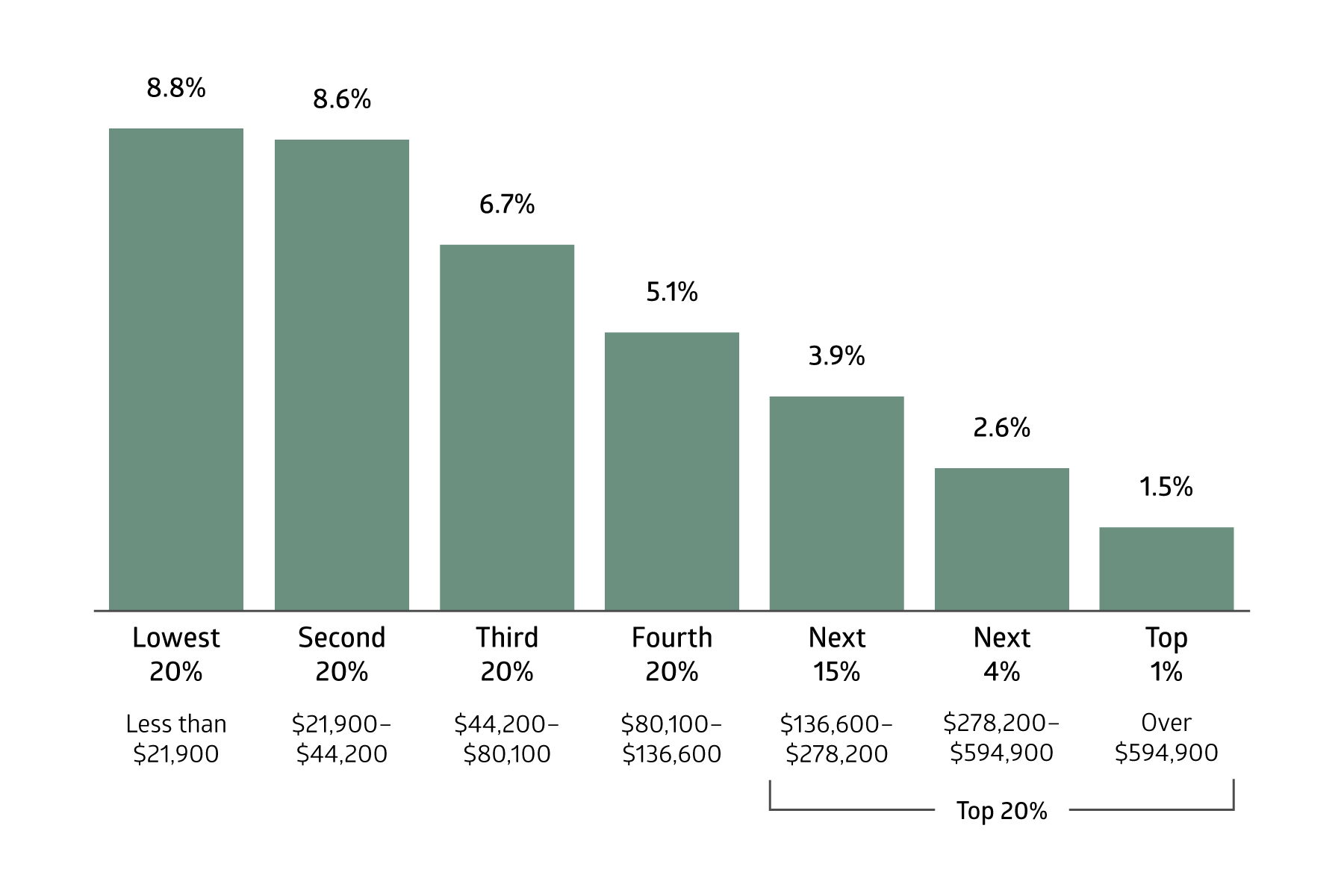
Hawaiʻi is one of only seven states that taxes groceries. The GET and sales taxes in general are widely regarded as regressive and unfair to low-income families. In Hawaiʻi, the bottom fifth of households spend nearly 9 percent of their annual income on the GET, compared with the top fifth of households that spend less than 4 percent.
Figure 1. Share of Family Income Required to Pay General Excise Tax by Income Quintile, Hawaiʻi (2024)
In Honolulu, the average household spent nearly $8,400 annually on groceries—the largest dollar amount in the nation. Out of that amount, $377 went straight to the GET.
Unlike sales tax, which is only levied on the consumer at the point of sale, the GET is charged at each point in the supply chain. Supermarkets and suppliers build those costs into their prices, passing the cost on to the consumer. The result: groceries in Hawaiʻi cost more for everyone, and families with the least amount of disposable income shoulder the heaviest load.
Food/Excise Tax Credits: An Imperfect Solution
Historically, the state’s solution for this injustice has been to compensate these households at tax time with a refundable Food/Excise Tax Credit. In 2022, this credit gave $25 million to around 208,000 Hawaiʻi households. Lawmakers doubled the credit in 2023, allowing households to claim up to $220 per person.
But in practice, many families never see that relief. The Department of Taxation estimates that, in 2021 (the most recent year for available data), nearly 158,000 eligible individuals did not take advantage of the credit. This could be because some low-income households aren’t required to file tax returns at all. For others, the labor involved in claiming the credit could simply be too high of a burden.
Legislative Efforts to Eliminate the GET on Groceries
Earlier this year, legislators heard a bill that would have eliminated the GET on food and non-prescription medication. The proposal drew strong support from food security advocates and the local food industry, but ultimately failed to advance. Lawmakers cited several challenges that would need to be resolved before such a measure could succeed in future sessions, including how to offset the loss of revenue.
Hawaiʻi’s Budget Dependence on GET
Looking at Hawaiʻi’s budget on the whole, the GET makes up nearly half of of the state’s general fund revenue. However, the amount contributed by the specific GET on groceries is a relatively small sliver—about 2.7 percent.
Figure 2. Hawaiʻi General Fund Revenue Sources, FY2023 ($Millions)
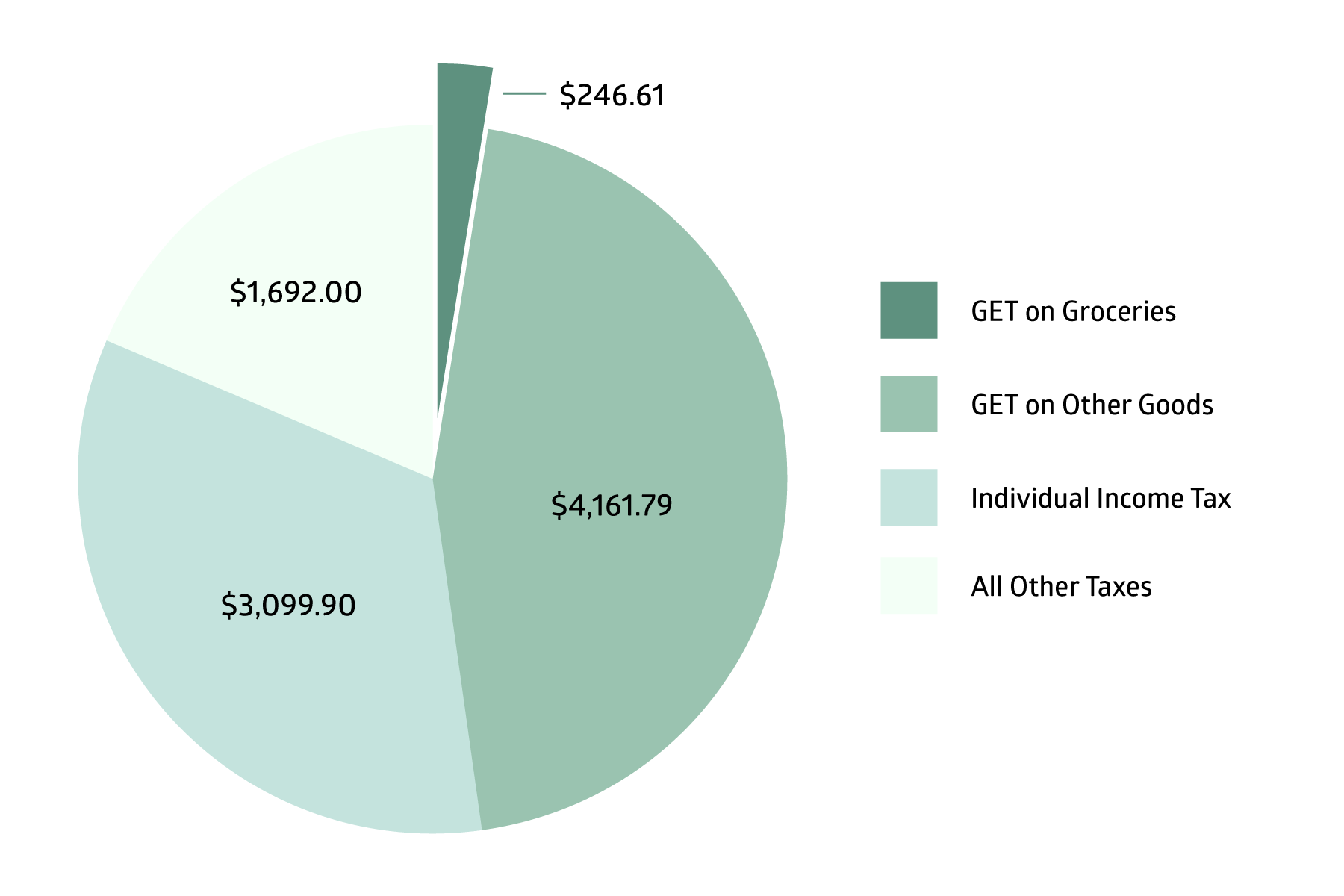
Source: Hawaiʻi Budget Primer, 2024-25
This still amounts to at least $240 million a year—the equivalent of over 3,100 teacher salaries. Supporters of the tax note that much of this revenue is contributed by tourists and higher-income households. They argue that, unless lawmakers are willing to raise other taxes or cut services, the costs would inevitably shift back onto local residents in some other form. Looming federal spending cuts to programs like Medicaid and SNAP could make it even harder for Hawaiʻi to forgo any portion of its GET revenues going forward.
If Not the GET, Then What?
Eliminating the GET on groceries and other basic necessities will require Hawaiʻi to find new sources of revenue to fill in this gap. The good news is there are many options out there, including closing the capital gains tax loophole or increasing the conveyance tax on out-of-state homebuyers. We also have an opportunity to revisit the sweeping tax cuts passed in 2024, making adjustments that can generate additional revenue. Any of these common-sense approaches could generate millions of dollars without raising costs for low- and middle-income families.
Balancing Trade-Offs
Ultimately, policymakers face a difficult choice. The GET is regressive, falling most heavily on families with the least disposable income. But it also funds critical services that Hawaiʻi residents rely on every day. Any proposal to reduce or remove the GET on food must be paired with a credible plan for replacing the revenue. It’s a challenge, but also an opportunity to build a fairer and more sustainable system.