Transformative change meets budget realities—a central lawmaking tension plays out in two new reports
Every year in Hawaiʻi, two parallel storylines unfold at the state capitol. One is a story of ambitious policy goals. Community needs are identified, solutions are proposed and hard-fought legislative victories are won. The other is a story of fiscal reality, where the state’s budget—a reflection of its values and constraints—determines whether those ambitions can be fully realized.
Together, Hawaiʻi Appleseed’s Policy in Perspective 2025 and the Hawaiʻi Budget Primer FY2025–26 provide a compelling—and sometimes sobering—look at how these two storylines intersect. The reports tell the story of how Hawaiʻi invests, and often under-invests, in its communities.
Policy in Perspective describes a legislative session of courageous but incomplete progress. It celebrates landmark achievements, such as:
Act 139, which expands free school meals and bans lunch shaming; and
Act 96, the “Green Fee” that asks tourists to contribute more to environmental preservation.
It also highlights profound disappointments: the failure to create a locals-only housing market, close the capital gains tax loophole for the wealthy, or establish a state Child Tax Credit. The report frames these outcomes as a tension between “grassroots power” and “fiscal reality,” where the will of the people bumps up against a system hesitant to challenge entrenched privilege.
This is where the Budget Primer becomes essential. It provides the ledger against which these policy battles are measured. The budget reveals a state financial system with limited flexibility. A staggering $5 billion—a quarter of the operating budget—is consumed by obligated costs like pensions, debt payments and Medicaid. These costs must be covered before any new initiatives can even be considered.
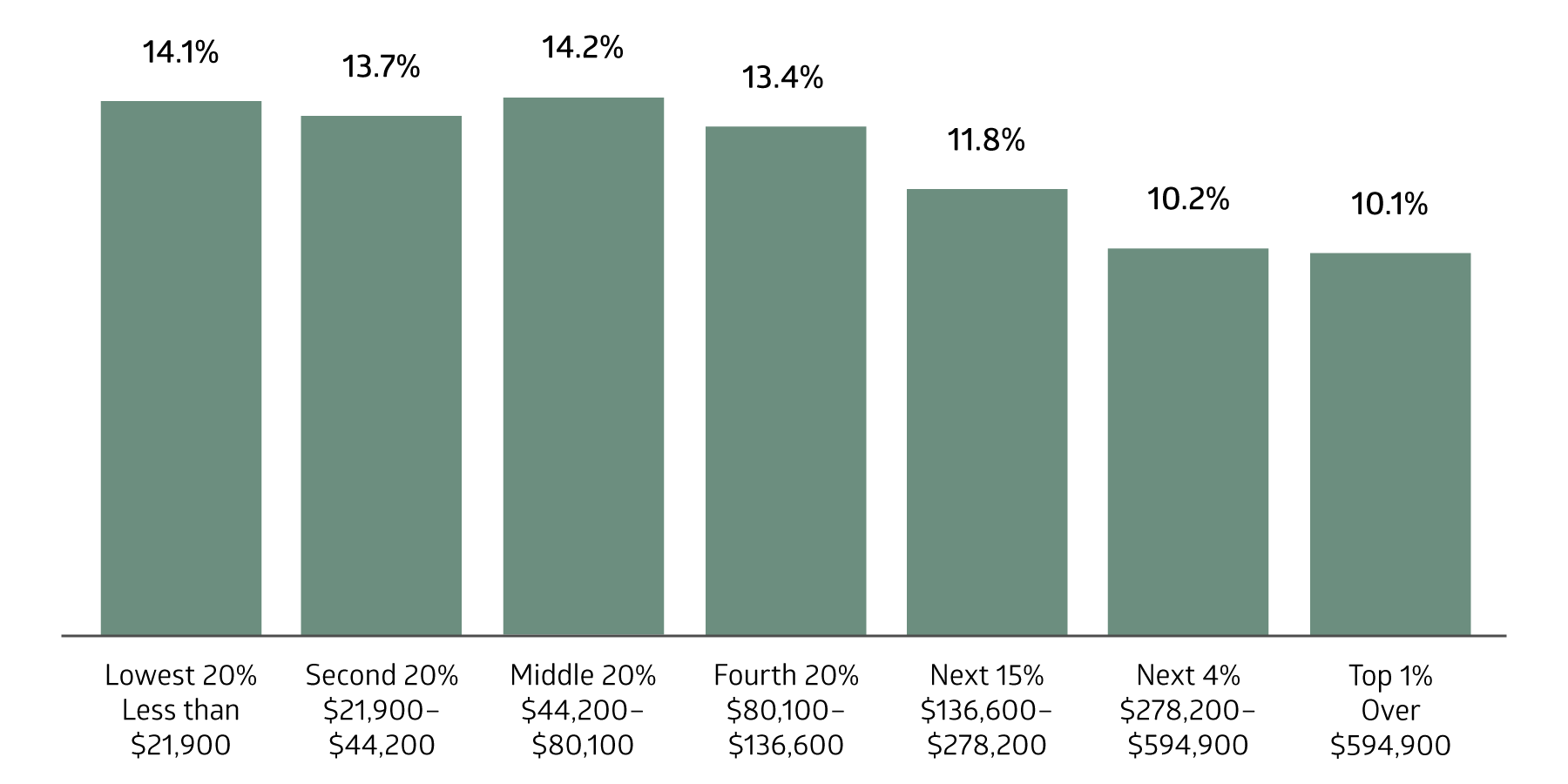
Furthermore, the state’s revenue structure itself is a barrier to equity. As the Primer illustrates, Hawaiʻi relies heavily on the General Excise Tax (GET), which accounts for over half of all tax revenue. This regressive tax hits low-income families hardest, as they spend a much larger share of their income on taxable essentials like food and rent.
Figure 1. Percentage of Income Paid in State and Local Taxes by Household Income Quintile (2024)
Source: Institute on Taxation and Economic Policy
The two documents together expose a critical contradiction: the state’s primary revenue tool exacerbates the very inequality that its policies, like school meal expansion, are trying to alleviate. Policy in Perspective argues for taxing wealth to address inequality and fund services, pointing to the rejection of a capital gains tax increase that could have raised $84 million. The Budget Primer quantifies this missed opportunity, showing that tax credits for businesses and wealthy taxpayers exceeded those for low-income families by over $50 million in 2022.
The state’s engine for raising revenue is fundamentally misaligned with its stated goal of creating a more just society. This misalignment is starkly evident in the transportation space. The Budget Primer shows that the Department of Transportation has a massive capital budget of $1.78 billion, largely for roads and highways. Policy in Perspective highlights that community safety and mobility access initiatives like Safe Routes to School must be funded by a new $5 vehicle registration fee, generating just a fraction of the needed funding. The state is willing to invest billions in vehicle infrastructure but relies on piecemeal funding for community-centered safety projects, reflecting a systemic prioritization that the budget makes plain.
Ultimately, these reports show that the legislative process is only half the battle. Passing a law is a victory, but without a dedicated and equitable funding stream, its impact can be muted. The eviction mediation required by Act 278 is a prime example. Policy in Perspective correctly identifies it as a partial lifeline—but one weakened by the legislature’s simultaneous failure to fund rental assistance. A policy solution, born from community advocacy, is hamstrung by a budget choice.
The most powerful thread connecting these documents is the looming threat of federal cuts. Policy in Perspective opens with the “existential threat” to Medicaid, SNAP, and housing vouchers. The Budget Primer explains that federal funds constitute just shy of 20 percent of the state’s budget. If Congress slashes these programs, Hawaiʻi will face an impossible choice: let vital services collapse or backfill the funding with state dollars. The legislature’s decision to set aside a $200 million contingency fund—which Policy in Perspective notes is enough to run the state for just four days—reveals the terrifying scale of this potential crisis.
These two reports tell a story of a community pushing for transformative change and a government apparatus struggling to keep up. They illustrate that a just future for Hawaiʻi requires not only passing good policies but also undertaking the harder, more systemic work of reforming the state’s budget and tax code. Lawmakers must find the courage to build a revenue system that asks the most from those who have the most to give back, so that the budget can truly become the tool Hawaiʻi needs to invest in the well-being of all its people.