Over the past several decades, housing that is affordable to the average Hawaiʻi resident has become increasingly out of reach for many. This housing affordability crisis is a direct result of decades-old policy choices that remain fiercely defended today. While it is true that global demand and outside investment play a role, these pressures on our housing costs are amplified because counties have stagnated on enabling new housing—even when it’s price-restricted, reserved for residents, or designed for perpetual affordability.
County governments hold the primary authority. They control what gets built through zoning, and through lengthy discretionary approvals. Both levers have historically been used to restrict supply. Multifamily housing, which effectively houses many families on a single lot, faces the longest delays. In Honolulu last year, it took a median of 554 days just to get a multifamily permit approved.
Instead of reforming the underlying land-use rules that restrict density, we’ve layered on subsidies. We fund affordable housing programs, and carve out narrow exemptions for certain projects. We also offer consumer subsidies in the form of rental vouchers and downpayment assistance—but neither is provided at sufficient levels to address the problem. The result is a system in which almost every new project requires a supply-side subsidy to move forward, and many residents still need a demand-side subsidy to afford it. We are stacking subsidies on top of subsidies, all while the fundamental barriers to building remain.
This creates a predictable outcome: costs keep rising, and families are left desperate for housing that never gets built at the necessary scale. So they leave the state.
Subsidies do serve a vital, targeted role in assisting those with the lowest incomes. But when used to compensate for a restrictive system, they distort the entire housing market. Developers come to expect public assistance before moving forward, and the accompanying conditions limit the type and number of units built. The biggest casualty is the middle: working families who earn too much for assistance, but too little to compete in an artificially inflated market.
Figure 1. Change in Housing Supply vs. Relative Rent Growth by County, 2018–2023
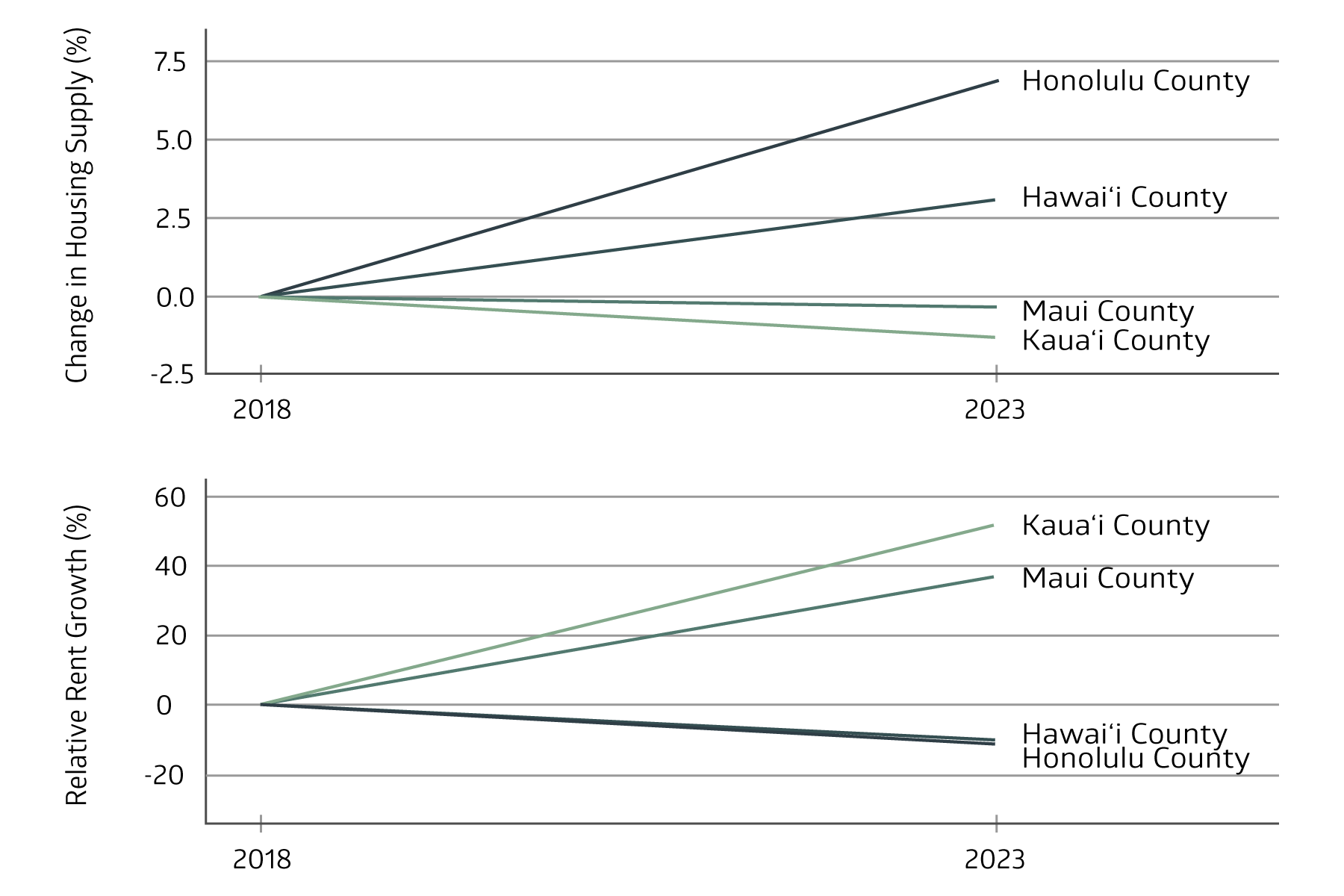
Relative rent growth captures the percent difference between the county growth rate and overall state growth rate (0). Rents have increased everywhere, but much faster in counties with fewer new homes being built (for example, almost 60 percent faster in Kauaʻi County compared to the state).
Source: University of Hawaiʻi Economic Research Organization (UHERO)
Evidence of a better way exists. When cities allow supply to meet demand, prices stabilize:
In Austin, a surge of new construction drove rents back down to pre-pandemic levels.
In Salt Lake City, a building boom caused average market rents fall below some government-capped “affordable” rates.
Here in Hawaiʻi, the University of Hawaiʻi Economic Research Organization (UHERO) found that counties that expanded supply, like Honolulu and Hawaiʻi Island, saw slower rent increases; while Maui and Kauaʻi—where supply stagnated—saw rents spike 37 to 51 percent faster than the state average.
Some progress has been made locally:
Kauaʻi has reformed its inclusionary zoning rules and embraced form-based codes.
Honolulu’s Bill 7 created a streamlined, ministerial approval path for certain rentals.
Maui is working to phase-out thousands of short-term rentals.
Hawaiʻi County now allows three Accessory Dwelling Units (ADUs) per lot.
These are positive steps, but they are too limited to match the scale of the crisis. They’re also politically fragile. Already, legislation is being debated in Honolulu that would roll back progress.
The lesson is straightforward: To make housing affordable, counties need to get out of their own way. The current path guarantees ever-higher costs. Counties have the power to choose a different future—one where housing can be built at a scale that meets the needs of local families. Counties should:
Allow for more housing in existing urban areas, particularly dense housing near jobs and transit stations;
Move away from discretionary approvals that trap projects in political limbo, and instead adopt ministerial approvals that let compliant projects move forward automatically; and
Rethink inclusionary zoning.
Our housing crisis is the result of past choices. The solution requires the courage to make new ones going forward.