On tax policy, state legislators made progress in 2023 with tax relief, but left smart, revenue-raising policy initiatives on the table for next session.
As Hawaiʻi’s working families continue to weather our highest-in-the-nation cost of living here in the islands, the 2023 state legislative session saw lawmakers vote unanimously to expand several tax credits for working families, including the earned income tax credit (EITC) and refundable food/excise tax credit through House Bill 954. While other tax relief concepts, such as creating a state-level child tax credit, didn’t quite materialize this year, the final agreement to pass HB954 will provide much-needed financial support.
Since these credits are refundable, they will put more cash directly into the pockets of the lowest-income workers in particular, targeting relief where it’s needed most and maximizing the economic return these credits generate through consumer spending, workforce stabilization and improved family and community health.
The legislature also heard a number of bills that would have raised revenue through better targeted taxes on those of us who are thriving and can afford to contribute more toward essential investments in our collective future. Investments in priorities such as affordable housing, environmental conservation, and government assistance programs could be paid for through improvements to the conveyance tax and capital gains tax, as well as through a new “green fee” tax on tourists.
None of these measures made it through to the end of the session. However, tax advocates will have the opportunity to reintroduce them next year, and some could even be picked up right where they were left as part of the biennium structure of Hawaiʻi’s legislature. The need to fund comprehensive solutions to Hawaiʻi’s many challenges remains, and lawmakers will need to find equitable ways to raise the necessary revenue to meet these challenges head on.
The Conveyance Tax
Out of all the costs that working families struggle with in Hawaiʻi, the biggest by far is the cost of housing. The housing market in Hawaiʻi is burdened by an insufficient supply of affordable units, increasingly exacerbated by frequent investment purchases which remove affordable homes from the rental market and instead transform homes into short-term rentals or other forms of investment property.
Fortunately, there exists a tax lever that can simultaneously discourage the frequency of investment purchases, keeping more homes on the market for local residents, as well as increase the amount of public financing to develop new, truly-affordable housing. That tax tool is the conveyance tax.
The conveyance tax is a one-time tax that is paid when someone buys or sells property, such as a house or a piece of land. It is meant as a tax on the transfer—or conveyance—of property. In Hawaiʻi, this tax is equal to a percentage of the property’s total value, and the rates increase in steps as the property value rises.
House Bill 1211 would have significantly boosted the conveyance tax, especially on properties worth over $2 million. For owner-occupied properties, the tax rates would have started at a minimum rate of 10 cents per $100 (or .01 percent) for properties valued under $600,000, going up to a maximum rate of $10 per $100 (or 10 percent) for properties worth at least $24 million.
HB1211 (and another proposed bill, Senate Bill 678) would have also directed 10 percent of the conveyance tax revenue to a new fund for homeless services, with a full 50 percent for affordable rental housing and 10 percent for land conservation. In particular, adding 10 percent to homeless services made this proposal one of the most widely supported housing policy proposals in the 2023 legislative session among members of the public.
The Capital Gains Tax
Figure 1. Residents’ share (percentage) of long-term capital gains tax increase by income bracket, Hawaiʻi (2023)
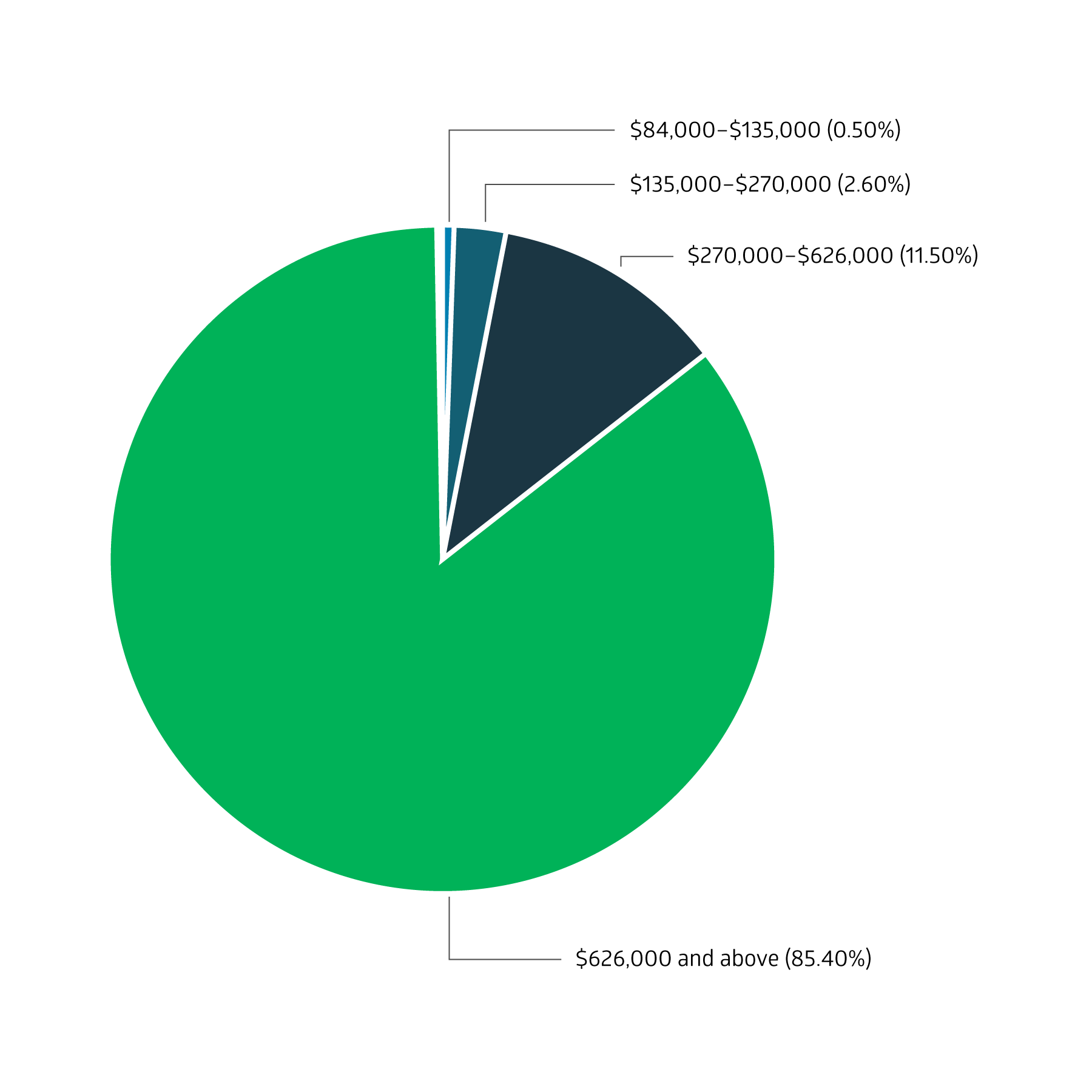
Figure 1. An overwhelming majority of the proposed tax increase burden would fall on the top 1 percent of income earners in Hawaiʻi. This group would pay 85 percent of the capital gains tax increase. At the same time, this tax increase would only account for 0.71 percent of the income for residents belonging to this group.
Another way to make our tax system more fair is to change the way that Hawaiʻi taxes capital gains. Capital gains are the profits made by selling a capital asset that has gone up in value. These assets come in many forms, but some common ones include stocks, real estate, art, and antiques.
In Hawaiʻi, the maximum tax rate for long-term capital gains is 7.25 percent, regardless of the taxpayer’s income bracket. This provides a significant tax break to the wealthy, since they pay a lower tax rate on their capital gains than they do on their ordinary income which is taxed at a progressively higher rate. At the same time, the flat 7.25 percent tax could be higher than the tax rate lower-income families pay on their ordinary income, making the tax prohibitive and limiting access to capital gains for families that aren’t rich.
This is why 77 percent of capital gains accrued in Hawaiʻi go to taxpayers making at least $400,000 a year. House Bill 232 would have changed the state tax code so that capital gains would be taxed at the same progressively higher rates as ordinary income. If you’re rich, you pay a higher tax on your capital gains than if you earn less.
Not only would this be a more fair way to tax this kind of income, the change would also generate over $132 million in additional tax revenue for the state each year—money that could be used to directly help those who need it the most. For example, this revenue could fund the creation of a state child tax credit for families with keiki, with larger amounts going to families with more children.
Figure 1 shows that this change would mostly affect Hawaiʻi’s wealthiest taxpayers, while having little effect on low- to middle-income taxpayers.
The Green Fee
Over-tourism, pollution and misguided land management have led to the degradation of Hawaiʻi’s environment. However, only 1 percent of the state budget is dedicated to conservation efforts, leading to a yearly funding shortage of $360 million. Imposing a green fee on tourists could fund key conservation efforts, such as the protection of endangered species and restoration of natural habitats. In the process, it would help preserve Hawaiʻi for generations to come.
House Bill 442 would have implemented a fee on tourists entering the state. Under the proposed plan, individuals who are 15 years or older would pay a $50 fee to the state, allowing them to access state parks, beaches, and trails for a year. This green fee would have brought in an estimated $400 million in revenue for the state.
The idea of a green fee also lays the foundation for other fees and taxes that can redirect revenue towards critical spending areas while providing an environmental benefit. Environmental activists have proposed creating a carbon tax that would charge businesses for their carbon emissions. The revenue from this tax—whether it’s the entire sum or a partial amount—could then be distributed in the form of a rebate or tax credit to offset the regressive impacts such a tax would have on low-income Hawaiʻi residents.