Hawaiʻi lawmakers have an obvious solution at their disposal, if they are willing to act on it.

Many parents used the expanded Child Tax Credit annual benefit of $3,600 (for a child under age 6) to cover some 4 month’s worth—or 36 percent—of their annual child care costs in Honolulu during 2021.
During the COVID-19 pandemic, the federal government expanded the federal Child Tax Credit (CTC) from $2,000 to $3,000 for each child over the age of 6, and from $2,000 to $3,600 per child under the age of 6. Congress also made the CTC partially refundable, which meant that even low-income parents who owed little to no income tax could receive some of the value of the credit in the form of a small tax refund.
Over 162,000 families in Hawaiʻi benefited from this expansion, receiving monthly cash payments that they used to cover their basic necessities.
The CTC expansion had a historic impact on families across the U.S., including in Hawaiʻi, lifting 2.1 million children out of poverty, and cutting the national child poverty rate by an unprecedented 40 percent. However, this pandemic-era expansion expired at the end of 2021 when policymakers in Congress did not extend the enhanced benefits.
Data from the U.S. Census Bureau released in September 2023 shows a corresponding, alarming increase to the poverty rate across the country last year. Nationally, poverty increased from 7.8 percent to 12.4 percent in 2022, while the child poverty rate more than doubled from 5.2 percent to 12.4 percent. This increase in the national poverty rate—according to the Supplemental Poverty Measure (SPM)—was the largest in over 50 years. (The SPM takes into account local cost of living and public benefit programs.)
One key driver of this increase in poverty, especially with regard to the increase in child poverty, is clear: the failure by Congress to renew the expanded CTC. If the CTC expansion had been maintained through 2022, it could have prevented over 3 million children from experiencing poverty.
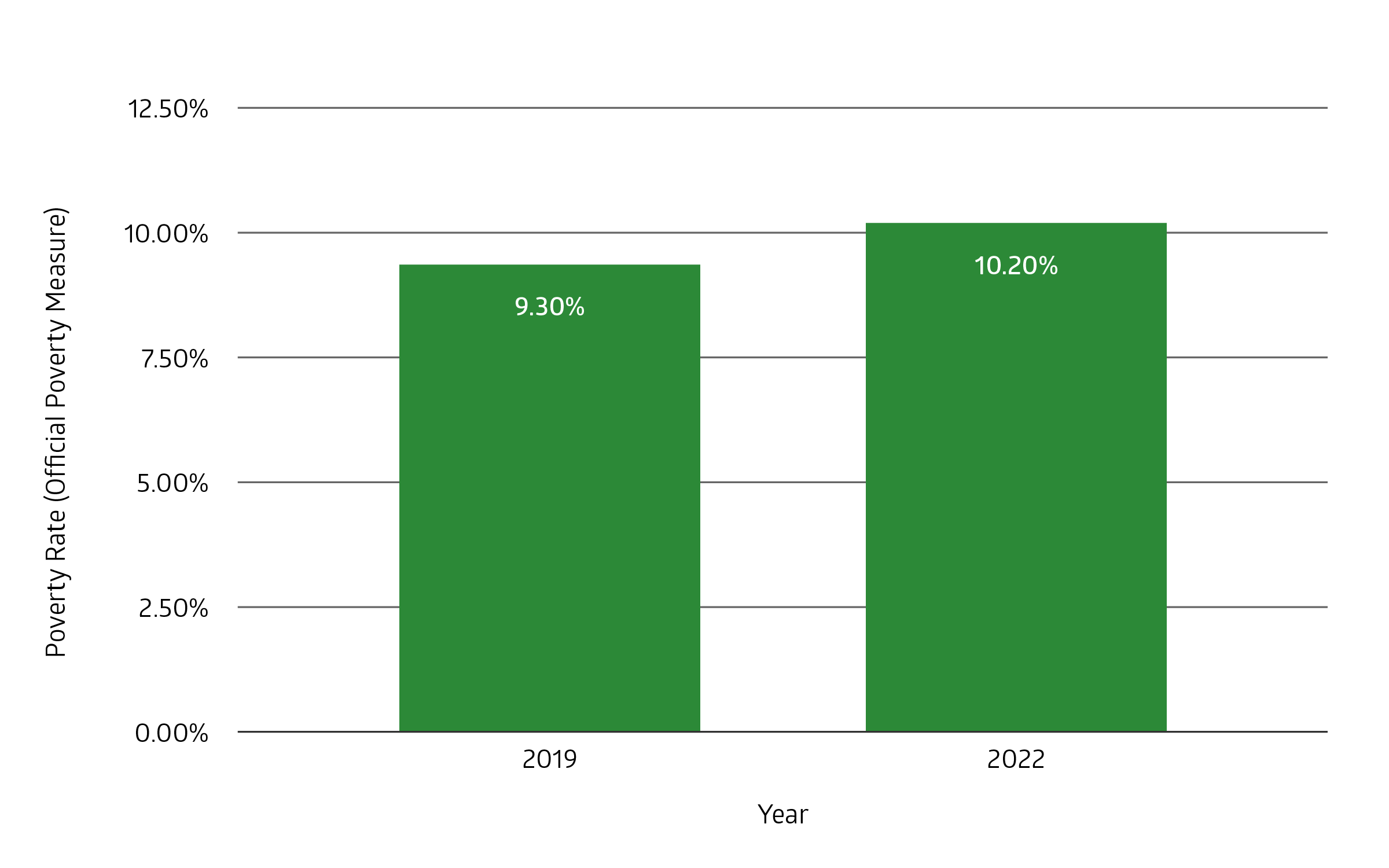
In Hawaiʻi, the Census Bureau reported that, in 2022, 10.2 percent of Hawaiʻi residents were living in poverty, including 12.6 percent of our keiki. However, these results are given according to the Official Poverty Measure (OPM), which does not take into account local cost of living, and other public benefits. These results paint an incomplete picture of poverty here in the state, as our uniquely high cost of living is likely pushing more people into economic crisis than is captured by the national OPM. An SPM-based accounting of our poverty rate would put it at a higher percentage than the OPM indicates.
The Census Bureau does not release a year-over-year estimate of each state’s SPM rates, and only provides a three-year average at the state level. In the absence of that data, it becomes even more difficult to get a clear picture of poverty at the state level. However, the OPM in 2022 was still a percentage point higher than it was in 2019, before the COVID-19 pandemic, indicating that making ends meet is still a significant struggle for thousands of Hawaiʻi households
While the steep increase in child poverty is striking, it isn’t surprising. As the pandemic era expansion of the CTC came to a close, many feared we would see a return to higher rates of poverty among families with children. And indeed, many families are now once again struggling to afford stable housing, food and healthcare. The data shows that expanding the federal CTC corresponded with one of the steepest drops in child poverty ever. We know what works. What we lack is the political will in Congress to make those investments permanent.
Increase in Poverty Rate for Hawaiʻi, 2019 vs 2022
Children who grow up in financially secure households do better in school, tend to have better health outcomes, and are more likely to be employed and earn higher wages relative to their poorer peers. Investing in the financial security of children now pays all kinds of social (and financial) dividends throughout their lifetimes.
Looking forward, Hawaiʻi’s legislators have an historic opportunity to fill the gap left by the federal government by creating a state-level CTC or ‘Keiki Credit’ for local families. In doing so, Hawaiʻi would join 14 other states that have made the intentional decision to invest in their children and collective futures by creating a state-level CTC. While Congress remains divided and deadlocked, can we muster the political will here in Hawaiʻi to set up our keiki for success and ensure each of them has a shot at a bright economic future?
For more on the Child Tax Credit and what it could do for Hawaiʻi’s keiki, check out our report, “Investing in our Future: A Keiki Credit for Hawaiʻi.”