Cutting state contracts would hurt the private sector economy
Economists have found that cutting state spending during a recession, when private sector economic activity slows down, only prolongs and deepens financial hardship for both governments and families. Cutting the state budget in response to pandemic-associated tax revenue reductions would damage the economy in far-ranging ways.
It is pretty straightforward that trimming the state payroll through furloughs or layoffs would reduce the circulation of money through the economy. Less obviously, cutting the state budget also directly hampers private sector employment and business activity. This is because local businesses, both nonprofits and for-profits, provide a significant level of services and goods to the state through contracts. As a result, cutting the state’s contractual costs would be at least as devastating to the economy as cutting state worker hours.
Figure 1. Services Contracted to Nonprofits, Fiscal Year 2020, in $ Millions
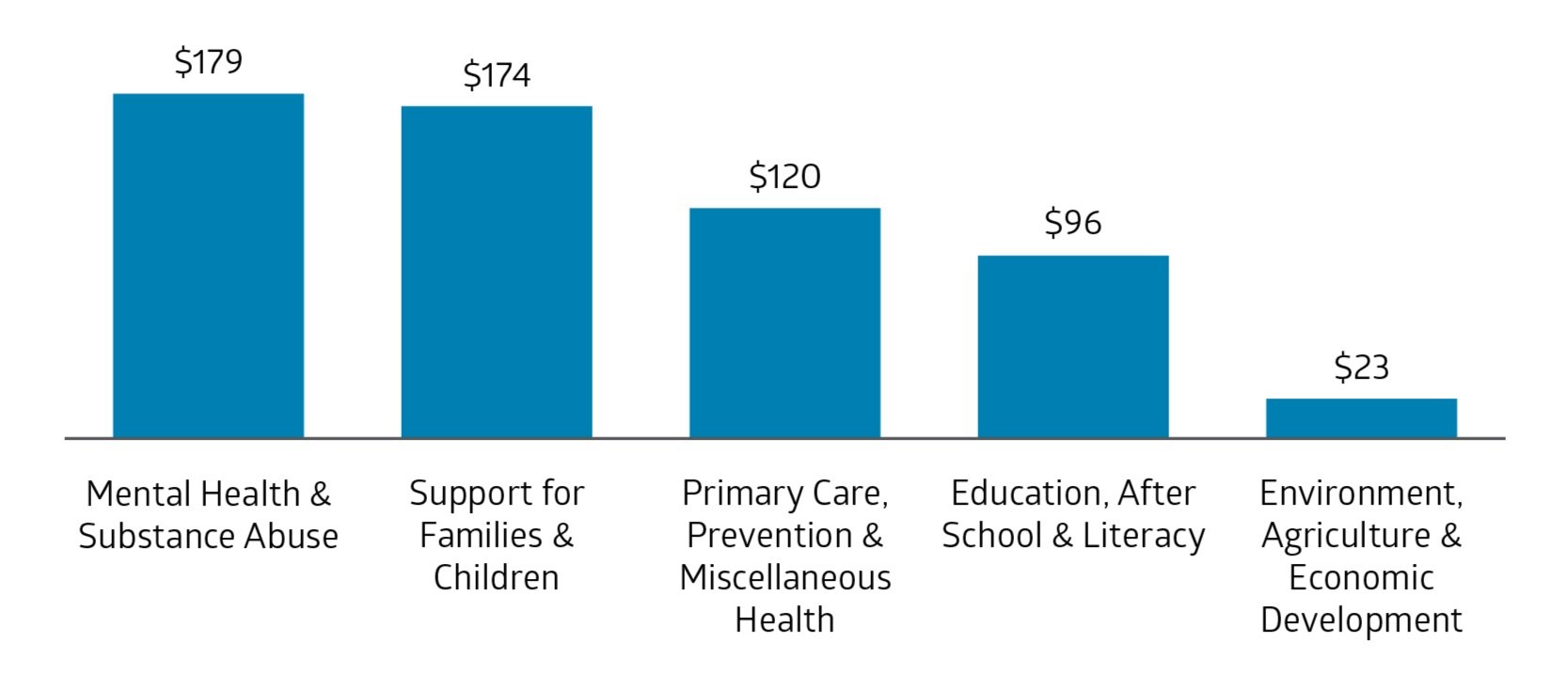
The state provides a significant amount of essential services through contracts with private nonprofit organizations. These services, which are more in-demand than ever because of the pandemic, include mental and physical healthcare, reducing substance use, family support services, food distribution, domestic violence prevention, and housing and homelessness reduction. Others support agricultural training and business development, environmental stewardship, community reinvestment activities, and home energy assistance.
In fiscal year 2020, 10 of the state’s 18 executive branch departments, the Judiciary Branch, and the Office of Hawaiian Affairs contracted a total of $592 million to scores of nonprofit organizations. About three-quarters of the funds that paid for these services came from state general, special, trust and revolving funds, while the rest were supported by federal grants, some of which require a state match.
For-profit businesses also provide necessary services to the state that include facility repair and maintenance, trucking and air cargo, building engineering, computer software, hardware and training, specialty professional services, program design and evaluation, trash collection, group home management, and security. Businesses also keep the state in office supplies, furniture and equipment, and telephone and internet communications.
The state’s Med-QUEST (Medicaid) program contracts with health insurers to cover the costs of healthcare services provided to more than a quarter of Hawaiʻi’s residents. These contracts, worth up to $3 billion, support both for-profit and nonprofit health plans and providers.
All these contracted services support the mission-critical business of the state but, because the businesses that contract with the state are also economic engines and business anchors on every island, this state spending supports the economy. Nonprofits especially are often located in economically-challenged communities where they are key employers, occupy and maintain facilities, and circulate money when they buy supplies and services from community vendors.
Both state spending and state budget-cutting have an estimated economic impact—about $1.50 for every dollar spent or cut. That means the $592 million the state spends through nonprofits is worth $888 million in economic value. Unfortunately, we are hearing that some nonprofits are getting notices that their contracts will be cut, often in such large amounts that whole programs are in jeopardy. This is about the worst possible decision: these budget cuts will reduce services needed more than ever, they will necessarily result in job losses among efficient nonprofit providers, and they disproportionately reduce the economic capacity of the communities most in need of stimulus.
State budget policy always matters. During a recession, decisions about spending matter more than ever, and passing budget cuts along to private sector contractors can be the worst decision of all. This is the time to ask policymakers what they’ll be doing to sustain state spending and support the economy.