The inequality in race and wealth we see all around us is no accident. Rather, it is a direct result of our public policies. Our tax system plays a big role in the widening gap between those who are wealthy and those who are struggling to get by—a gap that is exponentially greater in Black, brown and indigenous communities.
Indisputably, the growth in income and wealth has concentrated in upper-income households, at least since the 1970s. Several factors explain the increasing gap in wages, including the decline of unions, globalization and increased dependence on technology. However, our tax system and massive tax reductions for high-income earners in recent decades have allowed high earners to not only increase the distance between their pay and that of middle- and low-income workers, but also turn earnings into wealth.
We can easily see how tax rates influence the ability to accumulate wealth. Year after year, high-income earners reduce their taxable income by deducting mortgage payments and pre-tax contributions to 401Ks and college savings accounts. The reduction in top marginal tax rates means they have a lot more after-tax money to put into investments, and those investments are taxed at favorable rates, too. They can use their growing assets to leverage opportunities to increase investments, to start businesses, to buy real estate, and to educate their children. In at least one way, death is more certain than taxes, since estates valued at almost $6 million ($11.6 million for a couple) are now exempt from any federal taxes. This allows rich families to amass wealth over generations.
The American tax system, at least through most of the 20th century, collected much more from high-earners and the wealthy to invest in the public good. And what’s been good for the public over the decades has been investment in people and infrastructure. While these benefits flowed (and still flow) mostly to white American families, they were nevertheless instrumental in creating the American middle class, a wholly new phenomenon in our history. The federal government created jobs and electrified rural America during the Great Depression. After World War II, it helped returning soldiers get college educations and buy homes. Starting in the 1950s, the federal government built the U.S. interstate system and invested in the research and science that supported the space program.
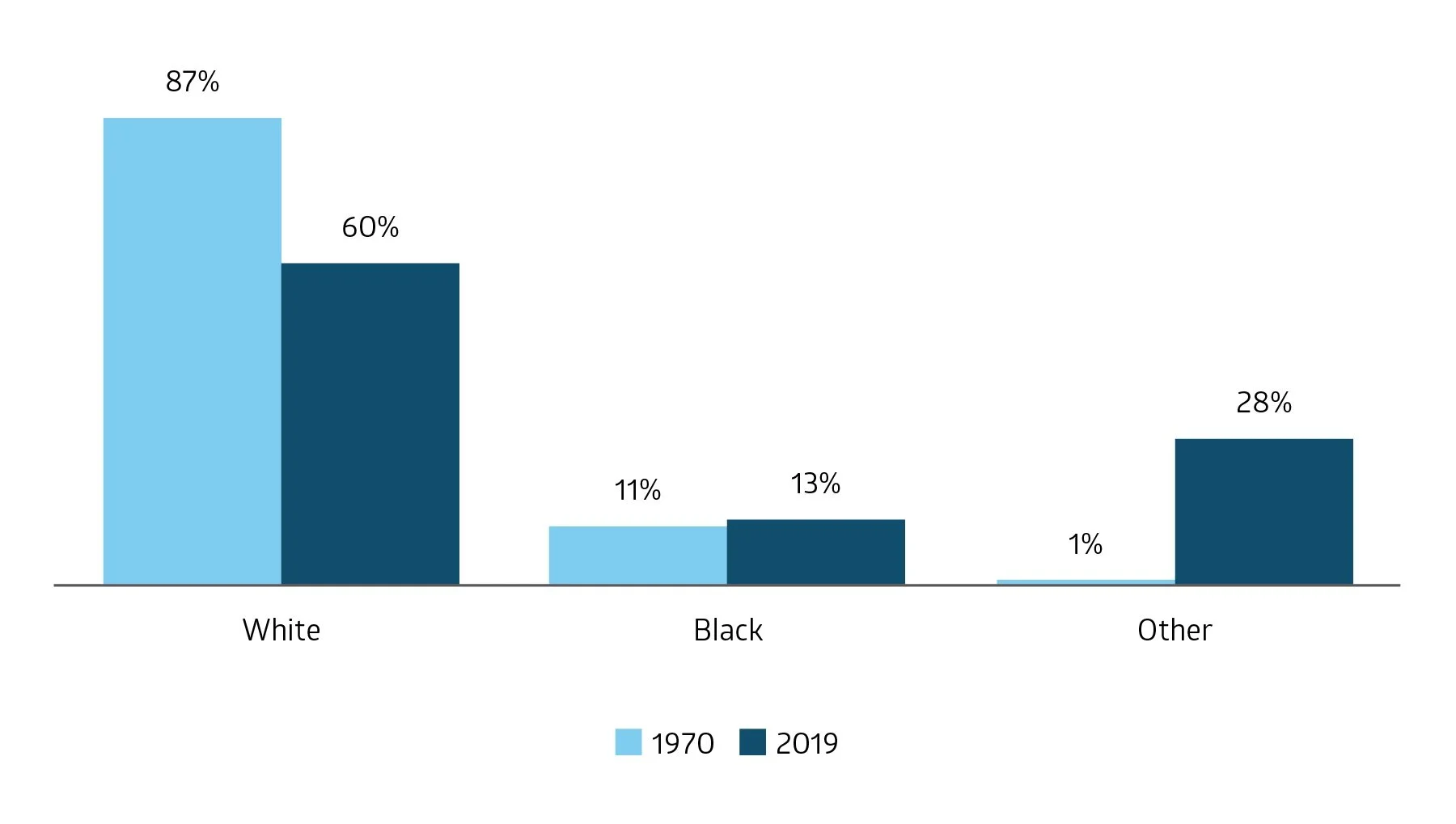
Figure 1. U.S. Population by Race, 1970 vs 2019
While these programs helped white Americans gain economic security, they often by-passed people of color. We see this in the history of redlining, a policy that kept families of color out of white neighborhoods, and in the use of infrastructure funding to destroy thriving Black, Brown and Indigenous communities. A prime example is Durham, NC, where a federal highway project demolished hundreds of homes and businesses in the late 1960s.
Since the 1970s, however, tax policy has been on a trend to reduce the contributions of those who are rich and almost exclusively white. Studies, such as this one published by the Northwestern Law Journal of Law and Social Policy, link those trends to racism and the country’s changing demographics, where non-Latinx whites have become a much smaller majority. The U.S. Census reported that, In 1970, 87 percent of Americans were white; by 2019, the percentage of non-Latinx white residents was 60 percent.
How Federal Tax Rates Have Changed to Favor the Rich
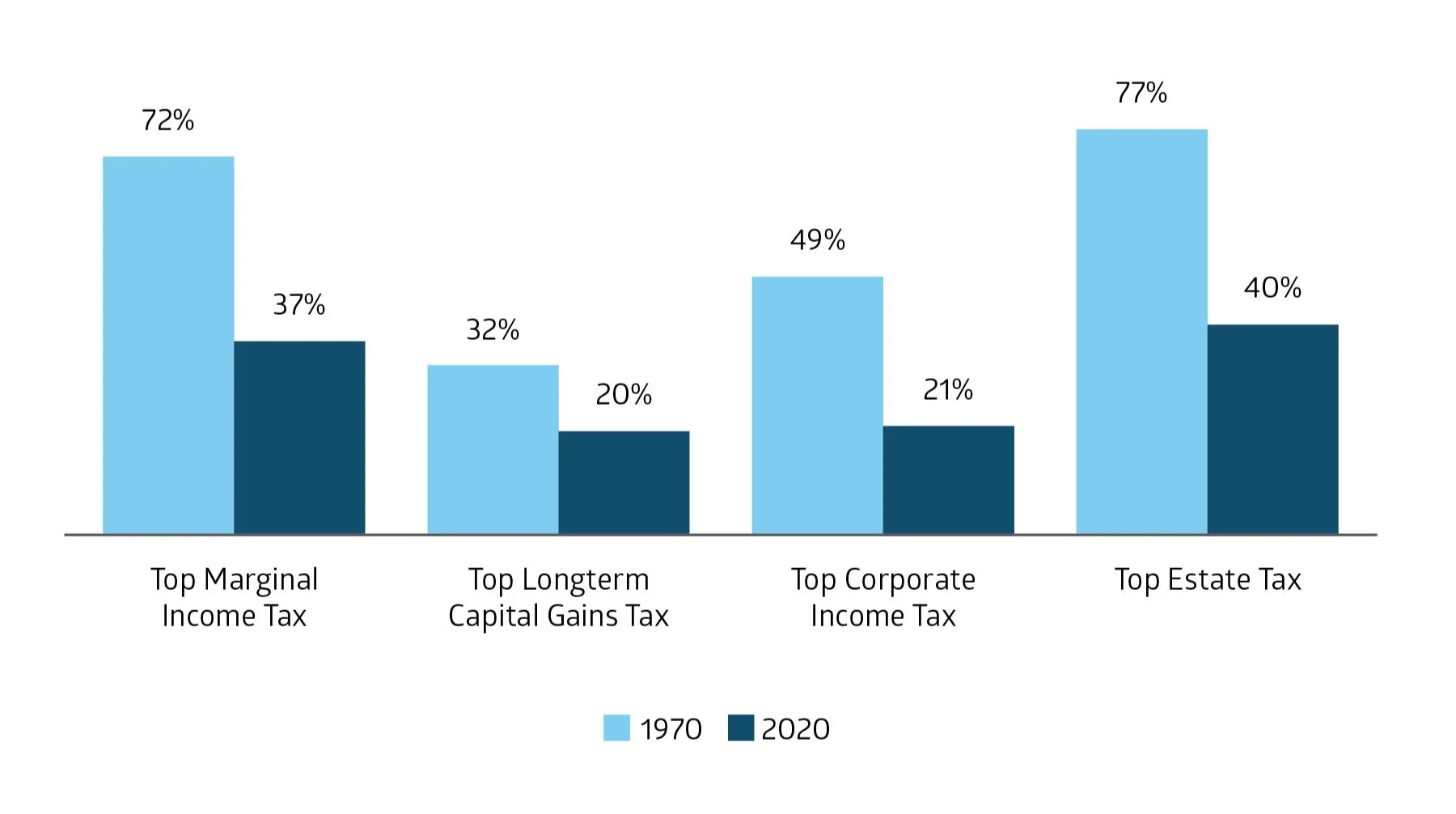
Income taxes. Through most of the 20th century, U.S. tax policy maintained very high marginal tax rates on high income. During World War II, the top rate for the rich was 94 percent. The top marginal rate in 1970 was 71.8 percent, but rates started to drop in the 1980s. The top rate now is only 37 percent.
Longterm capital gains taxes. At one time, longterm capital gains—profits from the sale of stocks and other assets—were taxed at the same rate as other income, but a separate, lower rate was later imposed. The tax on longterm capital gains was as high as 40 percent during the 1970s, but it is now half that: just 20 percent. This low rate does little, if anything, to spur economic growth; but it is a big benefit to the wealthy. In 2019, over 75 percent of the tax benefit of the lower rates went to taxpayers with incomes over $1 million.
Corporate taxes. The corporate tax rate has dropped from 49 percent in 1970 to just 21 percent now. Low corporate tax rates are intended to incentivize business expansion and wage growth. However, a New York Times analysis showed that businesses used the 2017 corporate tax cut disproportionately to buy back shares, increase CEO earnings, and make larger payouts to shareholders.
Estate taxes. Since 1970, changes to both exemptions—which determine how much of an estate is taxed—as well as to the estate tax rate itself have benefited the wealthy. In 1970, an amount equivalent to $400,000 in today’s dollars was exempted from taxation, and the value above that was taxed at a top rate of 77 percent. Today, the exemption is $5.85 million and the top tax rate is only 40 percent.
Figure 2. Changes in Top U.S. Tax Rates, 1970–2020
Income and wealth inequality is damaging to people, communities and the overall prosperity of the economy for a number of reasons. These include: reductions in opportunity and economic and social mobility; diminishing political influence for low-income households; and an increasing lack of trust in policymakers and government institutions.
People of color are disproportionately hurt by economic inequality because they are more likely to be left out of high paying jobs and less likely to have opportunities to build intergenerational wealth accumulation. But economic inequality affects everyone. The accumulation of untaxed wealth and the tax policy that enables it lead to inadequate government investment in people and infrastructure, and that is bad for us all and for the future of our country.