Making Hawaiʻi's housing market work for local residents
Investors are buying up more of Hawaiʻi’s homes than ever before because our current system encourages them to do so—that’s bad for our economy in the long run.
In 2020, more than 70 percent of homes purchased on Maui went to “non-owner occupants.” That is, people who bought houses to use as personal vacation homes or as a place to rent to others.
The rising demand for investment properties is driving up home prices, which is bad for both local residents and the overall Hawai‘i economy. The price for a Maui condominium increased by 10 percent last year, while the average single-family home price on the island is approaching $1 million. This leaves priced-out local residents with a choice between renting in an uncertain private market or moving out of state.
The trend of investor-owners buying up homes in Hawaiʻi began well before the pandemic, but has only increased since then. Historically-low mortgage interest rates available to people whose incomes remained unaffected by the pandemic likely contributed to this acceleration.
And as long as local wages remain stagnant and decrease in purchasing power, while home prices continue to rise, there is no reason to believe that this trend will reverse.
Figure 1. Maui Housing Market, 2016-2020, Owner-Occupied vs Investor-Owner
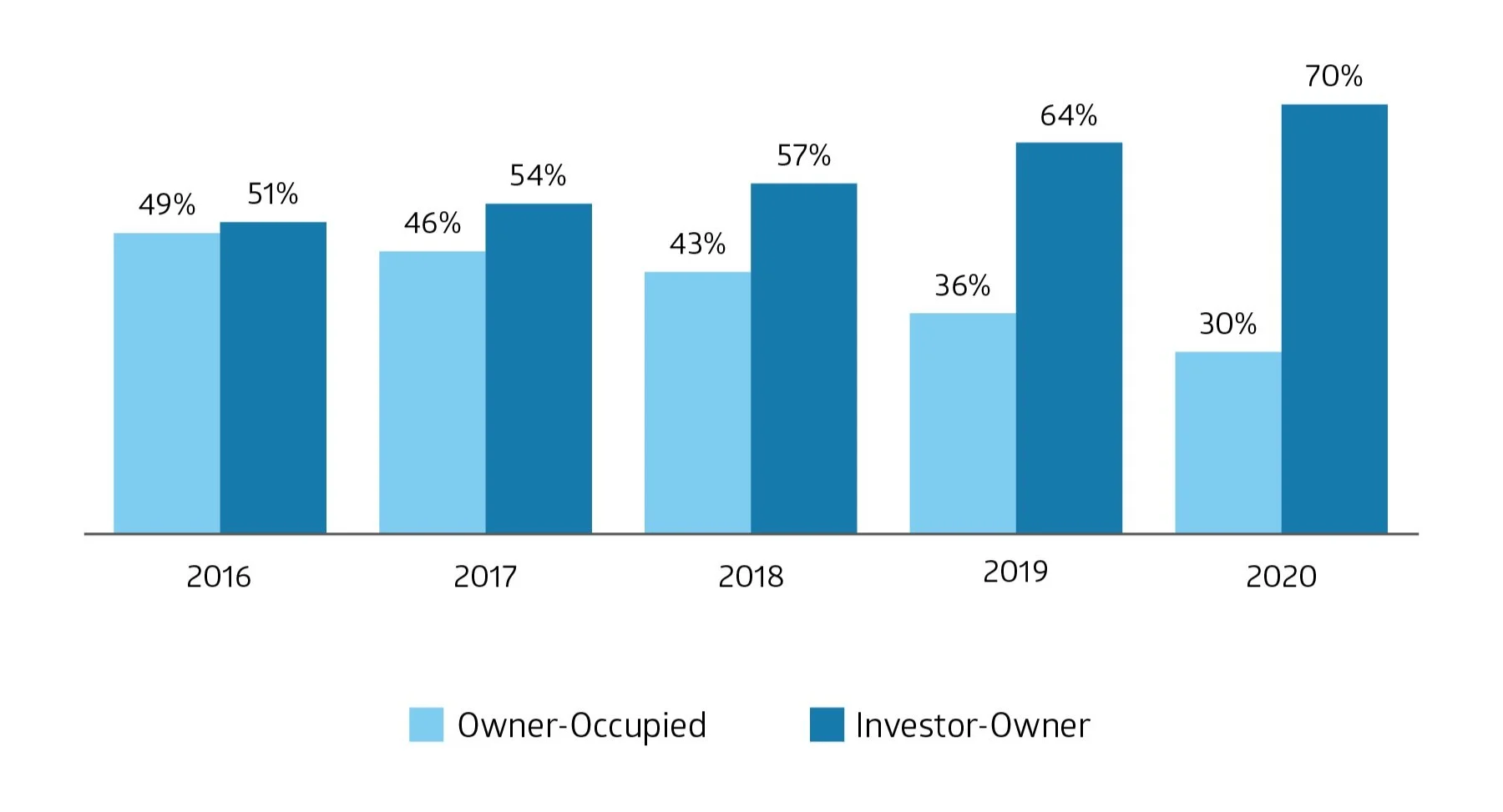
Figure 1. The percentage of homes being bought by investment owners compared to owner-occupants has dramatically diverged since 2016, when the rates were roughly even. This trend is damaging to Hawaiʻiʻs overall economic health.
What happens if this trend continues?
If 70 percent of available homes are purchased as investments instead of as places for people to live each year, Hawai‘i’s housing stock will be increasingly occupied by private-market renters instead of owner-occupants. (Less than 5 percent of Hawaiʻi’s current housing stock is government-regulated for renters.)
Does it matter if a growing share of Hawaiʻi residents are private-market renters?
Yes. This trend is bad for local residents and for the economy in several ways:
Private-market renters have no price protections. A landlord can increase the rent by any amount from year to year, and renters can either pay or move out. The lack of price protections also means that rents can continue to outpace wages, leaving local renters with too little money available for other necessities.
Renters have no right to retain occupancy. A landlord in Hawaiʻi can decide not to renew a lease at any time for any reason. This makes renting an inherently unstable arrangement in which families can find themselves suddenly uprooted from their communities at any time.
Renters don’t get the significant tax- and wealth building-benefits that homeowners do. As a result, local residents will be locked out of financial opportunities. These opportunities include deducting mortgage interest from federal and state taxes, and building home equity that can be used to finance college education for children, invest in business opportunities, or pay for a secure retirement.
If our priority is to provide housing for local residents, then we must create more housing that is restricted to local buyers at prices that stay affordable long term.
Different Affordable Models
Hawaiʻi already has several models of for-sale housing restricted to local residents with long-term affordability requirements. Some are smaller programs such as the Kauaʻi County Limited Appreciation leasehold program, which currently has about 30 homes available only to Kauaʻi County residents.
In this model, homes are sold for 30–40 percent less than market value. For example, a basic three-bedroom home that would normally sell for $550,000 has a price of $350,000 for a qualified resident. In exchange for the low initial price, a resident keeps just 25 percent of the equity if they sell the home.
There has been only one resale in the 15-year history of the program, so it is evident that the main benefit to owners is stable housing at affordable prices.
The Na Hale O Maui land trust is similar in program design. This model provides homes that are sold for at least 30 percent less than market price to local homeowners. Upon resale, owners are similarly restricted in the amount of appreciated value (i.e., profit) they get to keep, maintaining an affordable sales price for the next buyer.
A nonprofit runs the Na Hale O Maui program, which has almost 50 homes in its inventory.
Both of these programs achieve low-prices by providing mortgages on the building without including the value of the land, as well as through some public subsidies.
Another affordable for-sale model is the sweat equity model used by Self-Help Housing and Habitat for Humanity.
There are more than 1,000 of these homes across Hawaiʻi, and they provide deeper savings—often more than 50 percent less than market rate—by giving the owners an opportunity to invest their own labor into the creation of the home in exchange. For residents and families who can contribute evenings and weekends to help achieve the goal of homeownership, this is a popular model.
A third affordable for-sale option is through the various counties’ affordable housing requirements. In these models, market-rate developers provide some below market price homes in exchange for faster approval, taller building heights or other incentives.
Affordability is created through agreements with private market developers without any direct public subsidy. As a result, the discount in price tends to be much less (10–20 percent) and, unlike with the other programs, there is usually no downpayment-assistance.
The higher selling price and lack of down payment assistance means some of these “affordable” homes have difficulty finding buyers.
The largest and oldest affordable for-sale model in Hawaiʻi is the Department of Hawaiian Home Lands, with more than 8,300 current residential leases. Although this program is restricted to people of at least 50 percent Native Hawaiian ancestry, it has a waiting list for residential leases of over 23,000 families who could be served if the program were fully funded.
Each of these models provides homeownership restricted to local residents at below market prices. The publicly-supported programs are popular and have long waiting lists, and all could be significantly expanded with more county, state or federal funding.
Meeting Hawaiʻi’s significant housing needs through these models would require significant investment and up-front funding. However, such an investment would serve Hawaiʻi well by ultimately giving residents stable, affordable housing. This, in turn, will allow residents the opportunity to circulate more dollars back into the local economy, creating a more cost-effective and sustainable system than the one we have now.