Since 1997, the Child Tax Credit (CTC) has reduced poverty for millions of families in the United States. It has provided badly-needed assistance to working families in Hawaiʻi, where the poverty rate for households with children has steadily increased in recent years.
Figure 1. Percentage of Hawaiʻi children living in households below the poverty level, 2016–21
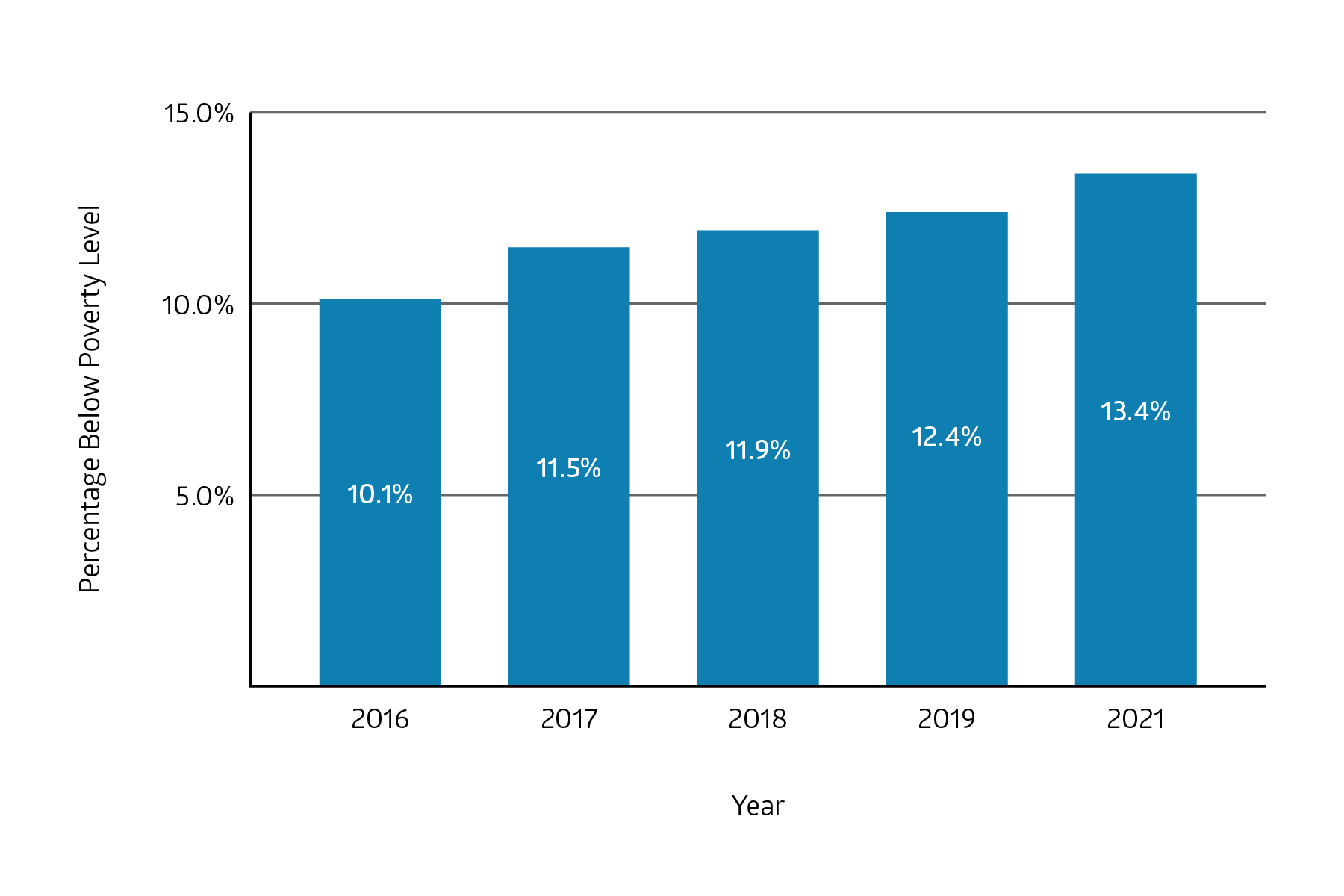
Note that, due to COVID-19 restrictions, the census data for 2020 is unreliable.
Source: United States Census Bureau, “American Community Survey 1-Year Estimates Subject Tables, Hawaiʻi,” United States Department of Commerce, Accessed 10/27/2022, https://data.census.gov/cedsci/table?q=child%20&g=0400000US15&tid=ACSST1Y2021.S0901
Between 2016 and 2021, the poverty rate for households with children in Hawaiʻi rose by over three percentage points. This trend has been driven by the rising cost of living in Hawaiʻi, which was only made worse by the economic fallout of the COVID-19 pandemic.
During the pandemic, surging unemployment led to large increases in poverty and food insecurity for U.S. households. Hawaiʻi’s average unemployment rate in 2019 was just 2.5 percent. By contrast, the average rate for 2020 was 12 percent.
The federal CTC provides a crucial tax break to households with children, but is normally capped at $2,000 for each child under the age of 17. In 2021, the American Rescue Plan (ARP) temporarily increased the limits for the credit to $3,600 for each child under the age of 6 and $3,000 for each child between the ages of 6 and 17.
In addition, the federal CTC was made fully refundable for the first time, and payments were distributed on a monthly—instead of annual—basis.
Due to this expansion, the federal CTC kept 3.7 million children throughout the U.S. out of poverty in 2021. The impact was more pronounced for communities of color. Nationally, the poverty rate for Black and Hispanic children fell by 56 percent and 49 percent, respectively. In Hawaiʻi, some 162,000 families and 272,000 children benefited from the CTC during that same time period.
Although there is a lack of data illustrating how the CTC expansion affected different ethnic groups in Hawaiʻi, Native Hawaiian and Pacific Islander households have historically reported higher rates of poverty than other ethnic groups. In 2021, 16.5 percent of Hawaiʻi’s Native Hawaiian and Pacific Islander population was living below the poverty line, compared to 11.9 percent of the white population and 7.6 percent of the Asian population.
However, once the expanded federal CTC was phased-out at the end of 2021, the groundbreaking impact it had on child poverty was lost. Consequently, food insecurity among households with children in the U.S. increased by a staggering 25 percent between January and July of 2022.
Despite this tragic regression, states do have the ability to create and expand their own CTCs to fill the gap left by the federal CTC. Thus far, 12 states have formed separate CTC programs for their residents. Hawaiʻi’s legislature has previously considered bills that would implement a state CTC, but it has yet to pass any legislation. In 2023, Hawaiʻi legislators will once again have an historic opportunity to create a state CTC that could potentially lift thousands of local children out of poverty.
According to the Institute on Taxation and Economic Policy (ITEP), it would have cost the State of Hawaiʻi $119 million to create a state CTC (at $2,000 per qualifying child) in 2019. This state CTC would have lifted an estimated 4,000 children in Hawaiʻi out of poverty.
Download our policy brief for a more detailed analysis on the cost and impacts of a state CTC for Hawaiʻi.