Spending trends for Hawaiʻi’s children show we have lots of room for improvement
The Urban Institute recently released a State-by-State Spending on Kids Dataset that, as the title implies, reports on public spending on children in all 50 states and the District of Columbia. The data covers the vital areas of education, health, housing and economic security, tracing the public investment in children in each state over time.
The information covers the period between 1997 (1998 for some spending categories) through 2016, and comes from the U.S. Census Bureau’s Annual Survey of State and Local Government Finances, as well as other non-Census sources. Spending information presented here is adjusted to 2016 dollars for all years, and combines state, local and federal funds that support services for children.
So how did Hawaiʻi do?
Figure 1. Increase in Public Spending Per Child in Hawaiʻi, in 2016 Dollars

Figure 1. Between 1998 (the year that includes all data sets) and 2016, Hawaiʻi per-child spending grew from $14,898 to $24,682.
On closer inspection, we can see that most of those gains were during the early years of the reporting period. Between 1998 up to the Great Recession (2008), per-child spending expanded by 63 percent. However, between 2009 and 2016, spending increased by only 1 percent per child.
In comparison, spending for the U.S. increased by 46 percent per child between 1998 and 2008, and continued to increase by 20 percent during and after the Great Recession.
Public Education
One of the best investments in children and in our collective future is support for public education. The data available reports public spending on Head Start and pre-K, elementary and secondary education, as well as special services. In combination, spending in 2016 was $2,538 greater per child than in 1997. Again, while the increase in spending from 1997 to the Great Recession in 2008 was a robust 120 percent, since then annual spending per-child has decreased by 19 percent. U.S. comparisons show growth of 44 percent from 1997 to 2008 and 5 percent growth during and after the Great Recession.
There’s a good reason that Hawaiʻi invested heavily in education 20 years ago. In 1997, Hawaiʻi came in last in spending on public education, with just $3,232 invested per child. Best in the nation that year was Alaska, which spent $7,548—more than double Hawaiʻi’s rate. By 2016, Hawaiʻi’s spending was 38th in the U.S., an improvement but still only a third of that spent by the District of Columbia, which was first in the nation that year.
Higher Education
Higher education gives individuals more career choices and greater earning potential, and that translates into social and economic improvement for Hawaiʻi. Unfortunately, the public investment in higher education has eroded over the two decades studied in the report. In 1997, Hawaiʻi’s $1,733 per-child investment in higher education was the best in the nation. By 2016, Hawaiʻi had dropped to 25th, with spending that had increased by just $36 per student. The leading state that year, Wyoming, spent more than twice as much as Hawaiʻi.
Figure 2. Hawaiʻi Public Spending Per Child on Education, in 2016 Dollars
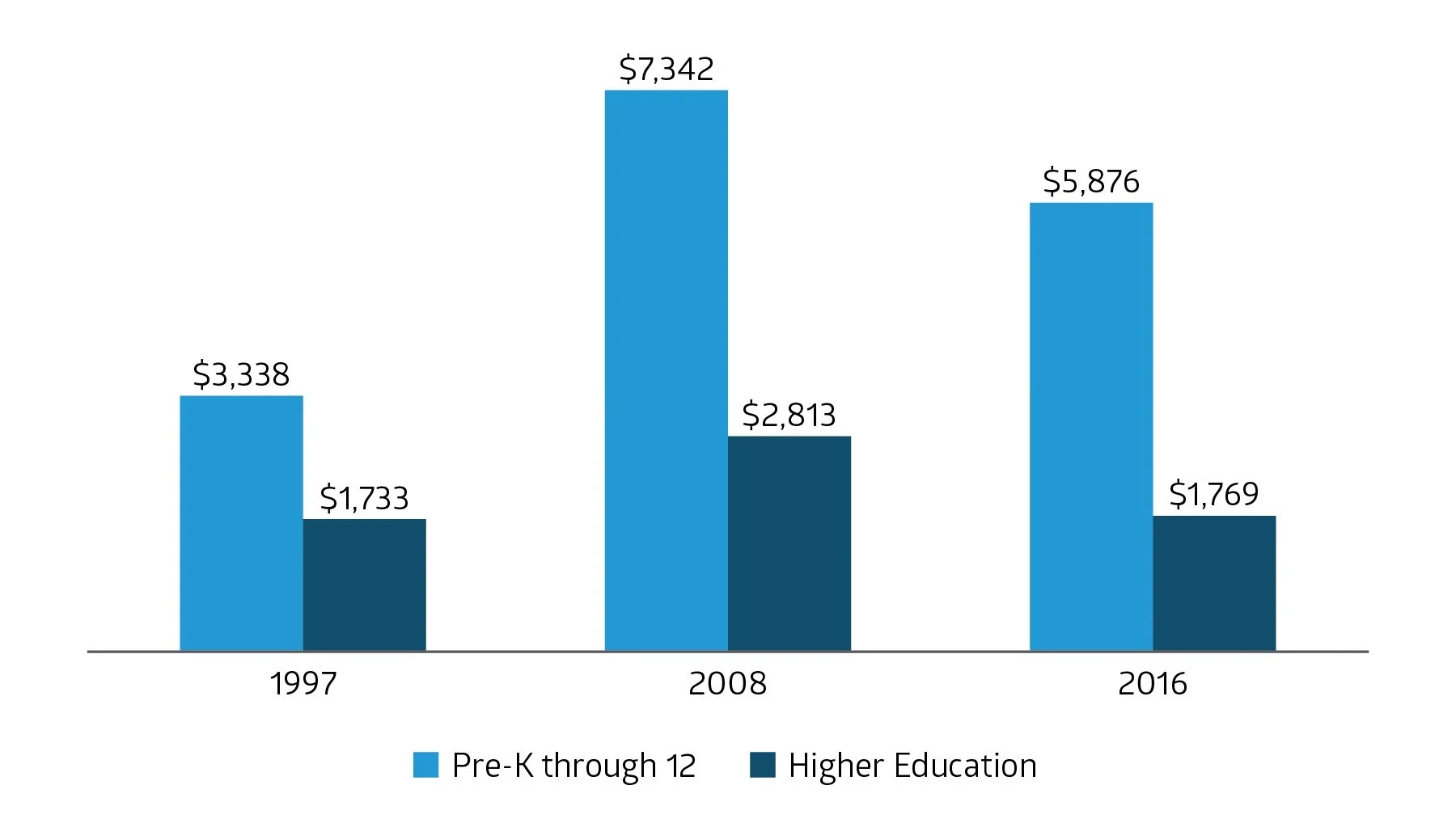
Figure 2. As with public education, spending on higher education in Hawaiʻi crescendoed in 2008 when more than $2,800 was invested per child. However, during and after the Great Recession, funds for higher education were similarly rolled back—to nearly 1997 levels.
Housing, Community Development & Community Services
Across the U.S. and in Hawaiʻi, investments that help communities thrive are modest considering their importance to family wellbeing. In 1997, Hawaiʻi was 4th in the nation in spending on housing and community development and 6th in funding parks and recreation. By 2016, Hawaiʻi was 14th and 9th, respectively. Our support for public libraries was a much lower 29th, and by 2016 had dropped further to 41st.
Figure 3. Hawaiʻi Public Spending Per Child on Housing & Community Services, in 2016 Dollars

Figure 3. Considering Hawaiʻi’s urgent need for more affordable housing, the amount spent on housing and community development per child grew modestly between 1997 and 2008. Once again, though, since the Great Recession that funding has declined. The investment in parks and recreation had a similar but less dramatic trajectory: 2016 spending ended up 30 percent higher than spending in 1997.
Food, Economic Security & Health
Hawaiʻi’s spending trends for these basic supports between 1998 (complete data wasn’t available for 1997) and 2016 are much more positive. However, this is probably because the federal government contributes part or all of the money that supports the spending in these categories.
Spending on food and economic security includes Temporary Assistance for Needy Families (TANF), the Supplemental Nutrition Assistance Program (SNAP), Social Security and federal Supplemental Security Income, federal and state Earned Income Tax Credits, the Child Tax Credit, and unemployment benefits. Health spending consists of Medicaid/State Children's Health Insurance Program, public health and “other health” spending such as payments to hospitals and other providers.
Figure 4. Hawaiʻi Public Spending Per Child on Health & Economic Security, in 2016 Dollars
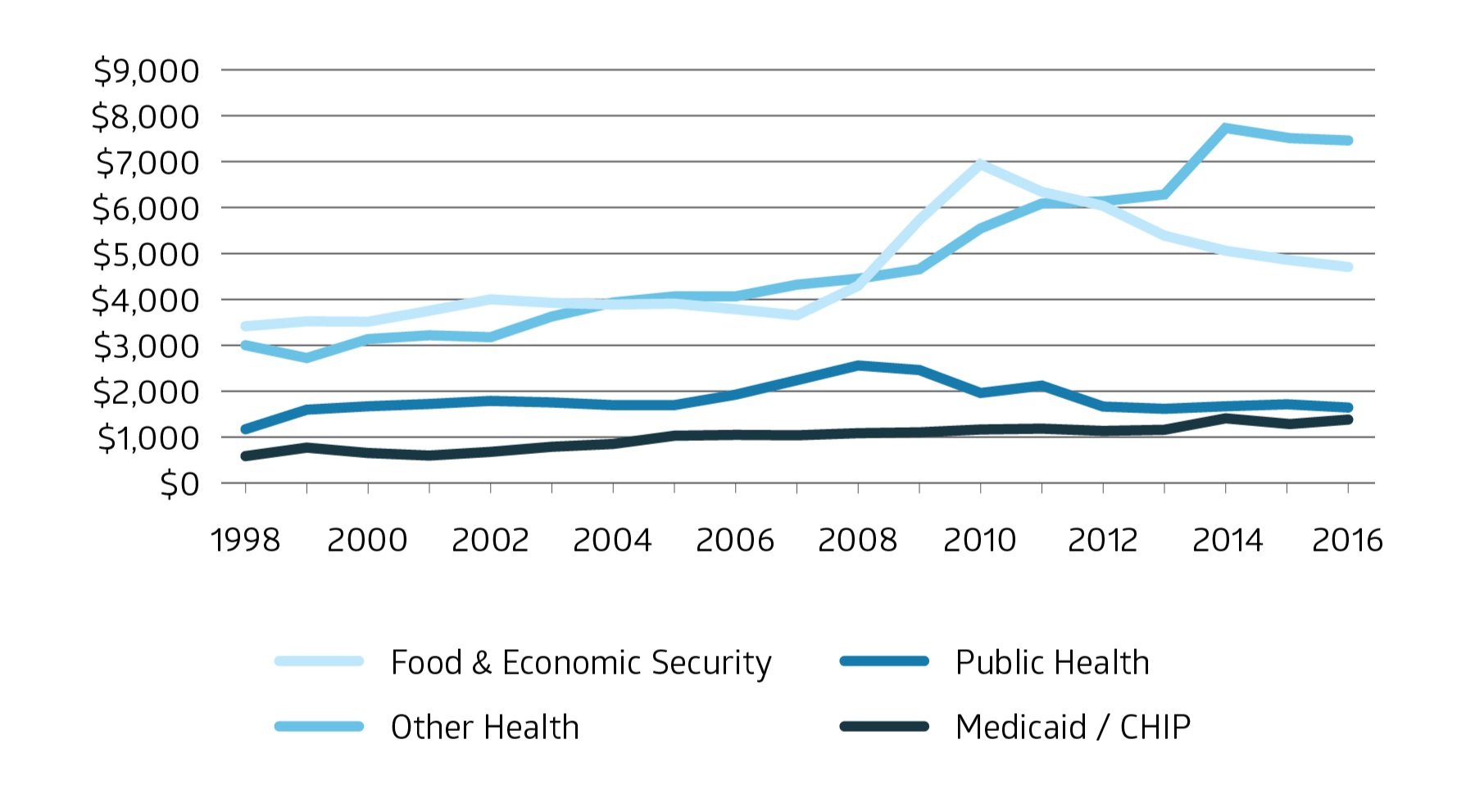
Figure 4. For the category of food and economic security, the high point for spending was 2010, which reflects the needs driven by the Great Recession. In health spending, the increase in “other health” was greater than in Medicaid or public health, which is not explained by the data set. Comparative U.S. data also shows a big jump in “other health” spending, but across the nation the greatest growth over time was for Medicaid. Hawaiʻi’s public health spending per child was 4th in the nation in 1997, but dropped to 11th by 2016.
Our future depends on public investments in our children. The data discussed here helps us understand spending trends and allows us to compare Hawaiʻi to the rest of the nation. Unfortunately, what we see is that, especially in the areas that depend most on state rather than federal funding, progress has stalled since the Great Recession.