A fair share for Hawaiʻi's future: Why we need to modernize the conveyance tax
At the heart of Hawaiʻi's identity is a promise we make to one another and to generations yet to come: that these islands will remain a place where our keiki can afford to live, where our kūpuna can age with dignity, and where working families are not priced out of the communities they helped build. That promise is becoming harder to keep.
As housing costs soar and the gap between the very wealthy and everyone else widens, we must ask ourselves: who benefits from Hawaiʻi’s economy, and who is asked to contribute? A just tax code answers that question by ensuring that those who profit most from our islands also invest most in their future.
The conveyance tax is one of our most effective tools for capturing revenue from the lucrative real estate market and channeling it directly into housing and infrastructure for our communities. And this session, House Bill 2049 (2026) offers a thoughtful, equitable path forward.
Why The Conveyance Tax Matters
The conveyance tax is paid when residential properties change hands. It's a modest transaction cost on some of the largest financial exchanges in our economy. And because it applies most heavily to high-value sales, it’s an excellent tool for ensuring that those who earn the highest profits from Hawaiʻi’s hot real estate market contribute to solving the problems that market creates—namely, the housing crisis.
HB2049 offers several key improvements to the state’s conveyance tax:
Creates a progressive, marginal rate structure, where only the portion of a property’s value above each threshold is taxed at a higher rate—avoiding the “cliff effect” that can disproportionately penalize modest property value increases.
Protects local homeowners by lowering or maintaining current taxes for most owner-occupants, particularly those with properties under $2.2 million.
Raises tax rates on high-value investment properties, asking those who profit most from our real estate market to pay a bit more.
Adjusts for inflation to prevent the tax’s value from eroding over time, and protects residents from rate creep.
Dedicates revenue to affordable housing and infrastructure, including a reliable funding stream for the Department of Hawaiian Home Lands.
A Marginal Rate Structure: Fairer for Everyone
Hawaiʻi’s conveyance tax rates haven’t changed since 2009, even as property values across the state have soared. HB2049 modernizes this outdated structure by converting the conveyance tax to a marginal rate system—similar to how our state income tax works.
A marginal rate structure avoids the “cliff effect,” where a small increase in property value can trigger a dramatically higher tax bill on the entire amount. Under the current system, a homeowner whose property value crosses a threshold faces a massive jump in taxes. Under HB2049, only the portion above each threshold is taxed at the higher rate.
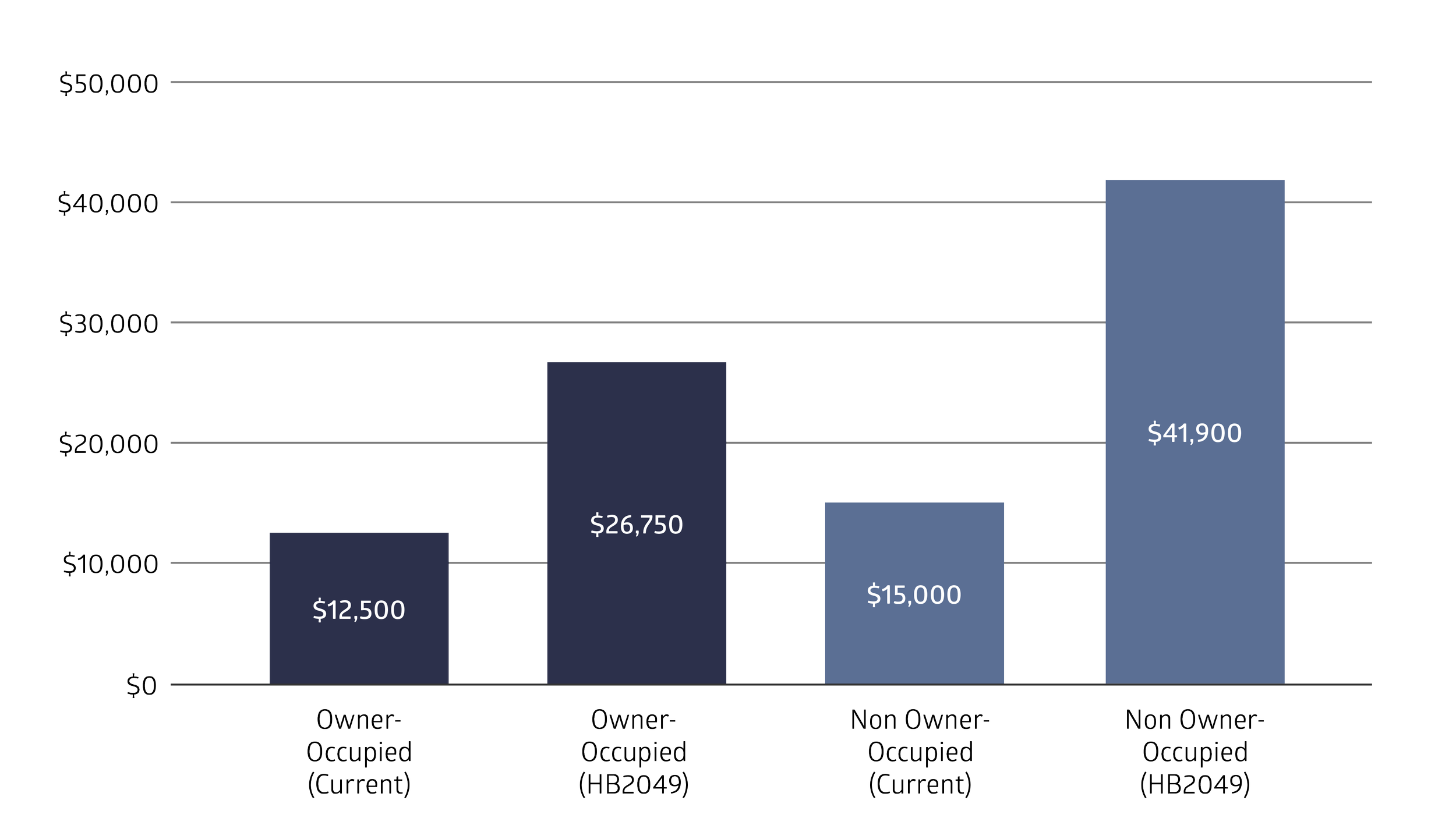
This provides a meaningful tax break for local homeowners with properties under $2.2 million, while raising rates slightly for high-value and non-owner-occupied properties. At a price point of $2.5 million, for example, the conveyance tax would rise considerably for a non-owner-occupied investment property—but the much smaller increase for an owner-occupied home would not realistically affect its selling prospects.
Figure 1. Current vs Proposed Tax for a $2.5 million Home
Investing in the Foundations of Community
Under HB2049, conveyance tax revenue would be directed to three critical areas:
Housing Infrastructure (DURF): 20 percent would fund the Dwelling Unit Revolving Fund to build roads, utilities, and other essential infrastructure for new housing developments. A lack of available infrastructure is one of the largest barriers to building new housing in Hawaiʻi. The Dwelling Unit Revolving Fund (DURF) helps pay for roads, water, and sewer connections that are necessary to build more housing. Boosting funding for DURF keeps housing projects moving forward, particularly in transit-oriented development (TOD) areas that support walkable communities.
Affordable Housing: Up to 20 percent (or $40 million, whichever is less) would go to the Rental Housing Revolving Fund, directly contributing to affordable housing development. The 2019 Hawaiʻi Housing Planning Study found that our state needed 50,000 more housing units by 2025, and over half of them needed to be affordable for working families. We’re falling behind. To catch back up and reach that goal, the state must raise as much funding as possible for infrastructure and affordable housing.
Housing for Native Hawaiians (DHHL): Up to 30 percent (capped at $60 million per year) would go to the Department of Hawaiian Home Lands, providing a reliable, ongoing funding source to build homes for Native Hawaiian families. The state has a constitutional duty to adequately fund DHHL. Although the department received a one-time $600 million appropriation in 2022, there remains a significant backlog for the homestead waiting list. DHHL estimates it will require $800 million to build homes for nearly 6,000 Native Hawaiian families. If HB2049 becomes enacted into law it would be the first time the legislature has committed dedicated funding to DHHL.
Land Conservation: Up to 5 percent (or $10 million, whichever is less) would go to the Land Conservation Fund, protecting the natural beauty that makes Hawaiʻi special.
Here’s the obscene reality: we dedicate more state funding to incarceration than we do to the Department of Hawaiian Home Lands—even though DHHL’s entire mission is to house Native Hawaiians, who are dramatically overrepresented in both our incarcerated and unhoused populations. This fiscal year, DHHL’s budget sits at $185 million, while we spend roughly $300 million on prisons. That means we’re investing more in jailing people—disproportionately Native Hawaiians, and often for non-violent offenses—than we are in housing them.
We wonder why the backlog for homesteads stretches on, and why homelessness persists. Instead of spending millions to lock people up, we should be investing in housing them. It would prevent crime, reduce homelessness, and honor our obligations. That we don’t already do this is, quite simply, terrible policy.
HB2049 would help correct this imbalance by dedicating up to 30 percent of conveyance tax revenue to DHHL—creating a reliable, ongoing source of funding that finally puts housing ahead of handcuffs.
The changes proposed in HB2049 are a major step toward a fairer and more sustainable future for Hawaiʻi. By modernizing the structure of the conveyance tax and adjusting rates thoughtfully, the state can generate more revenue without raising taxes on working-class residents. Those who profit most from our real estate market—investors in high-value, non-owner-occupied properties—would contribute a bit more. And those who call Hawaiʻi home—families buying their first home, kūpuna aging in place—would see their tax burden reduced or unchanged.
Investing this revenue in the Dwelling Unit Revolving Fund, the Department of Hawaiian Home Lands, and affordable housing programs will accelerate the development of homes and infrastructure our communities desperately need.
In short, these changes ensure that Hawaiʻi's lucrative real estate market finally contributes to solving the housing crisis it helped create. And in doing so, they bring us closer to the Hawaiʻi we all deserve: one where working families can afford to stay, where Native Hawaiian communities can thrive in their ancestral lands, and where the promise of these islands is kept for generations to come.