Unsheltered can mean costly health problems; Hawaiʻi should invest in supportive housing
For more information on the link between homelessness and poor health, read the Hawaiʻi Budget & Policy Center brief, Health and Care for People Experiencing Homelessness.
The relationship between housing instability and poor health is clear. Hawaiʻi’s unsheltered endure conditions that put them squarely at the intersection between the housing and health crises.
It may seem obvious, but getting people back into housing is essential to properly addressing their health needs. The lack of adequate housing and supportive services means many houseless individuals do not receive timely care for their illnesses. This leads to worse health outcomes and greater healthcare costs in the long term. Between January 2010 and September 2017, the cost of providing medical care to patients experiencing houselessness in Hawaiʻi averaged $8.6 million per month according to Med-QUEST estimates.
This reality is reflected in two surveys conducted with Hawaiʻi’s houseless population in 2020 (the Point in Time survey on Oʻahu and Bridging the Gap in Hawaiʻi, Kauaʻi and Maui Counties):
25 percent of the surveyed adults had been houseless for more than a year.
24 percent of the surveyed adults reported having serious mental health challenges.
18 percent of the surveyed adults had substance use disorders.
Furthermore, Native Hawaiians and Pacific Islanders were found to make up a disproportionate amount of the state’s houseless population.
The best practices for assisting houseless individuals incorporate permanent supportive housing and preventive care. For example, the evidence-based Housing First and Permanent Supportive Housing (PSH) model acknowledges that individuals must have reliable housing in order to fully benefit from supportive services. Once they are housed, these individuals can better focus on their health and economic well-being.
Studies have shown that permanent supportive housing programs improve the well-being of houseless patients and reduce their health-related costs. From 2014 to 2017, the Hawaiʻi Pathways Project offered permanent housing assistance and a wide range of supportive services to its clients. In the process, it cut hospital admissions among its participants by 72 percent and saved over $50,000 in costs per client. Over the course of 10 years, permanent supportive programs could potentially save millions of dollars in healthcare costs.
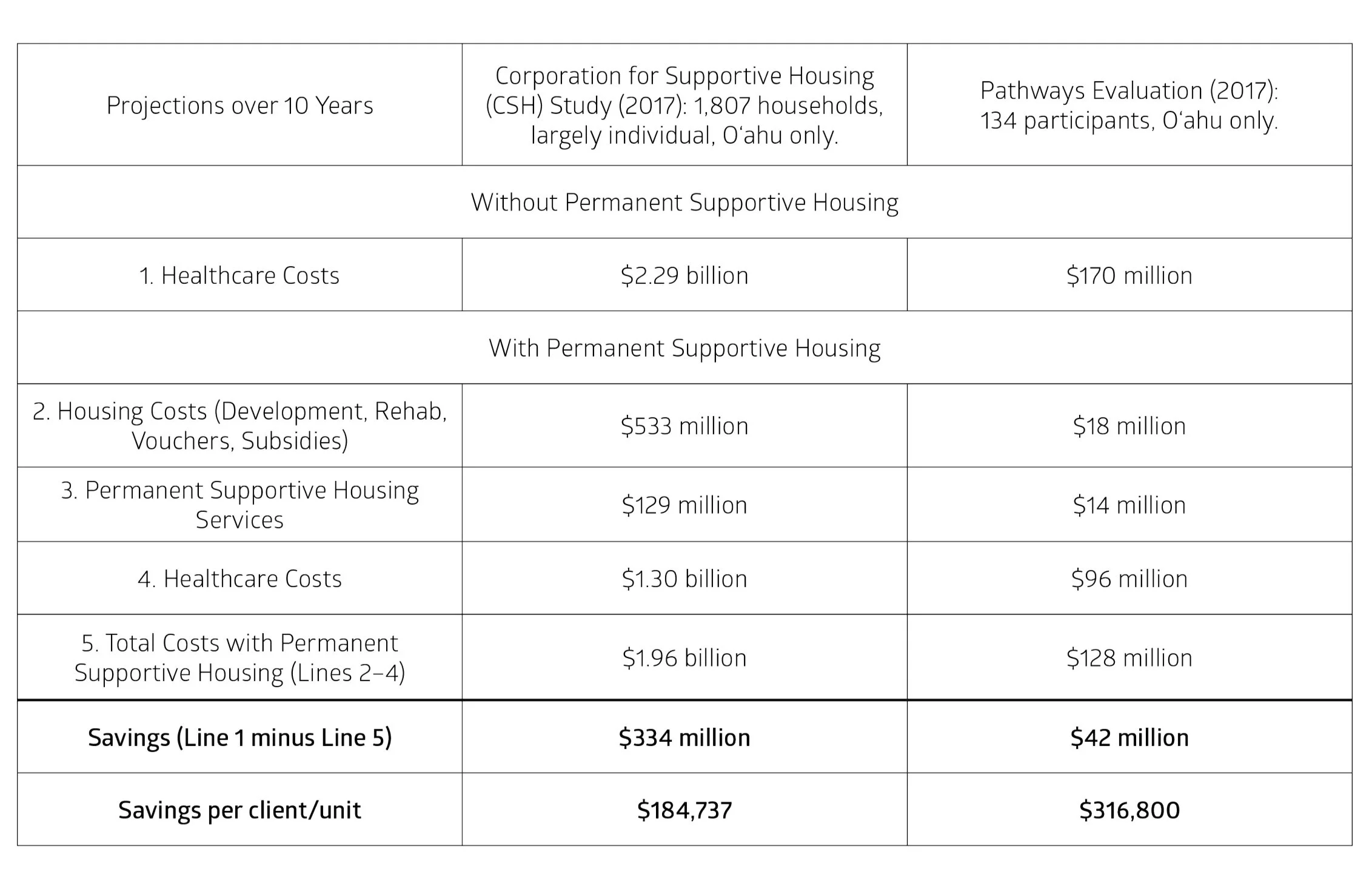
Table 1. Med-QUEST’s estimate of savings through permanent supportive housing is supported by another Hawaiʻi-specific study and the evaluation of the Hawaiʻi Pathways project. They show expected net savings over 10 years that range from $185,000–317,000 per client.
Housing vouchers are an effective way to help low-income renters remain housed. However, many landlords in Hawaiʻi do not accept housing vouchers, and legislation is necessary to address this source of income (SOI) discrimination. State legislators are currently considering HB1752, a bill that would offer incentives for landlords to accept Section 8 housing vouchers, and SB206 and SB 2399 which would prohibit SOI discrimination.
Moreover, there are several proposed bills in the 2022 legislative session that would bolster housing support and essential services for houseless people throughout Hawaiʻi.
SB3018 seeks to establish the kauhale program, which would have the authority to expedite housing projects intended for the houseless through permitting exemptions; the premise of this program has been backed by the success of communities such as Puʻuhonua O Waiʻanae.
SB3168 would extend the existing ʻOhana Zones pilot program. While this program provides needed funding for services, advocates have raised concerns about the allocation of its funds and the lack of input from houseless individuals.
HB2512 is an ʻOhana Zones bills with some kauhale program language inserted.