At a moment when Hawaiʻi desperately needs more revenue, California’s proposal to tax billionaire assets offers a model for making the ultra-wealthy pay their fair share.
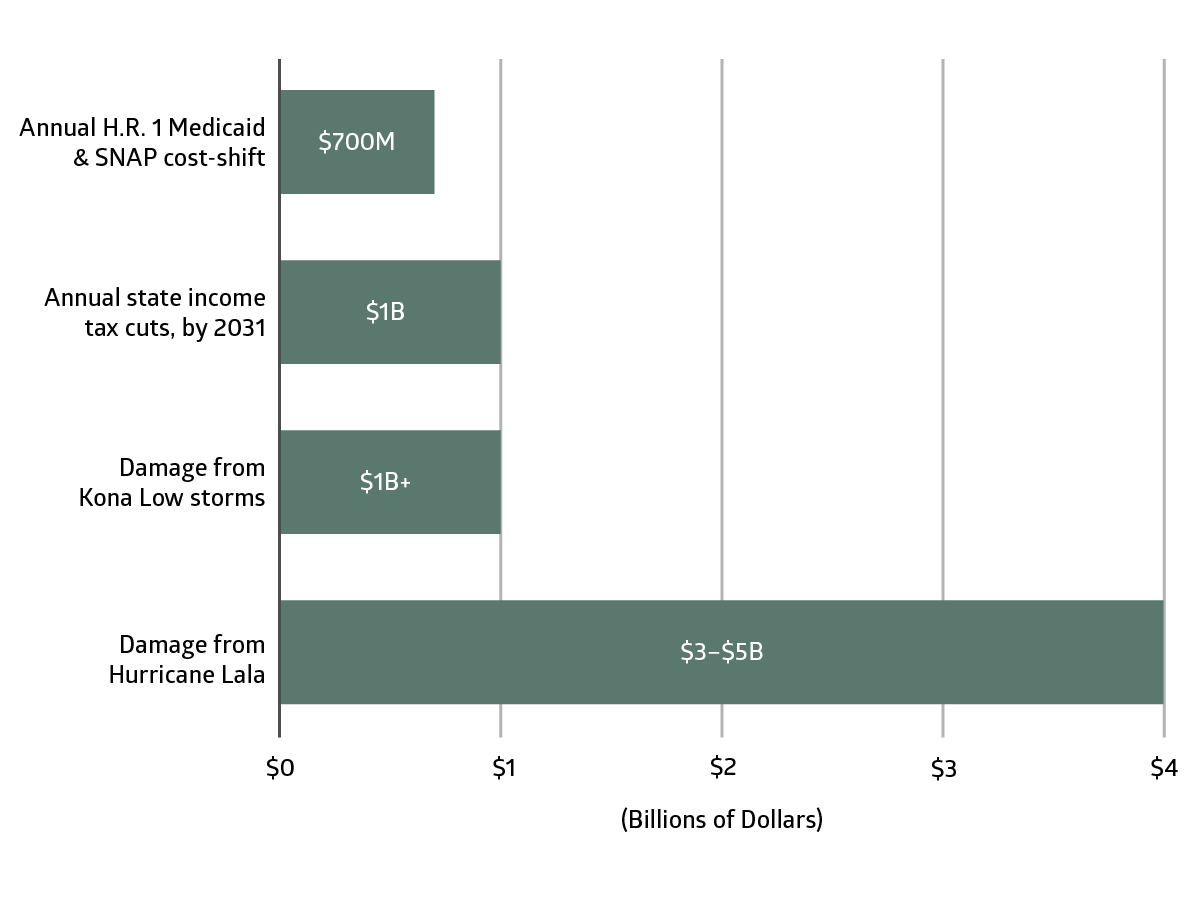
Hawaiʻi is currently dealing with the aftermath of Hurricane Lala, and early estimates suggest a staggering $3–5 billion in damages. Over 100 homes were either damaged or destroyed on Hawaiʻi Island alone, while communities throughout the state lost power and access to critical roads. This disaster comes just months after the Kona Low storms caused an estimated $1 billion or more in damages statewide.
These powerful storms are becoming the new normal for Hawaiʻi. With each one, the state must spend huge sums of money on emergency response, infrastructure repair, and assistance for affected families. As climate disasters increase in frequency, so does the pressure on a state budget that has been diminished by tax cuts and federal spending cutbacks.
Billionaire Wealth Tax on the Ballot
This November, California voters will make a pivotal decision on their state’s financial future. A ballot initiative there looks to impose a one-time, 5 percent-tax on wealth belonging to the state’s roughly 213 billionaires.
According to a recent analysis by the Institute on Taxation and Economic Policy (ITEP), the tax proposal would raise about $100 billion for healthcare, K-14 education, and food assistance programs facing federal cuts under H.R. 1.
The argument behind California’s billionaire tax is straightforward: the state’s billionaires hold $2.18 trillion—27 percent of all U.S. billionaire wealth. Their wealth grew by one third in the last year alone. Because investment profits are only taxed when assets (like stocks) are sold, billionaires end up paying a lower income tax rate than the average American. By directly taxing liquid assets, California would require its billionaires to pay a fair share of the tax burden needed to invest in the state’s future.
Figure 1. Hawaiʻi’s Major Budget Challenges
Hawaiʻi may have relatively few billionaires, but the same inequities are also baked into our own tax code. Hawaiʻi caps its tax on capital gains—profit from selling stocks, real estate, and other investments—at 7.25 percent, which is well below the top 13 percent rate on income from work.
More than 70 percent of those capital gains flow to households making over $400,000 a year. Taxing investment income at the same rate as a regular paycheck would raise an estimated $132 million a year for Hawaiʻi, largely from the top 1 percent of earners. That revenue will be necessary to maintain Hawaiʻi’s programs and services—especially with an expanding list of costs.
Although the legislature passed Senate Bill 3125 (signed into law as Act 24) this year, rolling back Act 46 (2024) tax cuts for the highest earners, the remaining income tax cuts will still drain more than $1 billion a year from Hawaiʻi’s budget by 2031. At the same time, H.R. 1 could shift up to $700 million a year in Medicaid and SNAP costs onto the state.
Without more tax revenue, these costs will translate to budget cuts that impact working families.
In recent years, California has led the charge on raising taxes on the ultra-wealthy. The state has taxed capital gains at the same rate as ordinary income since 1987, and it continues to have the highest income tax rate in the U.S. at 13.3 percent.
It’s also part of a growing national movement that has produced Maine’s millionaire surcharge, Washington’s capital gains tax, and Hawaiʻi’s own Act 24. For Hawaiʻi, ensuring the wealthy pay their fair share isn’t just good policy—it’s the only path to economic security.