
The surveillance grocery store: How algorithms target Hawaiʻi consumers
“For an average family of four, these algorithmic markups translated to an extra $1,200 a year in grocery costs.”
For generations, the price on the retail shelf has been the price you pay—unchanging whether you’re a CEO, a student, or a single mom. But that era is ending. The rise of online shopping has ushered in a new paradigm: surveillance pricing, where what you pay depends on who an algorithm thinks you are.
Surveillance pricing occurs when companies charge different people different prices for the same item based on personal data. Algorithms, data harvesting, and dynamic pricing tech track who you are, where you shop, what you buy, and how much you can afford to pay. Instead of setting prices based on supply and demand, corporations are tailoring prices to target each individual’s financial pressure points.
The mechanics of individualized pricing can draw on a wide range of personal signals:
Your precise location: Inferred down to the IP address, zip code, or neighborhood
Demographic profiling: Extracted or modeled data on fixed criteria such as income, age, gender, family size, race or ethnicity.
Historical behavior and preferences: Browsing history, past purchases, device type, and inferred urgency, all modeled to determine how much you’ve historically been willing to spend.
In an isolated state like Hawaiʻi, where shipping costs are already high and consumers have limited store alternatives, replacing fair market pricing with individual data extraction turns everyday necessities into variable-cost traps.
Figure 1. Dynamic Pricing vs Surveillance Pricing
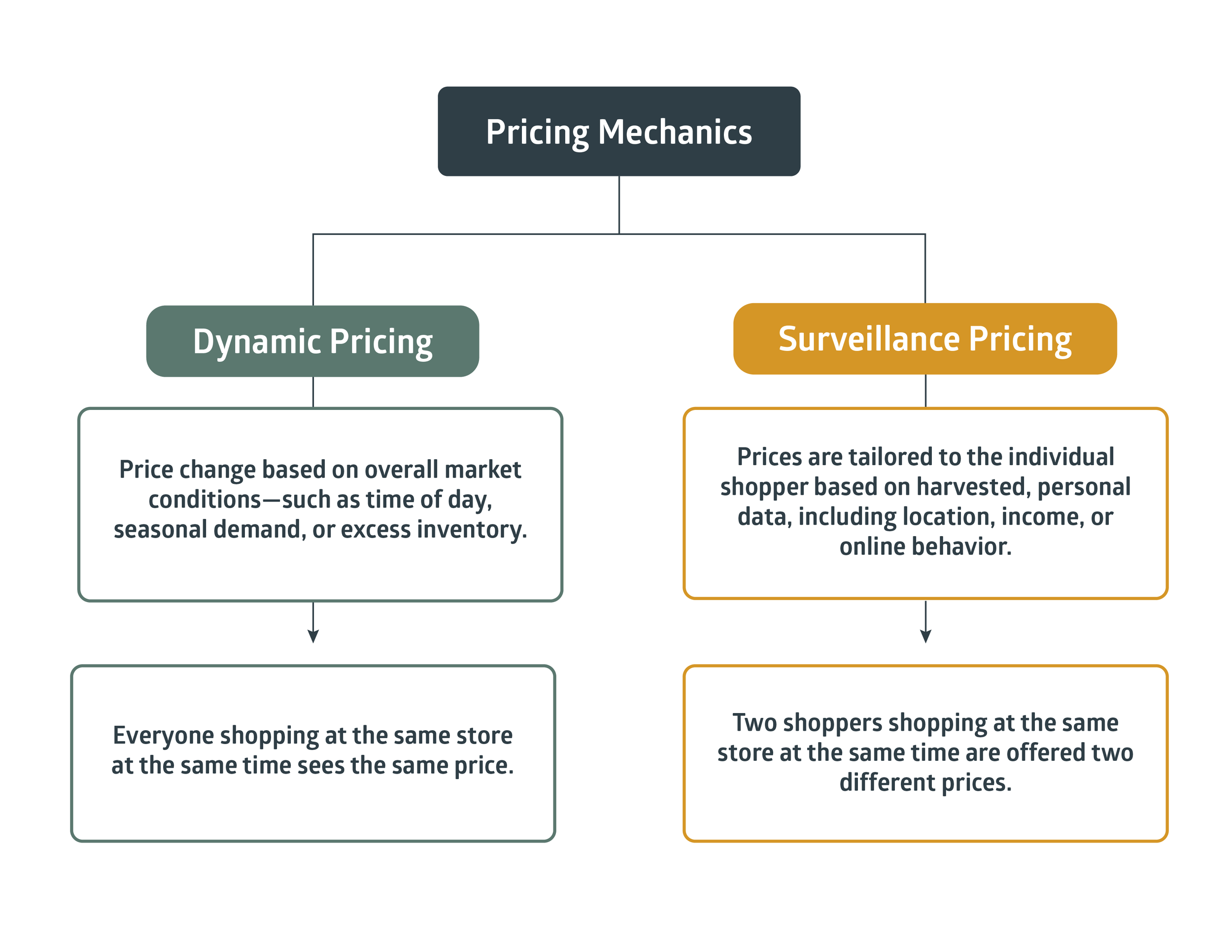
Figure 1. Although it’s often conflated with surveillance pricing, dynamic pricing is a different mechanism used by companies to target overall market conditions, rather than individual consumers.
The Illusion of “Deals” and the Reality of Extraction
“Instead of offering relief, these algorithms can use that desperation to inflate prices at the moment shoppers are most vulnerable.”
Companies and industry advocates try to frame surveillance pricing as a consumer benefit, claiming that algorithms allow stores to deliver “personalized savings and targeted coupons.”
In reality, these “benefits” are a mathematical illusion. Instead of offering genuine discounts, companies can use algorithms to set artificially high base prices and then offer “personalized coupons” only to customers they think might walk away.
This isn’t theoretical. Last year, a landmark investigation pulled back the curtain on AI-driven pricing experiments. It found that prices for basic staples like cereal, eggs, and peanut butter varied by up to 23 percent online—at the exact same store, at the exact same time.For an average family of four, these algorithmic markups translated to an extra $1,200 a year in grocery costs.
A report by the Federal Trade Commission (FTC) confirmed the dystopian mechanics behind these markups. The report confirmed that third-party intermediaries were actively helping major corporations track granular consumer data—from precise geolocation down to mouse movements on a screen—to target shoppers with higher price points.
In their report, the FTC highlighted something even more alarming: Beyond manipulating consumers into thinking they are getting a deal, algorithms can recognize when a shopper is buying out of necessity rather than preference, such as selecting fast delivery on infant formula or searching for emergency supplies after a flood, fire, or other disaster. Instead of offering relief, these algorithms can use that desperation to inflate prices at the moment shoppers are most vulnerable.
“Hawaiʻi needs protections to ensure access to our basic needs aren’t algorithmically exploited.”
Surveillance pricing is no longer a hypothetical concept or one confined to e-commerce. On the continent, digital price tags are already active in Kroger and Walmart stores. Like something out of science-fiction, some grocers have even begun using images of shoppers—taken with in-store cameras in the frozen foods aisle—to offer a shopper’s likely age, gender, income, race, and shopping behaviors.
So far, these technologies are not commonplace in grocery aisles in Hawaiʻi. But consumers here are not entirely safe either. Delivery platforms like DoorDash, Uber Eats, and Instacart—alongside online platforms for major grocers like Safeway, Target, Walmart, and Whole Foods—are widely used across the islands, bringing algorithmic pricing straight to the pocketbooks of local consumers.
Lower-income consumers are inherently more vulnerable to the impact of this technology because they are often geographically captive to shopping in a particular store—and algorithms can detect this information. Furthermore, groceries—unlike booking an Uber or going out to dinner—are not something a family can simply opt out of purchasing.
From Hesitation to Action: Lessons for Hawaiʻi’s Legislative Future
Hawaiʻi needs protections to ensure access to our basic needs aren’t algorithmically exploited. During last year’s legislative session, Hawaiʻi lawmakers considered a major step toward consumer protection: House Bill 2458. The bill was originally drafted to prohibit surveillance pricing for any food eligible to be sold as part of the federal supplemental nutrition assistance program (SNAP) or special supplemental foods program for women, infants, and children (WIC).
The bill was amended to a study, and ultimately failed to pass—primarily because many lawmakers say they simply didn’t know enough about surveillance pricing to vote on it. That hesitation gave room to tech and retail industry groups, who claimed a ban would accidentally destroy store rewards cards—like the local Maikaʻi card—or eliminate senior discounts.
That industry narrative paints a false choice. Reward programs could easily be protected with transparent bill language specifying a ban on individualized pricing, while protecting store-wide sales, opt-in loyalty programs, and uniform group discounts (such as savings for seniors or veterans).
Regardless of what companies say, public opinion is overwhelmingly against surveillance pricing; recent polls show that 76 percent of Americans support efforts that bring an end to the practice. Even when told that personal data might be used to offer discounts, studies show that 72 percent of Americans still prefer smaller average discounts over giving up their personal data for pricing.
Although HB2458 did not pass, it brought up an important question about fair marketplace pricing in Hawaiʻi, where high grocery costs already leave families highly vulnerable to price inflation.
Hawaiʻi is far from alone in tackling this issue. Several other states are demonstrating how to address the harm being done to consumers. There are two distinct strategies for reigning in algorithmic pricing that Hawaiʻi policymakers should take note of. Both are shown in Figure 2, below.
Figure 2. State Legislative Playbook on Surveillance Pricing
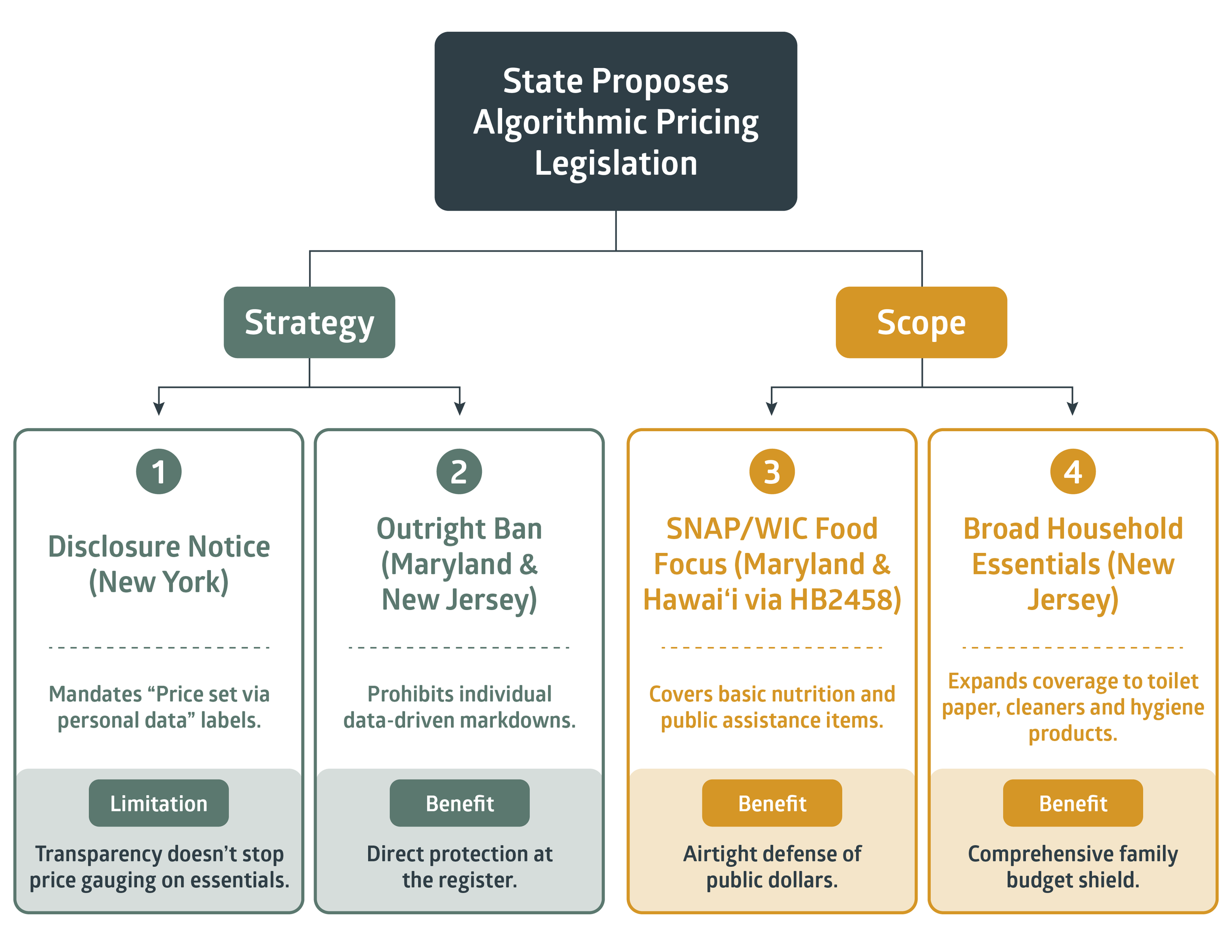
Historically, consumer protections have lagged behind new technologies and their impacts on people and communities. As retailers quietly integrate dynamic algorithms, shelf cameras, and AI tracking into daily operations, companies will not slow down the monetization of consumer data on their own.
Hawaiʻi has a unique opportunity to lead the nation in stopping predatory surveillance pricing on groceries. By re-introducing smart legislation that protects consumers from price gouging—while preserving standard rewards programs—lawmakers can ensure that technology serves local shoppers, rather than squeezing them at the checkout line.
Protecting SNAP and WIC eligible foods is an urgent, necessary first step. But as lawmakers in Hawaiʻi and across the country begin drafting regulations, banning personalized extraction in the grocery aisle opens up a much larger set of policy questions: Can a single state effectively police out-of-state algorithms? Is a disclosure warning enough, or do we need an outright ban? And is food just the tip of the spear in a broader fight over consumer data privacy?
In Part 2 of this series, we’ll break down the legislative playbook and examine how states are tackling enforcement loopholes, jurisdictional hurdles, and data broker pipelines to build lasting consumer protections.