Safe streets for all: Why Hawaiʻi can’t wait another year for pedestrian safety progress
Hawaiʻi’s pedestrians are in crisis. Fatalities are rising, our most dangerous intersections remain unfixed, and the people most affected—keiki, kūpuna, people with disabilities, and low-income families who walk out of necessity—continue to bear the heaviest burden.
This legislative session brought hope. Two common-sense pedestrian safety measures advanced further than ever before. Both made it to the final stage of the legislative process, but neither crossed the finish line.
Now, as we look ahead to 2027, we need to understand what happened, why it matters, and why we can’t afford to wait another year for change.
The Head Start We Didn’t Get
The Pedestrian Head Start bill, SB2470 / HB1884, would have required the installation of Leading Pedestrian Intervals (LPIs) and Accessible Pedestrian Signals (APS) at signalized intersections statewide. These are among the most cost-effective pedestrian safety improvements available—some LPI installations cost as little as a few hundred dollars per intersection through simple signal retiming.
LPIs give people walking a brief head start—typically 3–7 seconds—before drivers receive a green light. That small window of time makes pedestrians more visible to turning vehicles and reduces conflicts at the most dangerous point of an intersection. APS communicate walk and don’t walk signals through audible and vibrotactile cues, making crossings accessible to blind and low-vision pedestrians.
The evidence is overwhelming. In Seattle, intersections with LPIs saw a 48 percent reduction in pedestrian turning collisions and a 34 percent reduction in serious and fatal injuries. In New York City, a 2025 study found a 33 percent reduction in pedestrian injuries at treated intersections and a 65 percent drop in fatal crashes during daytime hours. LPIs are a proven safety countermeasure recognized by the Federal Highway Administration.
SB2470 made meaningful progress this session. It cleared its committee hearings and advanced all the way to conference—the stage where the House and Senate reconcile their versions of a bill before a final vote. Getting to conference means the bill had enough support in both chambers to keep moving.
But no conferees were ever assigned. Without conferees, a bill in conference simply sits and dies when the session ends. There was no public vote against it, no committee hearing where it was debated and rejected. The people who testified in support—who shared why safer crossings matter to them—deserve a clearer picture of what happened.
Jaywalking Reform Stalled—Again
This session marked the third year in a row the Legislature took up jaywalking reform, and the third year in a row the session ended without meaningful change.
Hawaiʻi Appleseed supported two bills that would have made modest but meaningful reforms. HB1523 would have reduced the fine for jaywalking to $25. HB1524 would have removed crossing during a pedestrian countdown timer as a citable violation. Neither bill sought to eliminate jaywalking enforcement entirely. They were measured, practical steps toward a more equitable system.
Both bills made it to conference committee. While House conferees were assigned, Senate conferees were not. Like the Pedestrian Head Start bill, these bills arrived at the final stage and quietly ran out of time.
Why do these bills matter? Because jaywalking laws in Hawaiʻi fall hardest on people who can least afford them. More than 5,000 citations were issued per year on average between 2018 and 2023, concentrated in working-class neighborhoods where residents are most likely to walk out of necessity.
Figure 1. Economic Characteristics of the Top Five Jaywalking Zipcodes in Hawaiʻi (2018 to 2023)
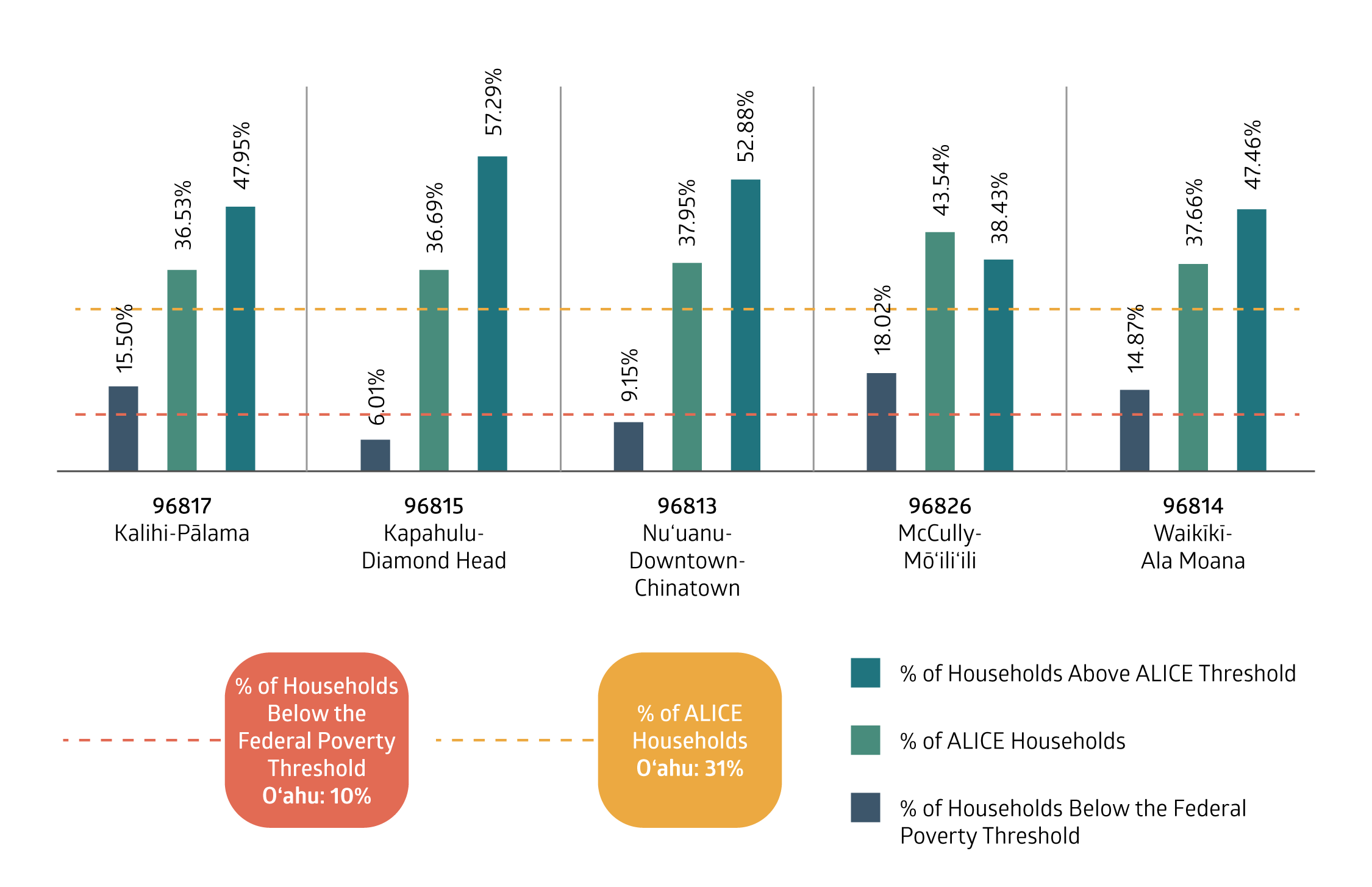
Based Hawaiʻi Appleseed analysis of citation records for jaywalking-related offenses from the Hawaiʻi State Judiciary for the time period of 2018 to 2023, as well as ALICE data for Hawaiʻi (see United for Alice, 2022)
For a family living paycheck to paycheck, a jaywalking fine ranging from $130 to $180 is not a minor inconvenience. It can spiral into a cycle of debt and a court record—real consequences for simply crossing the street.
This is not what real pedestrian safety looks like. Jaywalking laws were originally enacted in the 1920s following a lobbying campaign by the auto industry to shift blame for traffic fatalities onto pedestrians. Decades of data have confirmed that our current laws do little to prevent traffic violence while consistently burdening low-income communities. Reducing the fine to $25 and removing the countdown timer violation would have been a meaningful step toward creating a safer transportation system that treats pedestrians with more fairness and less financial harm.
A Pattern Worth Naming
There is a troubling pattern here. Both the Pedestrian Head Start bill and the jaywalking reform bills made it to conference, and in both cases, the Senate did not assign conferees. There was no floor debate, no recorded vote, and no public explanation. We’re continuing to investigate what happened and why.
What we do know is that the community support for these bills was real—and that support doesn’t disappear at the end of a session. More than half of pedestrian crashes in Hawaiʻi occur at intersections. The risks fall hardest on keiki, kūpuna, people with disabilities, and those who rely on walking and transit as their primary means of getting around.
There is also a practical legal dimension. Cities that have lagged on accessible pedestrian signals are increasingly facing lawsuits under the Americans with Disabilities Act. Chicago agreed in 2025 to install APS at more than 70 percent of its signalized intersections after litigation revealed fewer than 0.5 percent were accessible. Proactive investment is far less costly than a court-mandated retrofit program down the road.
The progress these bills made this session is real, and it reflects genuine legislative interest in pedestrian safety. Hawaiʻi Appleseed remains committed to advancing this legislation in 2027. With each session, the coalition behind this work has grown, the policy arguments have sharpened, and the data supporting reform has only gotten stronger.
The goal remains the same: shift public resources away from penalizing pedestrians and toward the infrastructure improvements—better crossings, slower streets, protected bike lanes—that actually keep people safe. Safer crossings are achievable. The evidence is there, the tools are proven, and the community support is growing.
Pedestrians across Hawaiʻi deserve better. We will keep pushing until they get it.