Remembering Victor Geminiani
Victor Geminiani—the leading co-founder of the organization that became the Hawaiʻi Appleseed Center for Law & Economic Justice—spent more than 50 years using the law on behalf of those too often overlooked in Hawaiʻi and on the continent. A relentless advocate for people without a voice in the halls of power, he devoted his entire career to securing the rights, and improving the lot, of the poor and the vulnerable. He died on June 10, 2026, at the age of 82.
To say Victor was passionate in his advocacy would be an understatement. He spoke quickly and gestured widely, his eyes intent—a man who seemed to gather rather than lose energy with the decades. His message was always clear, direct, well-reasoned and persuasive. A former colleague once called him “a fast-talking salesperson for justice.” The description fit a career that ran from the segregated South to the Hawaiian Islands he loved since first visiting them as a young man.
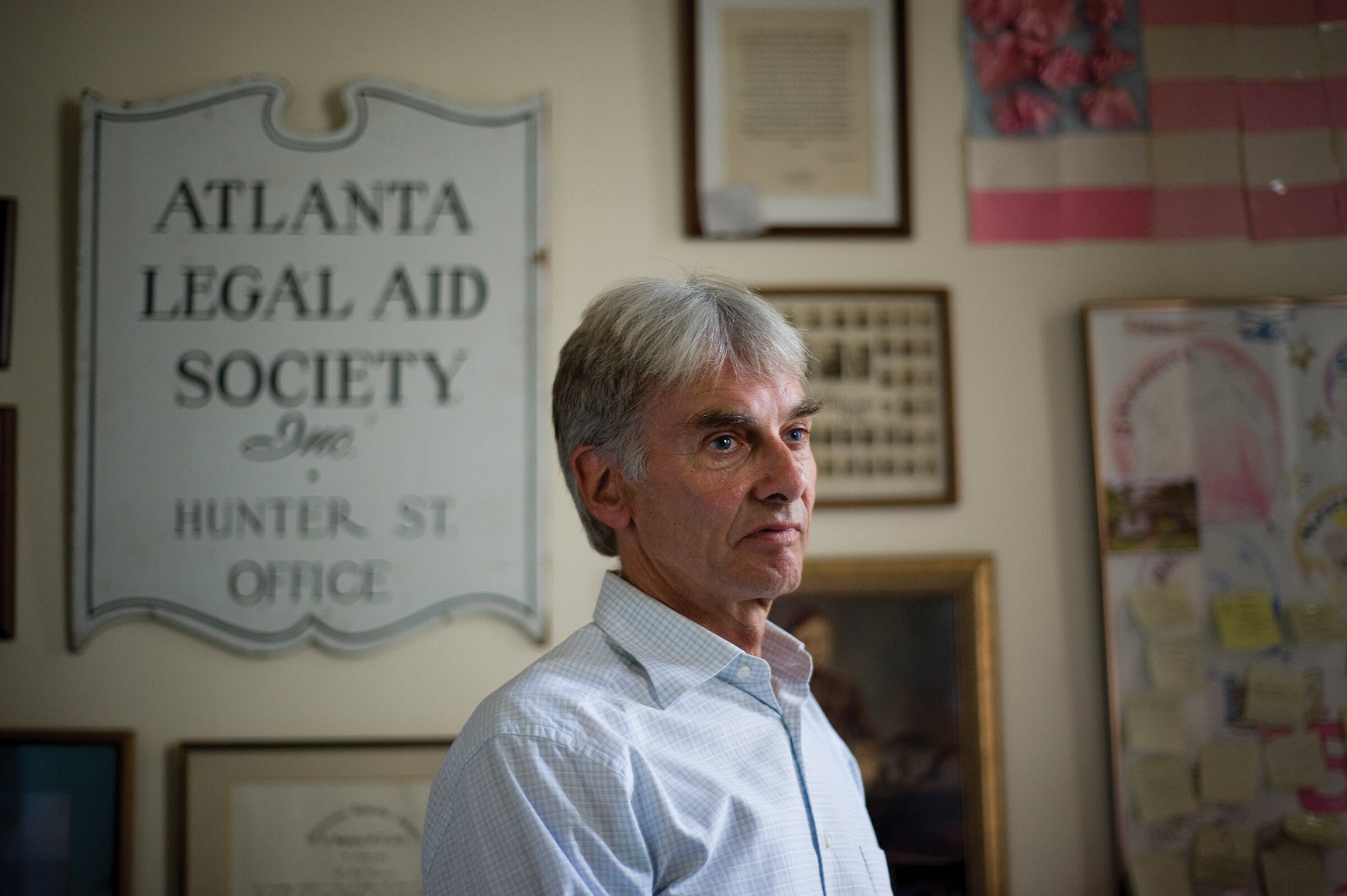
Victor was born in 1944 on Long Island, New York, to Irish and Italian immigrant parents. After graduating from Fordham University in 1966 and Villanova Law School in 1969, he joined Volunteers in Service to America (VISTA), the domestic service corps created as part of President Lyndon Johnson’s War on Poverty. He was sent to the Atlanta Legal Aid Society, one of four young lawyers in a single office.
He wasted no time. In his first week, he helped organize a rent strike against the landlord of a 200-unit complex over its squalid conditions. It was the opening note of a lifelong theme. As a young attorney in Georgia, he also filed one of the first federal class-action jail-closure cases in the country, winning permanent injunctions against two jails whose conditions, a court agreed, amounted to cruel and unusual punishment.
Over the following decades, he directed legal services programs in Georgia, New York, Massachusetts, and California, and during the Carter Administration served as a regional director for the federal Legal Services Corporation (LSC), overseeing 75 legal aid programs across 10 southern states.
Courtesy: Elyse Butler
Victor had fallen for Hawaiʻi on a visit in 1965, and in 1994 he moved to the islands to lead the Legal Aid Society of Hawaiʻi (Legal Aid), a post he held until 2005. It was there that he fought the battle that would shape the rest of his career. In 1996, Congress barred legal aid organizations that received LSC funding from bringing class actions and engaging in legislative and other policy advocacy that had long been their most powerful tools for achieving large-scale, systemic change.
Rather than accept these restrictions, Victor drove a landmark lawsuit against the federal government, challenging them as unconstitutional conditions on the organizations’ First Amendment rights. Legal Aid was the lead plaintiff in the suit, filed in the U.S. District Court in Hawaiʻi, and Victor drew on one of his great strengths—building coalitions and recruiting pro bono support—to bring legal aid organizations from other states in as co-plaintiffs and to enlist help from both Hawaiʻi-based and national law firms, as well as the American Civil Liberties Union. The case forced a rewrite of the LSC rules, creating a pathway for LSC-funded legal aid organizations to establish separately incorporated affiliates that could once again pursue class actions and systemic legislative and policy advocacy.
That fight pointed the way forward. Working with Goodsill partner David Reber, who Victor had recruited to become the volunteer President of Legal Aid, Victor created an organization which began as Lawyers for Equal Justice (LEJ) and, in 2011, became the Hawaiʻi Appleseed Center for Law & Economic Justice. Victor led the organization as it grew from a scrappy litigation project into an institution that also aggressively advanced the interests of the low-income population through policy advocacy. Closely affiliated with Legal Aid in its early years, Appleseed eventually struck out on its own—independent, but still a partner to Legal Aid wherever their interests aligned.
What Victor built has made possible victory after victory for people who rarely had an advocate in their corner. LEJ’s very first case ended a decades-long practice of overcharging public-housing tenants, cutting rents by more than a million dollars a year, and later cases returned more than $3 million in improper charges to tenants.
When children who had become homeless were being pushed out of their schools because they no longer lived in the school district, the organization sued the state—enforcing these students’ right under federal law to stay in their home schools, with state-provided transportation to get them there. Litigation brought by Appleseed also achieved a long-overdue increase in the statewide rates paid to the individuals and families who look after Hawaiʻi’s foster children.
Victor spearheaded lawsuits that forced long-delayed repairs in some of Hawaiʻi’s oldest and largest public-housing projects, including restoring hot water and repairing inoperable elevators that elderly and disabled residents depended on. In one of these cases, Hawaiʻi Appleseed’s efforts led to a $150 million redevelopment of one project and to substantial increases in annual legislative appropriations to maintain public housing generally. Victor led the fight that compelled the state to process food-stamp applications on time, after which Hawaiʻi moved from the worst-performing state in the nation to one of the best.
When the state moved to cut off health coverage for legal immigrants from Micronesia and other Pacific nations, Victor went to court to stop it. He won an injunction stopping the cuts at the trial court level. Although the victory was later overturned on appeal, and the U.S. Supreme Court declined to hear the case, the years of injunctive relief that the lawsuit achieved for people who depended on dialysis and cancer treatment were the difference between life and death. Coverage was finally restored by an act of Congress in 2021.
Victor came to believe that winning cases one at a time—even class actions benefiting thousands of people—was not enough. He came to believe that lasting change required better laws and policies, not just the enforcement of existing laws. Under his leadership, Appleseed grew from its litigation focus into the research, policy analysis, coalition-building and legislative and administrative advocacy organization it remains today.
He was one of the driving forces behind the state Earned Income Tax Credit, adopted by Hawaiʻi in 2017; behind a two-decade Hawaiʻi Appleseed push to get nutritious meals to low-income children in their schools; behind the drafting and adoption of the Honolulu ordinance permitting the creation of ADUs (accessory dwelling units); and behind the effort to curb the spread of illegal vacation rentals that he argued were pricing local families out of their own neighborhoods. And Hawaiʻi Appleseed was instrumental in driving the coalition that has helped raise Hawaiʻi’s minimum wage—an effort now worth roughly a billion dollars a year to the state’s low-income workers.
In 2018, after more than a year of preparation, Victor led Hawaiʻi Appleseed in building a dedicated, data-driven capacity to analyze the state and county budgets and tax policy—bringing rigorous fiscal research to debates that had too often proceeded without it. Through that effort, Appleseed earned Hawaiʻi a place in the State Priorities Partnership, a national network of independent budget-and-policy centers, one per participating state, coordinated by the Center on Budget and Policy Priorities. That analytical capability remains one of the cornerstones of Appleseed’s work today.
For Victor, the rewards of the work were never measured in money, but in the lives it changed. And at times the work was precarious: in Appleseed's lean years, Victor went without pay for a time to keep the doors open.
When Victor retired in 2019, those who had worked alongside him reached for big comparisons. Paul Alston, the Honolulu attorney who co-counseled many of Appleseed’s cases, invoked Martin Luther King Jr.’s wish to be remembered as a “drum major for justice.” Victor, Paul said, “had been more than a drum major; he has been a tireless one-man band for social justice, peace and righteousness. For the people of Hawaiʻi, he has rallied others to work for justice and righteousness. For that, we should all be grateful. He will be missed; there is no one who can match his energy, drive and dedication.”
David Reber, the Goodsill partner Victor recruited to lead Legal Aid’s board in 1999 and his co-founder at Hawaiʻi Appleseed, was in near-daily contact with him for two decades and a close friend long after. Speaking at Victor’s retirement in 2019, he said: “It has been one of my life’s personal and professional privileges to have been able to work with Victor over all these years and to support his efforts to advance social justice in Hawaiʻi. It is impossible to capture Victor’s full contributions and accomplishments. But, in my mind, he is a national treasure and Hawaiʻi has been blessed to have him here for so many years of his professional life.”
Gavin Thornton, whom Victor recruited first to Legal Aid and then as one of Hawaiʻi Appleseed’s earliest employees, and later identified as his successor, served as the organization’s Executive Director from 2019 through 2024. “Victor has never hesitated simply because something has not been tried before,” Gavin said upon Victor's retirement. “His courage and convictions have propelled him to wage worthy battles for equity and justice in Hawaiʻi and throughout the nation, and to find creative solutions to complex poverty issues.”
Away from the work, Victor’s life was as full as his career. He tinkered with 1960s British sports cars that, by his own cheerful admission, seldom ran. He gardened. He played bocce. The son of a steamship-company executive, he had loved travel from an early age, and he roamed widely—to all 50 states and more than 65 countries. Above all, there was his daughter, Nicola (Koa) Geminiani. Victor spoke of her constantly and adoringly; she was the great love and pride of his life.
Victor never accepted the world as he found it. Where others saw conditions too entrenched to change, he saw a case to be made—and he made it, in courtrooms and legislative hearing rooms, in rent strikes and class actions, across six states and a half-century, always on behalf of people the law had overlooked. He never stopped believing the fight was worth it, or that it could be won.