Progress on the plate: Food access wins from this session—and the work still ahead
As affordability and Hawaiʻi’s high cost of living becomes an increasingly urgent point of discussion for residents across the islands, legislators are increasingly recognizing that food security is central to the well-being of our communities.
During the 2026 legislative session, the state legislature could not ignore the growing pressures that Hawaiʻi families face when trying to access and afford food. Following multiple federal funding crises, growing threats to nutrition assistance programs, and last year’s food security victories, lawmakers are now paying closer attention to the state and local programs that help to feed Hawaiʻi’s families.
Last year’s expansion of free school meals marked a major step for Hawaiʻi families, the effects of which will continue to be felt when an additional 11,000 public school students will gain access to free school meals this coming fall. However, 2025’s Act 139 still excludes many students from the proven benefits of free school meals, and lawmakers in 2026 ultimately failed to build on the momentum that law represents.
Since then, the effects of federal cuts to nutrition assistance under H.R. 1 have become more clear. Hawaiʻi’s second State of Food Insecurity Report has confirmed that, even with progress made, one in three local families still struggles to put food on the table.
Despite the lack of new progress on free school meals, the 2026 session did deliver important wins—from expanding access to the Supplemental Nutrition Assistance Program (SNAP) for vulnerable populations, to investing in programs that strengthen local food systems and connect families with locally-grown food.
Expanding SNAP
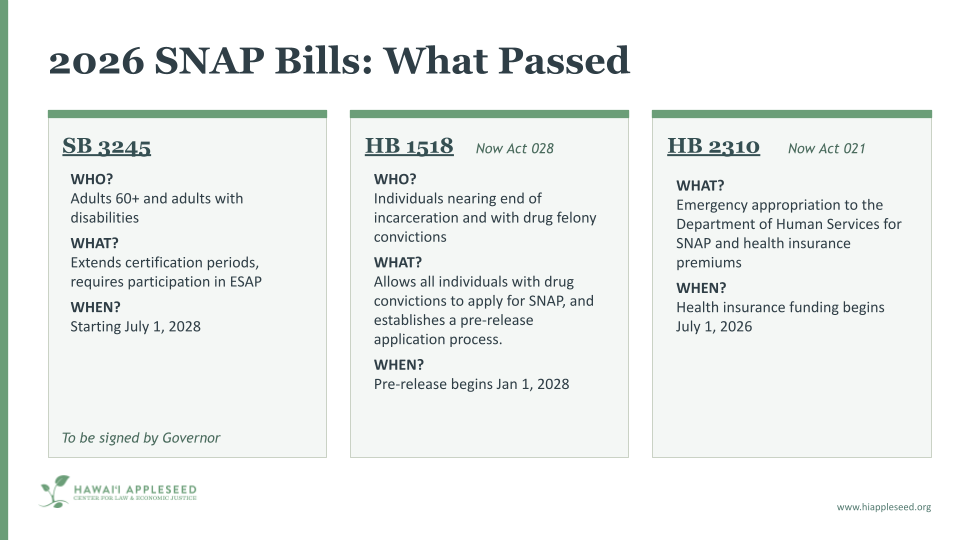
For years, advocates pushed for a simplified SNAP enrollment process for kūpuna—a simple administrative change that removes unnecessary friction for older adults to apply and recertify for the program. After multiple years of bringing this to the state legislature, advocates for the federal food assistance program finally passed Senate Bill 3245, which allows residents 60 and older to continue to receive the benefits they qualify for with greater ease.
Specifically, this law extends certification periods for adults 60 and older from one year to every two years. The law also requires that the state participate in the Elderly Simplified Application Project (ESAP), which would further extend certification periods for older adults and disabled individuals to every three years.
Once signed into law, this policy will make it much easier for SNAP recipients that typically live on fixed incomes and don’t have frequent income changes to get their EBT money without the frequent verifications and paperwork the program requires from working age adults. Kūpuna in particular should not be subjected to the unnecessary burden these restrictions present.
Lawmakers also passed House Bill 1518 (now Act 028), which will make it easier for individuals involved in the justice system to access benefits. Anti-hunger and civil rights advocates worked in collaboration to pass this important access bill, with both Department of Human Services (DHS) and Department of Corrections and Rehabilitation (DCR) working together to pilot a pre-release application process.
Starting in 2028, DHS and DCR must establish and implement a pre-release application process for inmates nearing release, allowing individuals to receive their EBT card the moment they re-enter society. Currently, newly released individuals can't apply until post-release—creating weeks or months of delay. With no income, job, or support network, closing that gap can mean the difference between reintegration and recidivism.
The new law also makes it easier for individuals convicted of felony drug-related offenses to apply for and receive SNAP, by removing the requirement to complete a treatment program. This reflects the growing understanding that access to healthy food is a basic need. Denying individuals one of the most essential resources—food—only makes it harder for people and families to build stability.
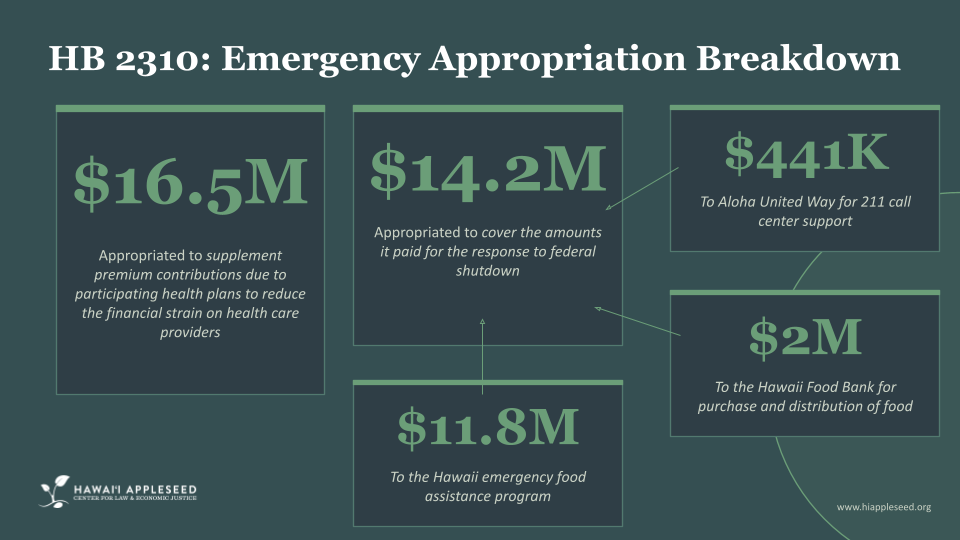
Another notable SNAP bill which lawmakers passed, House Bill 2310 (now Act 021), appropriates funds to DHS to make up for funds spent responding to the fallout from the full federal government shutdown, which lasted 43 days (October–November, 2025). This includes a total of $14.2 million for food banks, Aloha United Way, and for the Hawaiʻi Emergency Food Assistance Program, and another $16.5 million to supplement access to health insurance following the expiration of Affordable Care Act premiums.
A Win for Farms and Families
Another bright spot this session was continued investment in Hawaiʻi’s Farm to Families program, which allows food banks to purchase locally grown food, ultimately distributing nutritious and fresh produce to families facing food insecurity.
Lawmakers appropriated an additional $898,000 for the program, known as “Farm to Foodbank,” in the final state budget under House Bill 1800 (p. 410). This builds off of last year’s funding for the program, which allocated $500,000 per year for two years for the statewide program. With this latest investment, food banks across the state will be able to purchase and distribute nearly $1.4 million worth of Hawaiʻi-grown food every year, helping connect local harvests with local families who need them most.
With this program, every dollar spent on local food procurement helps keep food dollars circulating within Hawaiʻi’s economy, while improving access to healthy food for communities across the islands.
School Meals and the Work Ahead
Last year, Hawaiʻi took a major step forward by expanding access to free school meals for students from households earning up to 300 percent of the federal poverty level. As that expansion begins to take effect in the upcoming school year, some groups of keiki are still being left out. School meal advocates spent the 2026 session pushing for the end goal: universal free school meals.
The case remains simple. No child should be denied access to nutritious meals because of paperwork requirements, income thresholds, or the type of school they attend—as is still the case here in Hawaiʻi.
Despite Governor Green’s five-year vision for free school meals, the legislature did not fund an expansion to all public school students by 2030. But the conversation is far from over. Parents, educators, anti-hunger advocates, health professionals, and community organizations have spent years advocating for this policy, and every year more states across the country adopt free school meals for all. The sooner Hawaiʻi joins them, the better for our keiki, our community and our future.
The wins this session are worth celebrating, but they are not the finish line. Food insecurity continues to affect one in three households across Hawaiʻi, and federal cuts will only increase pressure on state and local programs in the years ahead. The challenge now is to build on this momentum and ensure every family, kūpuna, and keiki has reliable access to healthy food.