Our lack of decent, affordable housing costs us big time on healthcare
For a more detailed look at the relationship between housing and health, read the Hawaiʻi Budget & Policy Center brief, The Health and Housing Connection.
An often overlooked but significant aspect of Hawaiʻi’s lack of affordable housing is its effect on health and the cost of care. Conditions associated with housing instability include obesity, chronic physical ailments, and debilitating anxiety and depression. Housing in poor repair can result in injuries and exposure to disease-bearing pests and pollutants.
Research shows that underinvestment in low-income neighborhoods makes them more stressful and unhealthy for the people who live in them. Low-income neighborhoods offer fewer options to purchase healthy food and more that promote processed food and drink, and low-income housing is often placed in areas exposed to pollution such as vehicle emissions.
The cost of housing is typically the biggest burden for any household budget so the shortage of secure, affordable housing is likely to result in chronic economic stress, as well as overcrowding—a stressor all by itself. Hawaiʻi’s housing costs, as well as some cultural factors, make it the state with the nation’s highest rate of overcrowded housing, which is defined as housing units with more than one person per bedroom.
In cost-burdened households with children, housing instability—not being able to make timely rent payments, facing eviction, having to move frequently—adversely affects children’s health and wellbeing. Poverty and poor housing are linked to and exacerbate toxic stress and other adverse childhood experiences (ACEs), which can result in a lifetime of poor health. Moreover, children who experience ACEs are significantly more likely to experience episodes of homelessness in adulthood.
Housing costs affect the health of the elderly, too. Although most seniors have access to Medicare insurance, rent cost burdens may discourage regular medical visits and filling prescriptions, perhaps because a copay may be charged for many Medicare-covered services. Good nutrition also suffers from budget constraints.
The burden of poverty and poor housing falls much more heavily on Native Hawaiians, who not only earn less money than the state average, but also face the consequences of historical trauma, continued social prejudice, structural discrimination, and injustice regarding their land and culture.
It is impossible to develop a firm figure for the price paid for healthcare attributable only to poor housing. However, indications of the disproportionate burden and cost might be glimpsed in the estimated incidence of six conditions associated with poor housing and lower-income households—asthma, diabetes, high blood pressure, stroke, heart disease and poor mental health.
Figure 1. Prevalence of Housing-Linked Conditions by Income
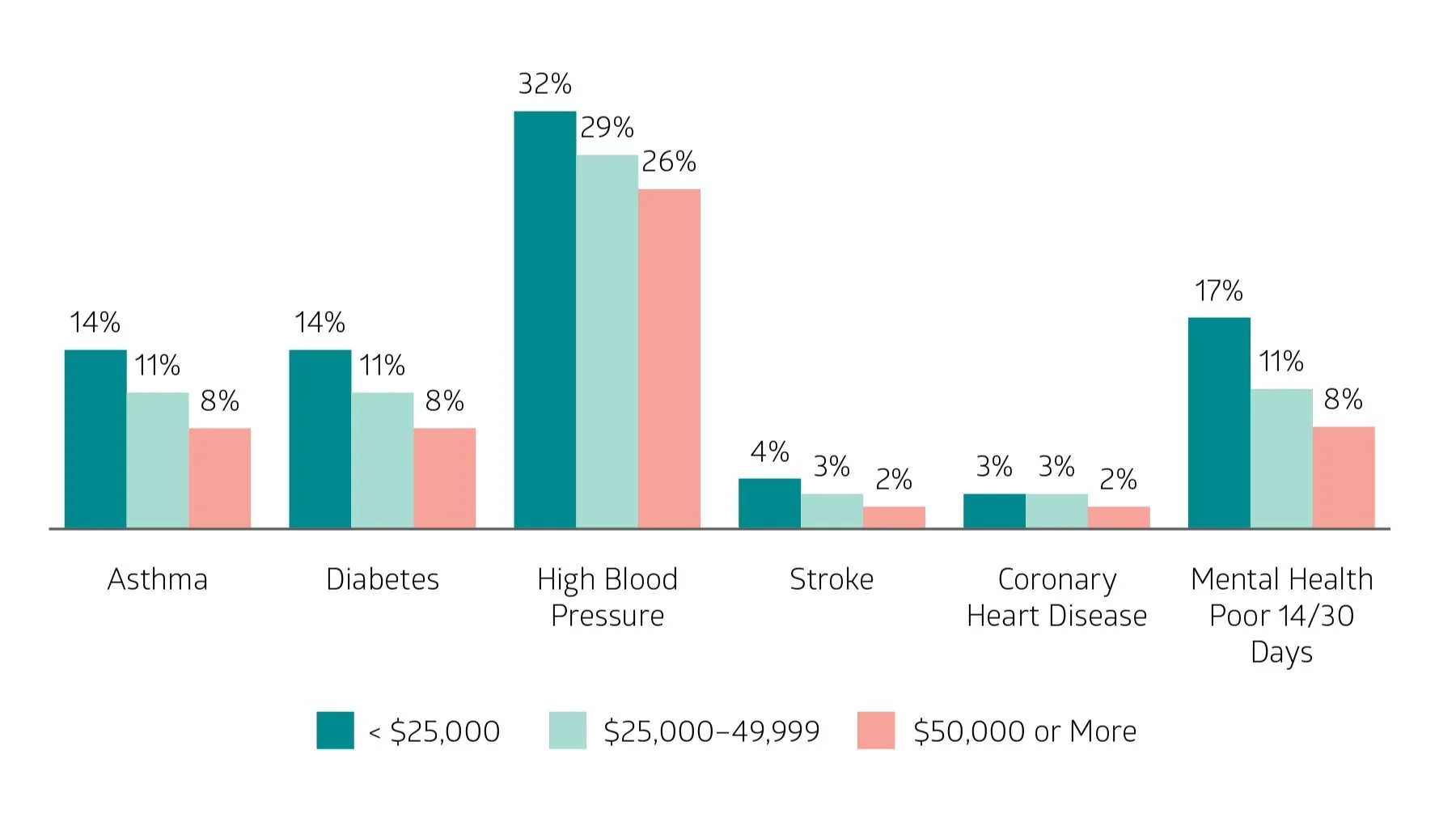
Figure 1. For each of the following housing-linked conditions, households with incomes below $25,000 per year have higher prevalence rates–as much as double–compared with households having incomes of $50,000 or more.
While the burden of this ill-health is surely felt most by the people who experience it, the whole community is affected. In addition, the cost of care is largely paid for through taxpayer-supported Medicaid.
Hawaiʻi’s policy, generally, is to provide public health insurance coverage for low-income individuals and to pay the bills for uninsured sick people who go to emergency rooms or need hospital care through Med-QUEST, Hawaiʻi’s Medicaid program.
Over the past five years (fiscal years 2017–2021), Med-QUEST has provided health coverage for one in four Hawaiʻi residents, spending an average of $2.3 billion per year. The federal government reimbursed two-thirds of these costs while Hawaiʻi taxpayers paid for the remaining third.
In 2018, Med-QUEST spent an average of $6,436 per person. This contrasts with per capita spending for private employer-sponsored insurance in Hawaiʻi, which was $3,299 in 2016. Med-QUEST’s per capita spending is higher because the agency serves as Hawaiʻi’s healthcare safety-net, providing coverage for people who are more likely to be in poor health, have costly medical conditions, or suffer from physical and mental disabilities.
Investing in Wellbeing
The United States spends more than any other country on healthcare, even as we fail to cover all residents. We also end up with mediocre results as measured by life expectancy and the prevalence of avoidable conditions.
Healthcare is expensive in the U.S. due, in part, to a system that values costly acute and specialty services above prevention and primary care, requires complex administrative and billing processes driven by regulations and concerns about liability and fraud, and too often fails to perform as an integrated system that offers and coordinates the right care at the right time. But poor health, which creates the need for healthcare, is driven by social and economic factors like poverty and discrimination, which the U.S. addresses inadequately, haphazardly and often grudgingly.
Compared to the U.S., countries that invest a greater share of their gross domestic product in social wellbeing are able to spend less on healthcare and still report better outcomes. The top 10 countries in order of their investment in social expenditures (from highest to lowest) are: France, Finland, Belgium, Denmark, Italy, Austria, Germany, Sweden, Norway and Spain. (The U.S. ranks 18th in social expenditure investments.)
The connections linking poverty, poor housing, and poor health are strong. Housing-related chronic diseases—asthma, diabetes, high blood pressure and stroke, heart disease, and anxiety and depression—are costly, and typically paid for by Med-QUEST, Hawaiʻi’s Medicaid program. It is time for state policymakers to consider that investing in housing and wellbeing for Hawaiʻi’s residents is also the cost-effective choice.