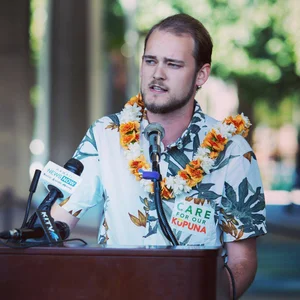
Hawaiʻi Tax Fairness Coalition presents equitable strategies to Fund Our Future
HONOLULU, Hawaiʻi – A broad alliance of community organizations, labor unions, nonprofit advocates, and concerned residents gathered at the State Capitol today in support of the Fund Our Future campaign, a movement dedicated to reforming Hawaiʻi’s tax system so that the wealthiest residents and large corporations pay their fair share—generating revenue for critical community needs without burdening working families.
Coalition members highlighted four key policy proposals that, together, would begin to correct a tax system where the wealthiest residents and large corporations currently pay a smaller share of their income than many working families.
With Hawaiʻi facing pressing needs in housing, education, healthcare, and climate adaptation, the coalition asserted that the answer lies not in cutting services, but in fixing a broken tax code.
On pausing income tax cuts for wealthy households (HB2306/SB3125):
Nikos Leverenz of the Hawaiʻi Health & Harm Reduction Center emphasized the necessity of pausing additional state tax cuts to protect critical programs.
“As a nonprofit administering essential services for our most vulnerable residents, we see every day what happens when budgets are squeezed,” said Leverenz. “The federal government is cutting taxes for the rich and slashing funding for Medicaid, SNAP, and other lifelines. If we proceed with additional state tax cuts on top of that, we will be forced to gut the very programs working families rely on. Pausing these cuts is not about raising taxes—it’s about preserving our ability to care for each other.”
On taxing investment income like income from work (HB1850):
Younghee Overly of Indivisible Hawaiʻi spoke to the danger of allowing unchecked wealth to accumulate at the top—and made a personal plea to lawmakers.
“As a retiree who depends on capital gains income, my message to the Legislature is simple: tax me more," said Overly. “Investors have never once passed on a good investment opportunity because of the tax amount. Capital gains taxes have been much higher in the past, and that allowed our government to invest in communities, schools, and infrastructure. The real threat to our democracy is not a modest tax increase on investment income—it is the unchecked accumulation of wealth that allows a few to wield power over the many. I can afford to pay a little more. Our future cannot afford to wait.”
On closing the Real Estate Investment Trust (REIT) loophole (SB2362):
Tanya Yamanaka Aynessazian of the Chamber of Sustainable Commerce called out the unfair loophole that allows multi-billion-dollar corporations to pay nothing in state income tax.
“REITs are massive corporations that pay zero state income tax—zero—while every local business the Chamber represents pays their fair share,” said Yamanaka Aynessazian. “These corporations extract wealth from Hawaiʻi’s land and resources; their largely out-of-state shareholders pay virtually no tax on their dividends to Hawaiʻi; and our local businesses are left at a competitive disadvantage. It’s wrong, and it’s time to close this loophole. We cannot claim to support local businesses while allowing giant corporations to operate here tax-free.”
On Raising the Mansion Sales Tax (HB2049/SB3028):
ʻAlihilani Katoa, a young organizer with Our Hawaiʻi, connected the fight for tax fairness to the promise of a Hawaiʻi where future generations can afford to stay.
“There’s a basic promise we owe to each other in Hawaiʻi—that our keiki will be able to live here, that our kupuna can age with dignity in the communities they helped build, and that working families won’t be pushed out of their own home,” said Katoa. “Right now, with housing costs skyrocketing and the gap between the wealthy and everyone else growing wider, that promise is slipping away.
“The conveyance tax is one of our best tools to make sure that those profiting from our red-hot real estate market—investors flipping high-value properties—actually contribute something back to the communities they’re cashing in on,” continued Katoa. “It’s about capturing some of that wealth and putting it directly into housing and infrastructure for local families—and especially Native Hawaiian families. That’s not just good policy. That’s keeping our promise.”
The Fund Our Future campaign will continue organizing and mobilizing throughout the remainder of the legislative session, urging lawmakers to prioritize tax fairness and community investment over continued breaks for the wealthy and corporations.