The life cycle of the Hawaiʻi state budget
The budget process involves many individuals and entities. The governor, the state Legislature, the Council on Revenues, the Department of Budget and Finance, and all the executive departments and agencies contribute to the process. The budget life cycle, shown below, is a visual summary of the process taken from information the Department of Budget and Finance makes available.
Due to the biennial time-frame, the Legislature passes a new budget every odd-numbered year and a supplemental budget every even-numbered year. Think of the supplemental budget as a revision taking into account updated information on projected revenue increases or shortfalls.
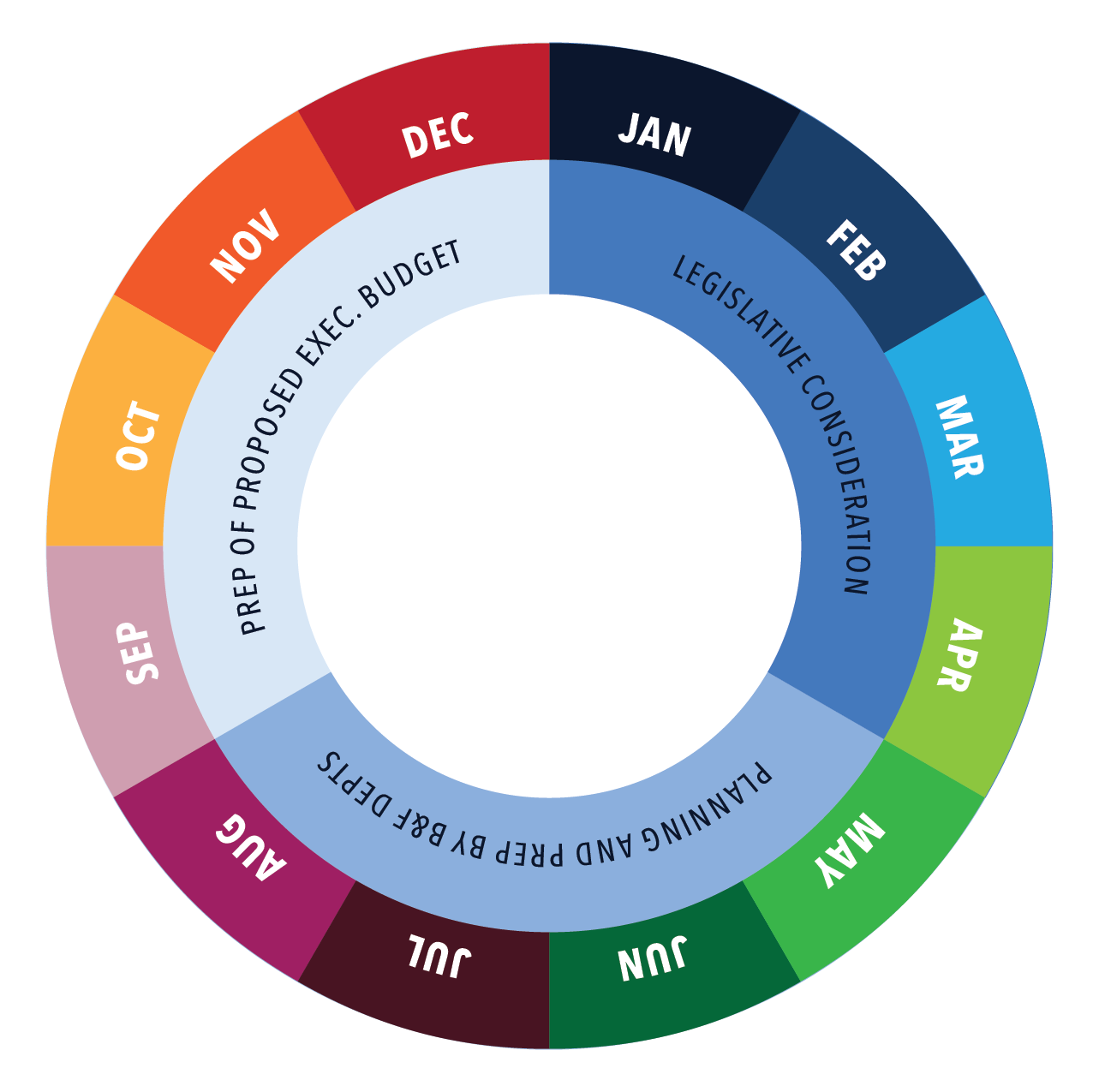
April to September
The budget process begins in the spring and summer with the Department of Budget and Finance (B&F), and the many other departments, providing program structure updates. In August/September, B&F issues budget preparation instructions to the departments.
October to December
Beginning in October, agencies submit their budget requests to B&F. After submitting budget recommendations to the departments and going through an appeals period. The governor prepares the proposed executive branch budget. B&F is largely responsible for crafting the proposed budget, in discussion with the executive departments and state agencies.
The governor submits this proposed budget to the Legislature in December, at least 30 days before the Legislature convenes. Throughout the budget life cycle, the Council on Revenues provides quarterly predictions of future revenues to inform the budget process.
January to April/May
No later than January 10, the Council on Revenues must share with the Legislature its quarterly general funds prediction for the remainder of the current fiscal year and its expectations for the next six fiscal years.
In the state Legislature, the corresponding money committees in each chamber—the Ways and Means Committee (WAM) in the Senate, and the Finance Committee (FIN) in the House—conduct public hearings with executive departments and agencies and prepare revised versions of the bill and budget worksheets. First, FIN reviews the bill and worksheets, and after three readings (votes), the whole House of Representatives passes a version of the budget. WAM then reviews this proposed budget bill and makes modifications before the Senate passes its own version, also after three votes by the full chamber.
Finally, select House and Senate members meet in a conference committee to reconcile their versions of the bill and worksheets. Both the House and Senate must then vote to pass the final conference version of the budget bill.
May
The agreed-upon budget bill then goes to the governor, who can sign or veto it. The governor also has “line item” veto power, which means that he or she may veto particular items in the budget by striking out or reducing those items. If the governor vetoes anything, the Legislature can reconvene to amend and pass the budget or to override the veto with a two-thirds vote in each chamber.
July through September and Beyond
The budget is adopted and funds are allocated based on legislative appropriations and action by the governor (e.g., vetoes or restrictions) for the biennium starting July 1 of the odd-numbered calendar year. The governor has the power to release or restrict funding that was appropriated. Restrictions are most frequently imposed when the Council on Revenues lowers its revenue projections.
The Following Year
The Legislature is not legally required to amend the biennium budget during the following legislative session (even-numbered year), but it almost invariably does update the executive budget. The governor proposes an executive supplemental budget, and the Legislature passes another budget bill that amends the budget passed in the first (odd-numbered) year via the same process.
The supplemental budget bill may change a department’s authorized funding and staffing for the second year in the budget biennium.