Hawaiʻi’s economy is still highly vulnerable to global shocks and recession
The Great Recession of 2007-2009 did not merely represent a temporary economic setback for Hawaiʻi—it exposed fundamental structural weaknesses in our island economy that continue to leave us vulnerable today. As economists monitor warning signs of potential future downturns—from flattening tourism growth to increasing bankruptcies—we must examine how the last crisis reshaped our communities and what lessons we failed to learn.
The story of Hawaiʻi’s recession experience is one of cascading failures across interconnected sectors, disproportionate impacts on already marginalized populations, and missed opportunities to build genuine economic resilience.
The House of Cards: Tourism’s Collapse
Hawaiʻi’s over-reliance on tourism created a “house of cards” economy—one that appears stable until the slightest disturbance sends it tumbling down. The numbers from the recession years tell a dramatic story: between 2007 and 2009, our islands welcomed one million fewer visitors, representing a staggering 14 percent decline.
But the real devastation came from spending patterns—while visitor days actually increased slightly from 9 to 9.38 days on average, total tourism expenditures plummeted by $3 billion as cautious travelers tightened their budgets.
This spending collapse rippled through every layer of our economy. The most visible casualties were Aloha Airlines and American Trans Air (ATA), whose bankruptcies in early 2008 eliminated critical transportation links overnight. But the damage extended far beyond airlines—hotels reduced staff, restaurants closed, and retail shops shuttered. The construction industry, which had been riding the wave of Hawaiʻi’s pre-recession boom, saw nearly a quarter of its workforce disappear as development projects froze.
What makes these numbers particularly sobering is how little has changed in our economic structure since then. If another recession were to cause a similar percentage decline today, based on 2017 figures, we would face the disappearance of 1.4 million visitors, 11 million visitor days, and $3.7 billion in spending—losses our monocultural economy remains ill-prepared to absorb.
The Human Cost: Families in Freefall
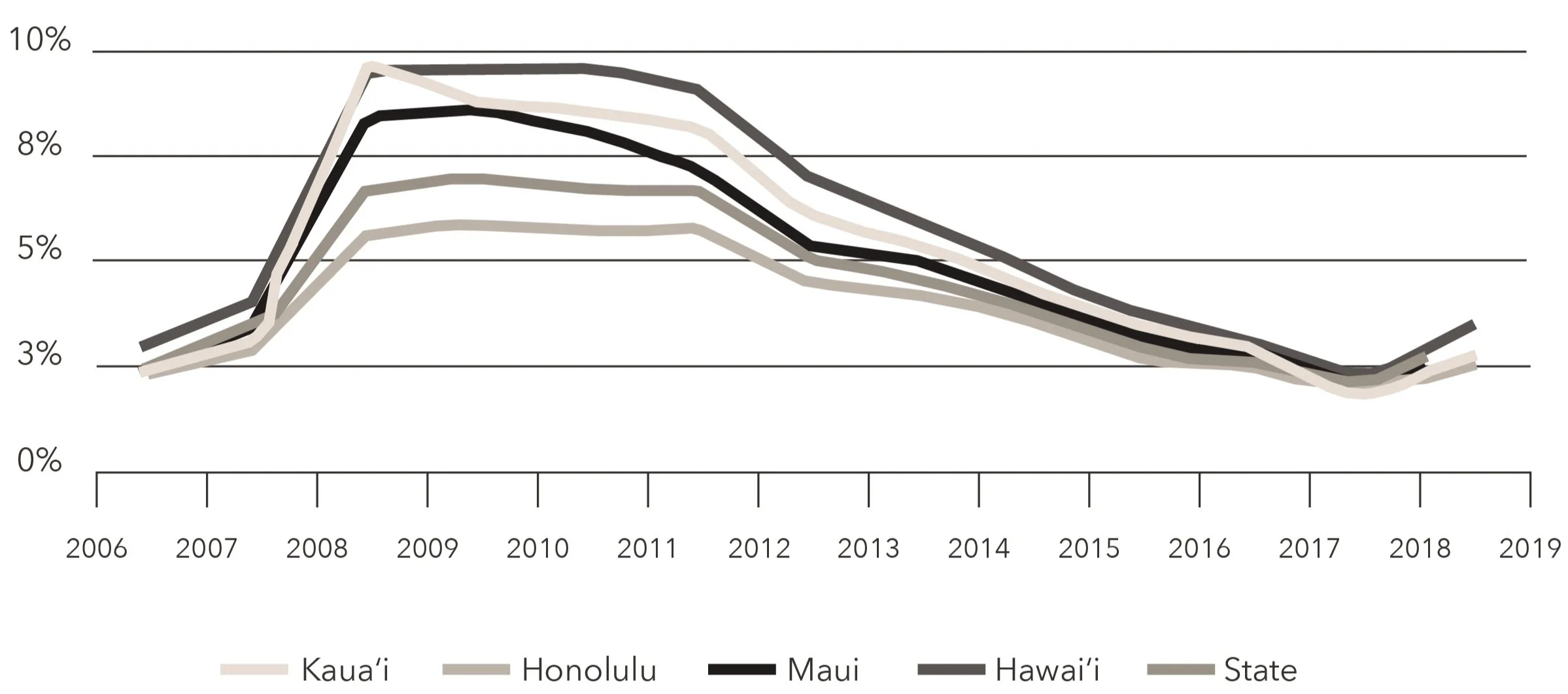
Behind these macroeconomic statistics lie deeply personal stories of struggle. The unemployment rate’s climb from 2.7 percent to 7 percent statewide—reaching nearly 10 percent in Hawaiʻi County—translated into real families losing livelihoods, homes, and health insurance. Weekly unemployment claims tripled from 6,600 to 20,500 at the peak of the crisis, each number representing a household facing impossible choices between rent, food, and medical care.
Figure 1. Unemployment Rates by County, 2007–2019
The recession exacerbated existing inequalities in disturbing ways. While all workers suffered, those at the bottom of the wage scale experienced the most severe and lasting damage. Inflation-adjusted wages for low-income workers fell by as much as 10 percent during the recession years—losses many never recovered even during the subsequent economic rebound. Meanwhile, the Aloha United Way’s ALICE report revealed that the basic survival budget for a family of four increased by 20 percent between 2007 and 2015, creating an impossible squeeze for working families.
Our education system became both a refuge and a casualty of the crisis. As job opportunities vanished, enrollment at University of Hawaiʻi campuses surged by 18 percent at four-year institutions and 28 percent at community colleges—a rational response from workers seeking to retrain. Tragically, this surge came precisely as state funding per student dropped by 26 percent, undermining the quality of education precisely when residents needed it most.
Structural Flaws Laid Bare
Three fundamental weaknesses in Hawaiʻi’s economic structure became painfully apparent during the recession years:
Our extreme dependence on tourism and government employment means that when one sector stumbles, the entire economy falls with it. The construction industry’s implosion demonstrated how even our secondary industries remain tied to tourism’s fortunes, as resort development and luxury home building ground to a halt.
Our over-reliance on low-wage jobs means economic downturns hit with particular severity. When the recession struck, nearly half of Hawaiʻi’s jobs paid less than what families needed to cover basic expenses. These vulnerable workers—many in hospitality, retail, and service positions—faced not just job losses but also reduced hours and benefits when they managed to stay employed.
The crisis revealed stark geographic disparities in economic resilience. While Honolulu’s unemployment rate peaked at 6 percent, more rural areas like Hawaiʻi County approached 10 percent unemployment—a disparity reflecting both the neighbor islands’ greater dependence on tourism and their lack of alternative economic engines.
Building a More Resilient Future
The painful lessons of the Great Recession point toward several critical pathways for reform. Economic diversification must become more than a buzzword—we need targeted investments in sectors like renewable energy, specialty agriculture, and technology that can provide stable, high-quality jobs less subject to tourism’s volatility.
Workforce development requires a complete reimagining. Rather than training workers for more low-wage service jobs, we should expand vocational programs in growing fields like healthcare technology, sustainable construction, and digital media. Our university system needs stable funding to serve as both an economic stabilizer during downturns and an engine of innovation during recoveries.
Social infrastructure demands equal attention. The Medicaid expansion during the recession prevented even greater suffering, proving the value of robust safety nets. We should strengthen these programs during good times rather than waiting for crises to reveal their importance. Similarly, affordable housing development near job centers would reduce workers’ vulnerability to economic shocks.
The Time to Act Is Now
With economists tracking troubling parallels between current conditions and the pre-recession environment of 2007—from slowing tourism growth to increasing consumer debt—complacency is not an option. The Great Recession demonstrated that Hawaiʻi’s working families bear the brunt of economic downturns while often being last to benefit from recoveries.
Building true economic resilience will require moving beyond temporary fixes to address fundamental structural weaknesses. This means making difficult choices today to diversify our economy, invest in our workforce, and strengthen our social safety nets. The alternative—another cycle of devastating losses followed by an uneven recovery—would represent an unacceptable failure of vision and leadership. The lessons of the last recession are clear; whether we heed them will determine Hawaiʻi’s economic future for decades to come.
Download our complete report on the Great Recession below, with recommendations for the state to better prepare for the next downturn.