Automatic voter registration boosts participation, especially among minorities
Automatic voter registration, or “AVR,” is quickly gaining supporters nationally, not only as a way of increasing the number of potential voters, but also as a way of ensuring more accuracy in voter rolls. Eleven states and the District of Columbia have implemented AVR and another six are in the process of implementing it. Other states, including Hawaiʻi, have introduced AVR legislation (HB2119, SB2005).
Figure 1. Which States Have Implemented Automatic Voter Registration?
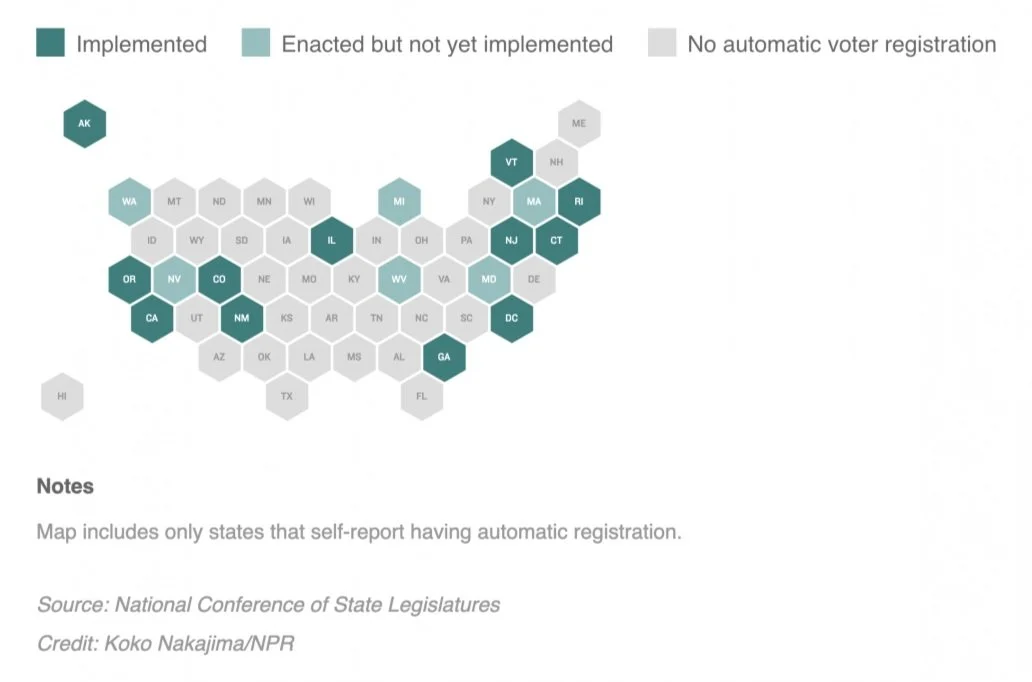
What does automatic voter registration mean? When a person visits the department of motor vehicles (DMV) or another state office to renew or acquire a drivers’ license, they will be automatically registered to vote unless they choose to opt-out. Currently, residents must opt-in to be registered. This is an extremely small, but potentially significant change in policy.
A broadly representative voter base is a cornerstone of a healthy democracy. But in Hawaiʻi, on average, only 42 percent of eligible voters in Hawaiʻi exercise their right to vote. Between 2006 and 2016, only 74 percent of eligible Hawaiʻi residents registered to vote, on average. Even worse, only 58 percent of those registered to vote actually voted in general elections, according to the U.S. Cenus Bureau and the State of Hawaiʻi Office of Elections.
Early adopters of automatic voter registration have seen their voter rolls increase dramatically. Oregon’s voter registration at DMV offices has quadrupled since 2016. Vermont saw an increase of 62 percent in registration during the first six months of 2017 over the first six months of the previous year, according to the Brennan Center for Justice. States have also seen voter rolls become more diverse in terms of age, ethnicity, income, and residence. Oregon has registered new voters who are younger, are members of minority groups, have lower incomes, and are non-urban, according to the Center for American Progress, and National Public Radio. It is still too early to determine the total impact of AVR on voting rates. However, indications are that AVR is a welcome path forward in broadening civic participation.