
Note: This is the second in a series of posts about surveillance pricing.
Part 1: “The surveillance grocery store: How algorithms target Hawaiʻi consumers”
This week, Hawaiʻi families will be shopping for Thanksgiving dinner and Black Friday deals online. Many of them will have no way of knowing whether the price on their screen is the same price that their neighbor is seeing. That’s because retailers are increasingly using a practice called surveillance pricing—harnessing vast amounts of personal data, from your location and browsing history to your device type and shopping habits, to quietly charge different people different prices for the exact same item.
While it’s often framed as an algorithm offering you a personalized deal, surveillance pricing frequently works the other way: identifying when you are most desperate or least likely to comparison shop and adjusting the price accordingly. It is a hidden, algorithmic form of price gouging that turns your personal data into a tool for corporate profit, leaving consumers entirely in the dark about how much they are actually being overcharged. In Hawai’i, where more than half (52 percent) of households are living below the ALICE Threshold, it is clear that local families can’t absorb another hidden cost.
The good news is that momentum to hold companies accountable is growing. In August, the Federal Trade Commission (FTC) proposed an enforcement policy warning companies that using personal data to set prices without telling consumers could violate existing federal law. It also ordered nine major airlines, rideshare companies, and food-delivery sites to disclose how they use personal data and algorithms to set prices for customers and pay for gig workers.
But the FTC’s action focuses only on disclosure, not a ban, and Congress has yet to give the agency power to prohibit personalized pricing outright. Meanwhile, Maryland, New Jersey, and Connecticut enacted the first laws restricting surveillance pricing this year, and New York’s legislature passed its own ban.
Under surveillance pricing, there is no single fair starting price. Instead, an algorithm can offer an illusion of discounts to shoppers likely to walk away, and make up for them by charging more to shoppers who can’t. That’s why some states are focusing on ensuring “one fair price,” while protecting loyalty programs and discounts. Here’s how Hawaiʻi could build out a policy on surveillance pricing, and what other states teach at each step.
Protecting Food and Essential Goods
Last legislative session, House Bill 2458 started out covering only SNAP- and WIC-eligible food. However that provision was removed, citing current federal law that already ensures SNAP shoppers pay the same prices as other customers for SNAP-eligible products. Whether or not that federal rule is enough to protect SNAP shoppers is a separate issue. However, limiting Hawaiʻi’s ban to these foods would mean that other essential items—like diapers or feminine products—would not be covered.
States across the country have each taken their own specific approach to what goods or stores should be protected from surveillance pricing. In New Jersey’s Fair Price Protection Act, food and drinks, household cleaning items, health and beauty products, and even pet food and supplies are required by law to be set at a single, fair price for all customers. Surveillance, or algorithm-based pricing is prohibited.
New Jersey even included a one-year freeze on new digital price tags, already active in Walmart and Kroger stores. These small digital screens on store shelves wirelessly display product prices and update remotely from a central system, making it easy for stores to charge different prices for different customers.
In Hawaiʻi, protecting essential everyday items like food, diapers, over-the-counter medicine, and menstrual products would give families a safeguard they can count on. Beyond what goods to protect, there is a larger question on how to effectively prohibit surveillance pricing, which Hawaiʻi can look to other states to answer.
Disclosure, Outright Ban, or Both?
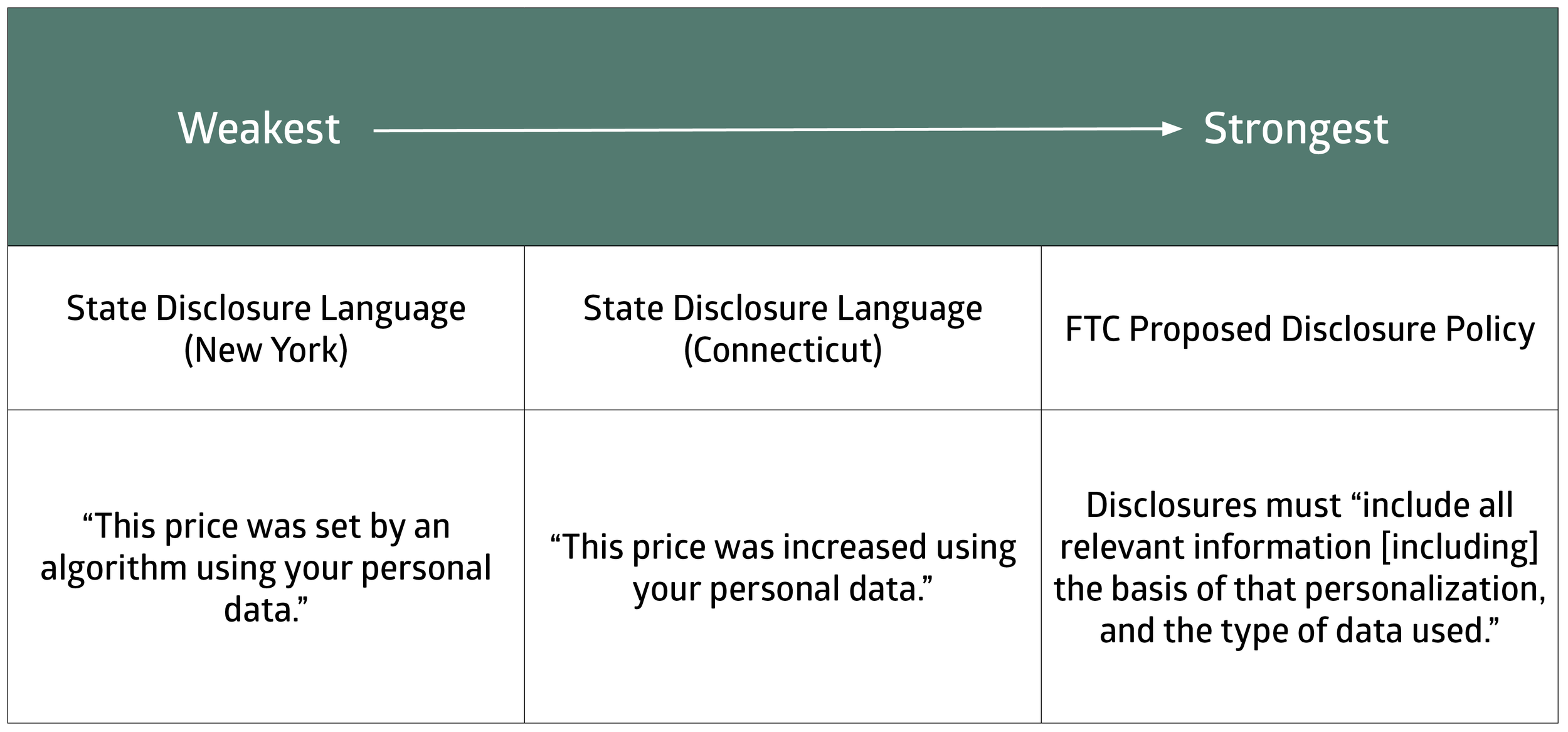
The suggested federal policy put forward by the FTC calls for disclosure. But without congressional approval of a bill like the 2025 One Fair Price Act, there is no federal enforcement to prohibit companies from preying on shoppers through surveillance pricing. Therefore, some states have begun to take matters into their own hands.
New York and Connecticut’s laws require a simple disclosure notice, but the FTC’s policy statement actually goes further, clarifying that these disclosures are most effective when they cover everything a consumer needs to know. Merely indicating that something is a “specially selected” price is not enough.
“The strongest step Hawaiʻi can take right now is a ‘one fair price’ law–backed by disclosure.”
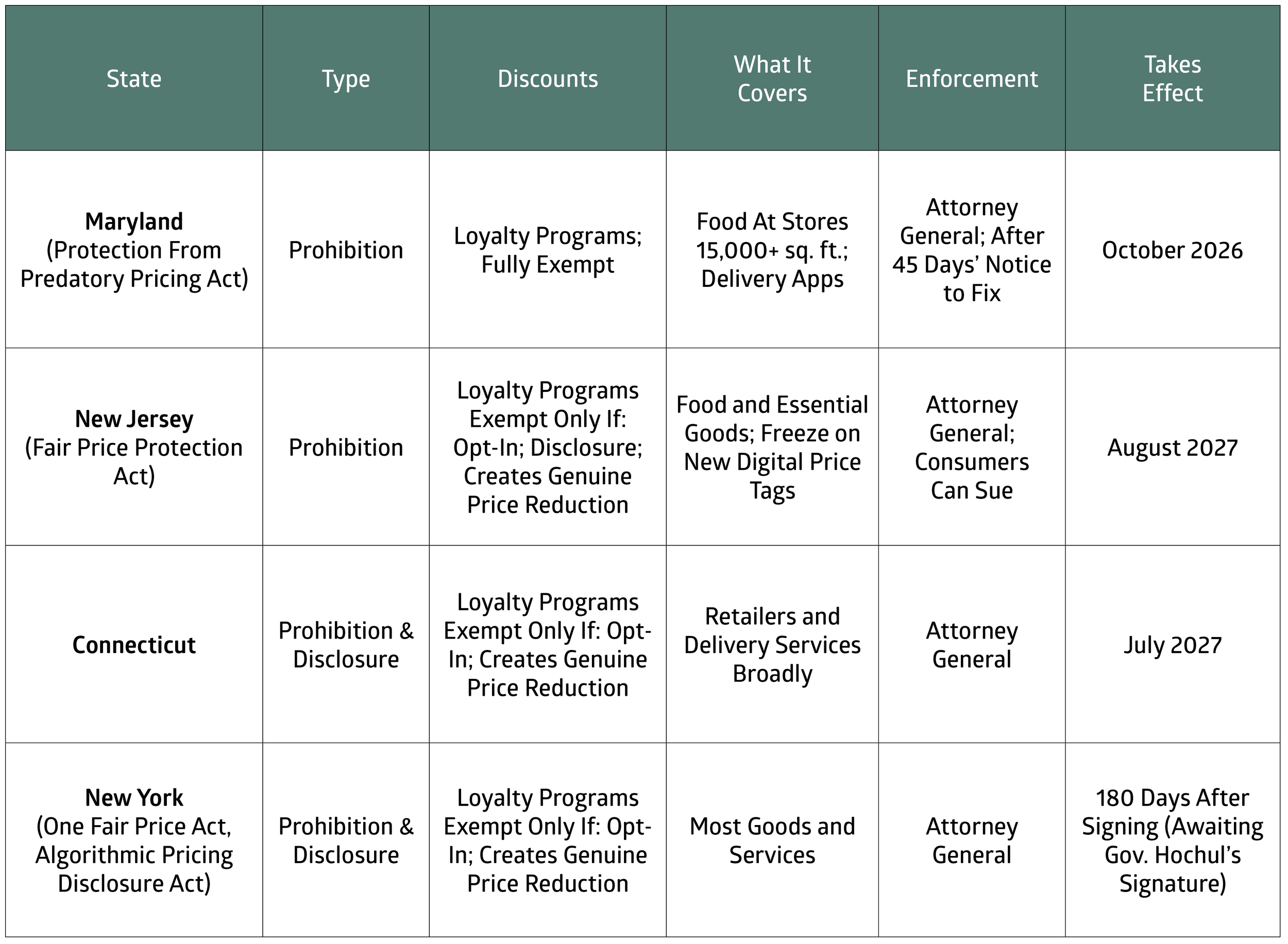
A notice can tell shoppers what happened, but it can’t change what they pay. That is why many of these disclosure efforts have turned into efforts to ban the practice outright. New York’s legislature voted to replace its disclosure law with the One Fair Price Act. Maryland dropped a disclosure requirement before passing its Protection From Predatory Pricing Act. and Connecticut included disclosure within its prohibition law.
National public opinion surveys show that 65 percent of consumers support prohibiting surveillance pricing, and it is also the model many states have pursued. However, it should be noted that no state has an outright ban on surveillance pricing. Every bill passed so far carves out exemptions for loyalty programs and other discounts so that consumers can keep receiving savings, though the scope of those exemptions varies.
Protecting Discounts: A Loophole No State Has Yet Tackled
One of the biggest concerns from Hawaiʻi lawmakers examining last session’s bill, HB2458, was that an outright ban would end rewards programs like Foodland’s Maikaʻi Card. Protecting those types of personalized discounts is precisely why no state has passed an outright ban on surveillance pricing, instead including carveouts for loyalty programs.
Maryland exempted loyalty programs outright, which essentially still allows surveillance pricing to occur, leaving a loophole for companies to continue the practice but under the guise of a “member discount.” Without state enforcement, a loyalty program can become the loophole that lets surveillance pricing continue under a different name.
Aiming to address this, New York and Connecticut require that shoppers opt in to the program. Both states also require a genuine reduction from the store’s regular price in order for a loyalty program to be exempt from the restrictions on surveillance pricing. New Jersey includes those same conditions and goes further, requiring the program’s terms to be public and the same for every member. These solutions are the closest states can get to banning surveillance pricing while protecting shoppers’ loyalty programs.
However, even with these state level laws in place, a discount that looks genuine on paper could still be built on a shopper’s personal data. Only an enforcement team with the staff and technical tools to test pricing systems would be able to tell the difference. During last session’s discussion over HB2458, the Office of Consumer Protection (OCP) requested a technologist, an attorney and an investigator—a budget ask of about $450,000—should Hawaiʻi go through with a ban. However, no version of the bill included money to fund those positions.
The strongest step Hawaiʻi can take right now is a “one fair price” law–backed by disclosure. This is the approach Connecticut has taken, and that New York’s pending law will follow. Hawaiʻi can borrow New York’s and New Jersey’s conditions so that loyalty discounts are exempted only when they are opt-in, include the same terms for every member, and create a real reduction in price.
Ultimately, these protections are only as strong as their enforcement, and further federal regulations are needed to prevent companies from using this loophole in state legislation to continue surveillance pricing. For families already stretched thin, the goal is simple: same store, same product, one fair price.