Food security is on Oʻahu’s ballot this November: What Question No. 1 would do
On any given day in the City and County of Honolulu, roughly 1 in 4 households lack reliable access to food. That amounts to nearly 250,000 residents who are food insecure on Oʻahu—a quarter of our neighbors, our coworkers, and of local families.
But hunger is only one part of the challenge facing Hawaiʻi’s food system. Beneath the everyday reality of food insecurity is a broader structural vulnerability: Hawaiʻi’s heavy reliance on imported food and global supply chains. When those supply chains are disrupted by a natural disaster, economic shock, or federal shutdown, Hawaiʻi has limited options for quickly getting food to residents affected by an emergency while continuing to meet the needs of people already experiencing food insecurity.
Ballot Question 1
Should the Charter require annual funding for a Food Security Fund, without having to simultaneously increase real property tax rates to fund the appropriation, to support programs and grants that provide locally grown or produced food to Oahu residents, as well as non-local food only in an emergency?
This November, Oʻahu voters will consider Question No. 1, a proposed Honolulu City Charter amendment that would establish a permanent Food Security Fund. The measure would not raise taxes, but would instead dedicate 0.5 percent of existing real property tax revenues—an estimated $8–9 million annually—to programs and grants that strengthen Oʻahu’s local food system.
How Does the Fund Work?
Honolulu’s Charter already establishes five special funds, including the Clean Water and Natural Lands Fund, Affordable Housing Fund, Climate Resiliency Fund, Honolulu Zoo Fund, and Grants in Aid Fund. Under the Charter, these funds receive an equal share (0.5 percent each) of annual appropriations from real property taxes.
If this proposal were to pass, the Charter would create a sixth special fund: the Food Security Fund. It would increase the portion of real property tax revenues dedicated to the Charter’s special funds from 2.5 percent to 3 percent.
“It’s important to note that the establishment of this fund would not create a new tax, raise property taxes, or add new fees”
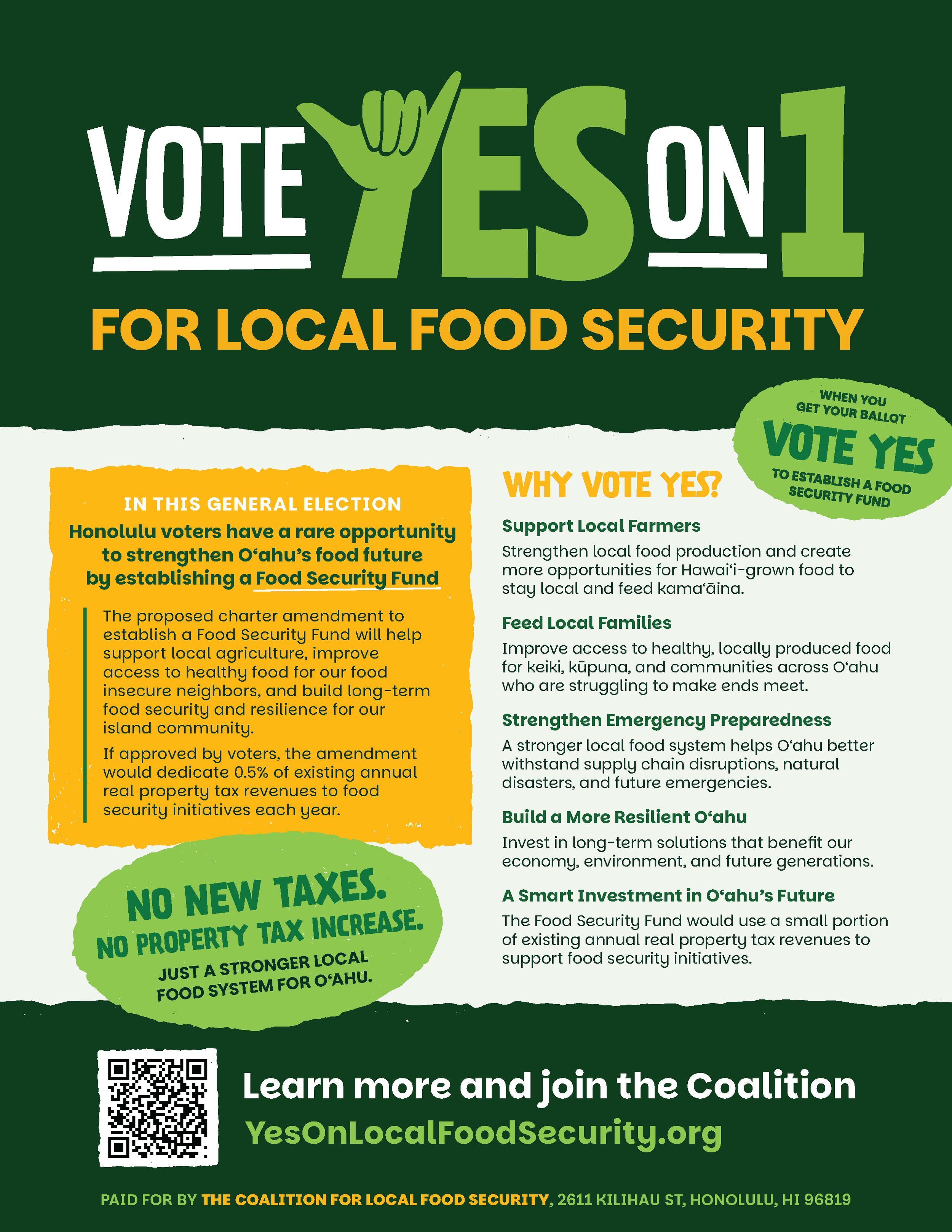
It’s important to note that the establishment of this fund would not create a new tax, raise property taxes, or add new fees. Instead, it reallocates a small portion of revenue already being collected into a dedicated, protected fund. The City Council continues to manage the rest of the budget through its normal process; this amendment simply ensures that food security is no longer left to compete against other priorities in every annual budget cycle.
The establishment of a fund for food security leaves room to use the funding in several ways:
While the programs and organizations utilizing this funding must address food insecure residents and communities on Oʻahu, food can be sourced from anywhere in Hawaiʻi.
The fund was written to include foods that are “grown, raised, or harvested” in Hawaiʻi, while also including “value-added or process products derived primarily from such foods.” This puts the focus on Hawaiʻi-specific products but leaves some flexibility for products that are primarily sourced in Hawaiʻi, but maybe be processed elsewhere.
The proposal also carves out an allowable use of up to 10 percent of funds for non-local food purchasing during a declared state of emergency.
A dedicated and permanent fund would give emergency feeding organizations and partners the long-term certainty they need to invest in local food production, strengthen food distribution infrastructure, and connect locally grown food with the families who need it most.
Purchasing locally grown food in Hawaiʻi often has a higher price tag than similar, imported counterparts. With this new pot of funding, feeding organizations can bring more local food that previously might have been too costly to Oʻahu residents.
This Matters Now More Than Ever
Following the March 2026 Kona Low storms, and the most recent hurricanes, Lala and Lowell, water, food, and ice were the first things people needed in an emergency. For families already struggling to afford groceries, there was no buffer. As climate change continues to reshape Hawaiʻi’s environment, extreme rainfall and flooding are expected to become more frequent and intense, increasing the risks communities face from severe weather.
Investing in local food is not just about hunger relief—in many ways it also means climate resilience infrastructure. A stronger local food system means more to fall back on when the next disruption comes, and more families better fed every day before that. A strong network of local farmers has made programs like Farm to Families successful in providing local produce to food insecure residents on Oʻahu—but additional funding is always needed when it comes to sourcing local.
While counties may not always be centered in the food security conversation, they are some of Hawaiʻi’s most powerful leaders in combating hunger. By funding kūpuna meals, strengthening emergency feeding plans, supporting community food networks, and investing in farm-to-family pathways, counties build the foundation of a more resilient Hawaiʻi.
Until recently, the City has had little involvement in alleviating this issue, leaving the majority of the responsibility to the state and to federal programs like the Supplemental Nutrition Assistance Program (SNAP). Those programs are essential, but they also come with federal requirements that can limit how funds are used and how quickly communities can respond to local needs.
The recent federal landscape has also put a huge strain on the state to even continue the current levels of SNAP, and federal cuts have impacted food banks, food hubs, and various feeding programs across the state. The City is uniquely positioned to have real impact with strategic investments that are relevant specifically to Oʻahu communities, and without the strict and often burdensome requirements of federally-funded nutrition programs.
How Oʻahu Voters Can Get Involved
During the 2026 general election, Oʻahu voters will consider 20 proposed Charter questions. Ballots are expected to begin arriving in October.
The first action item is to make sure you are registered. Then vote yes on Question No. 1.
Voters can learn more about Question No. 1, including the proposed Charter language and coalition information, at YesOnLocalFoodSecurity.org.
Community members can also:
Attend a Neighborhood Board Meeting: Coalition representatives are presenting information about the measure at neighborhood board meetings across Oʻahu. Join a coalition member at one of the remaining meetings happening now through October 1st. Sign up here.
Join the Coalition: Organizations and individuals can visit YesOnLocalFoodSecurity.org to learn more about the proposal, request materials, or get involved. Sign up here.
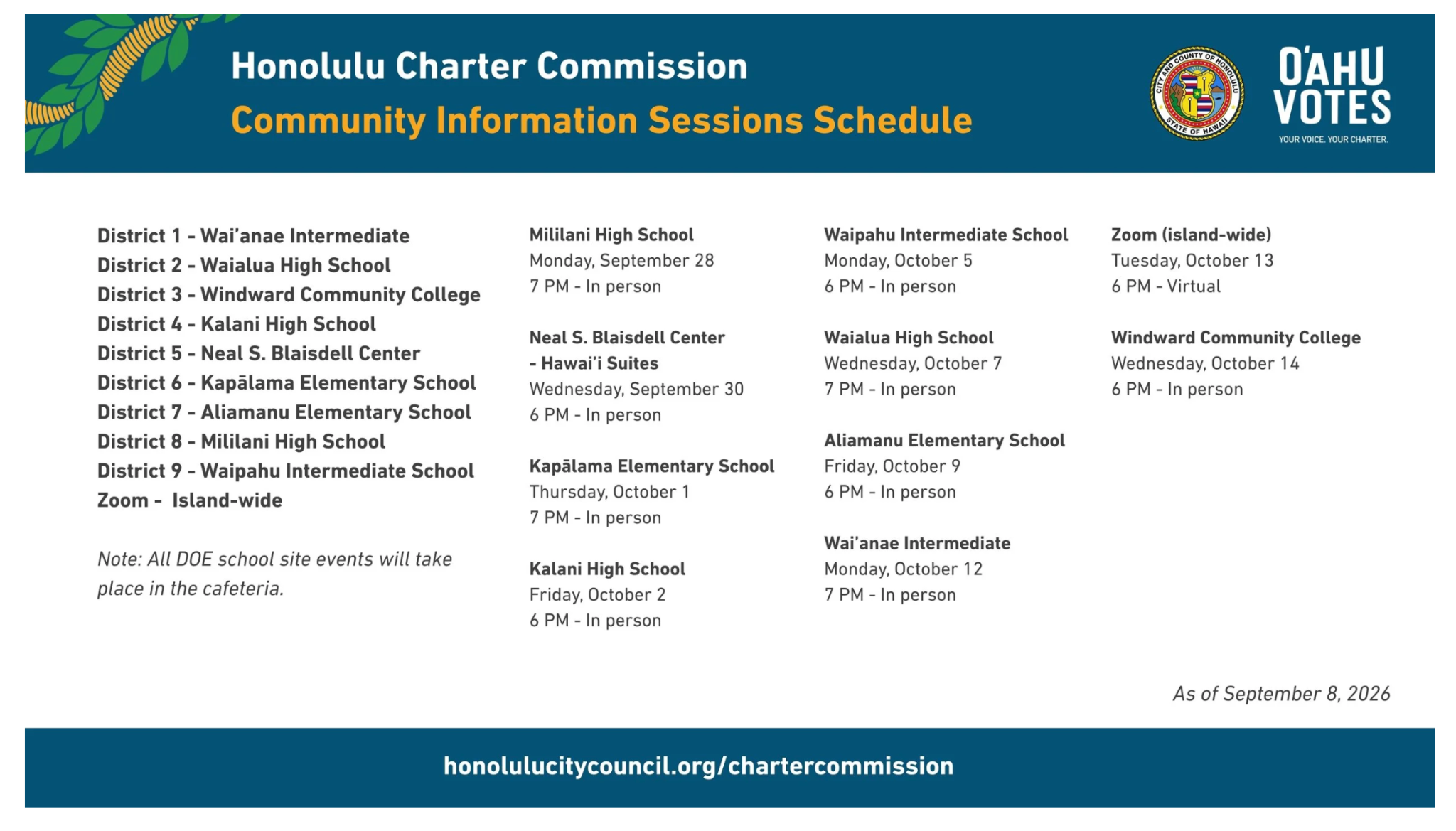
Talk With Your Community: The Honolulu Charter Commission is hosting Community Information Sessions beginning September 28 and through October 14. Check the schedule below and attend an information session near you to learn more. Sign up here.