
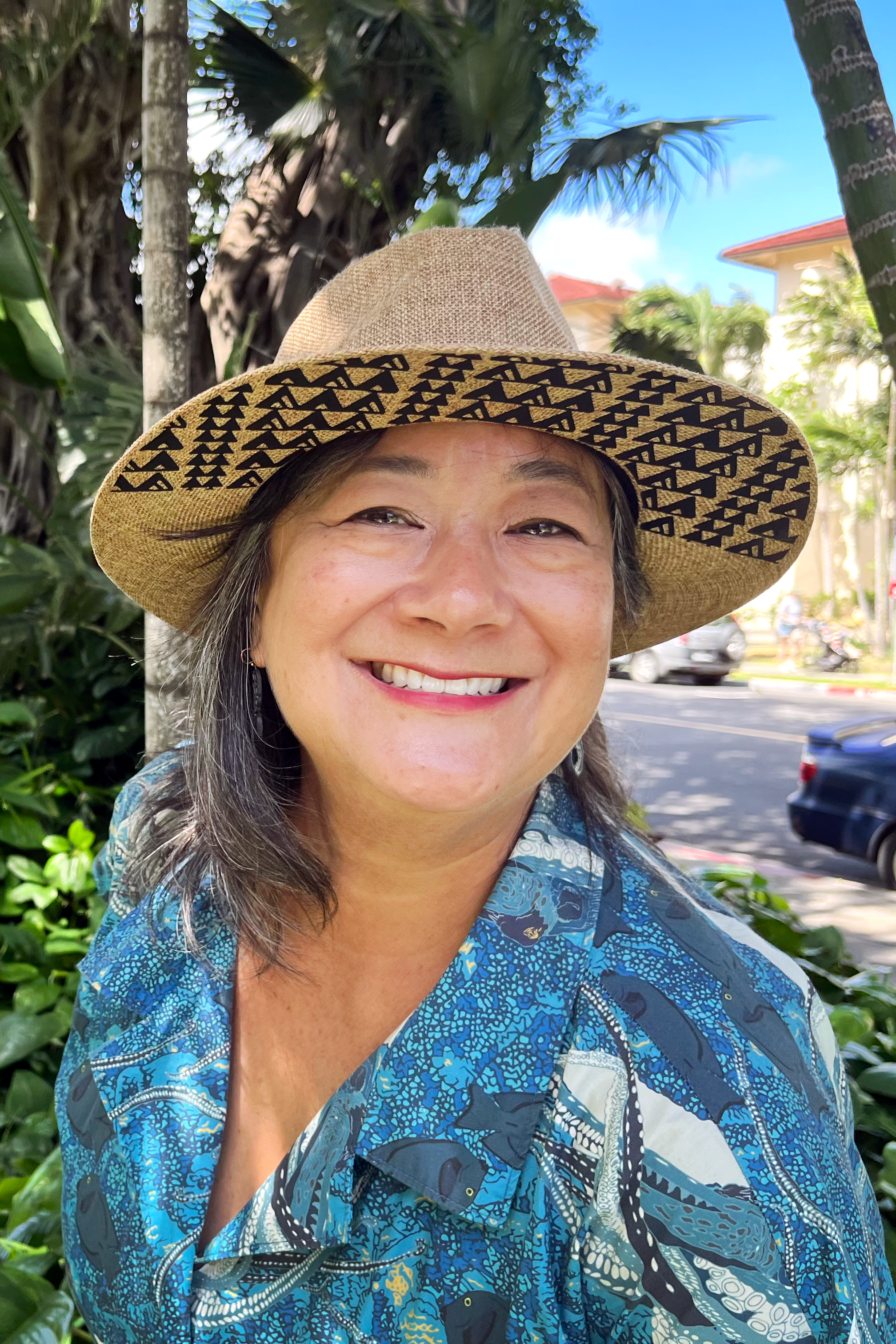
Photo: Courtesy
Q+A: Tanya Yamanaka Aynessazian
Community Advocate, Chamber of Sustainable Commerce
“That ability to thrive is the infrastructure of the economy itself. If people don’t have self-agency over their economic future, they’re never going to feel secure.”
Interview conducted September, 2026
Hawaiʻi Appleseed (HA): What first brought you to this work?
Tanya Yamanaka Aynessazian (TA): I was born in 1968 in Chicago, in the middle of major political turmoil—assassinations, the Democratic National Convention. My mom was carrying me then, and she disliked politics from the moment I was born. When I was pregnant with my daughter, it was right during 9/11, and I recognized the pattern.
9/11 was a big change for me. I realized the policies starting then were built not to unify us but to separate us—”you’re either with us or against us.” I thought, this is going to come back to bite us. But I didn’t understand how you make a difference at the local level until I got to Hawaiʻi in 2004 and started working on universal health care. That’s when I realized one person can make a really big difference.
Everything you do is political. If you can’t see that in 2026, you’re too busy to open your eyes and see how expensive everything is and why.
HA: What does economic justice actually mean in Hawaiʻi right now?
TA: Economic justice is everybody thriving. That ability to thrive is the infrastructure of the economy itself. If people don’t have self-agency over their economic future, they’re never going to feel secure.
We talk about affordable housing forever, but if we don’t talk about the banking problem, it doesn’t matter how affordable the house is if you need 20 percent down and people are making $30,000 a year. I want to see a system that cares about us as much as we care about it—because we participate in it with every dollar we make.
HA: Does this work feel different now than it did five years ago?
TA: Very different. The system is so clearly showing how bad it is. I’m not seeing things as separate problems anymore—housing here, minimum wage there. We’re at a point of convergence. If our biology isn’t thriving and the systems we depend on are dying, why are we supporting it at all?
I feel like the system has passed my boundaries. It feels abusive. If it were my partner, I would have left it.
HA: What’s something that would bring hope in the next year.
TA: This is hard. I don’t want to be a Pollyanna—I think our greatest opportunity to come together will probably come from more hardship. For me, it’s about how we rebound from whatever is coming and how we unify to take another shot. When people see a group persevering and trying to help everybody, more will realize they have to do something too.
Post-COVID, we said everything was going to change here. We saw hope—the environment looked better with fewer tourists. Then we all got back in there, same old thing. But I still have hope because I believe in people. Get involved in one group or issue. If you channel your energy into action, you rebound from the hits. Perseverance is one of the best tools we have.
HA: Who’s one person or family or movement whose story has genuinely stayed with you?
TA: Standing with the kiaʻi on Mauna Kea. When I saw how many people converged, the energy was that if we’re together, we can accomplish anything. There was such diversity of people, and yet this prevalence of Native Hawaiian culture. That was a huge shift for me.
When you feel that, you realize that’s life when it’s thriving. It was inspiring to see folks going up against not just the state but the federal government and a powerful consortium of wealthy, science-adjacent industries. It makes you feel like you’re not just a drop of water—you are the ocean.
HA: What’s something people misunderstand about the work Appleseed and its partners do?
TA: That it’s boring work. When people look at economic justice, or when you talk about food or housing, there are so many agencies and organizations that it looks overwhelming. It’s easy to check out.
But the economy doesn’t work the way it does in textbooks. Like affordable housing—we really have a banking problem. Banks don’t want to give loans because people are bad risks, because they’re not making enough money. So fix the banking problem. If we had community banks or state banks, we could create something much better.
HA: What’s your hope for Hawaiʻi 20 years from now?
TA: First, that Hawaiians are happier with the progress made with the occupation. The occupation affects everything—it’s the elephant in the room. How can we have a thriving regenerative economy if we’re still occupied? My metric is how Hawaiians are engaged, similar to the Māori movement. Are they feeling like we’re making big progress?
Second, that education shifts in a big way. The textbooks kids use in high school are 30 years old. Education should be hands-on. My six-year-old grandkid—I don’t know how he’s going to sit in these classrooms. These kids are bright lights, but because they can’t sit still and take tests, they’re being judged. Education needs to be reimagined to nurture kids for a regenerative world that heals instead of traumatizes.
Hawaiʻi is perfectly positioned to make big changes because we’re separate and smaller. When I got divorced, I had to start over—downsize, save, work less, demand more money because I wanted time with my kids. I realized what was most important. There’s a way for us to ask for what we want and demand it. Work shouldn’t be in exchange for time—that idea has to go. We keep fighting the good fight, but planting seeds in younger people for real reform—that’s what matters.