
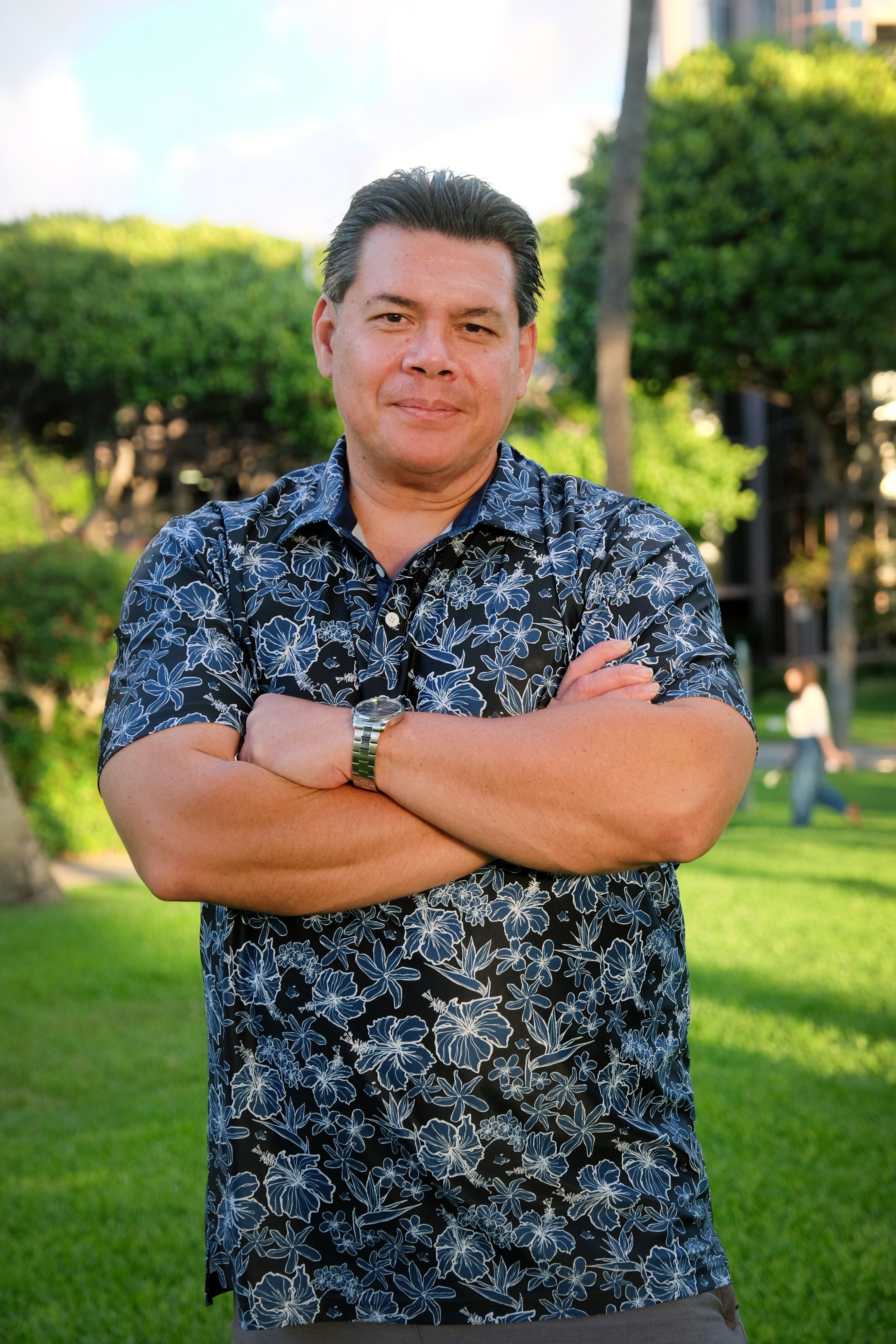
Photo: Will Caron, Hawaiʻi Appleseed
Q+A: Nikos Leverenz
Grants & Advancement Manager, Hawaiʻi Health & Harm Reduction Center
“People are struggling, and we need to calibrate our economy so service workers can rely, like my grandmother did, on wages and benefits that provide a solid baseline.”
Interview conducted September, 2026
Hawaiʻi Appleseed (HA): What first brought you into advocacy work?
Nikos Leverenz (NL): I had a junior high teacher at Maryknoll named Margot Adair—she was Filipina—who encouraged us to pay close attention to politics. This was 1986, during a contentious gubernatorial race, and we followed it all through the newspapers and evening news. We also paid attention to what was happening in the Philippines because when Marcos got ousted, he ended up in a house overlooking our school. That seed was planted early.
By the time I got to college, I was a politics major. I went to Occidental, then to law school at McGeorge. But in law school, I saw how insufficient the law was at creating a climate where people could thrive—both in terms of political economy and civil rights. I was also a very early drug war skeptic. When you do any thorough analysis of how the drug war has been implemented, it’s been a catastrophic failure. And yet here we are, 50-plus years down the line.
So I decided I’d rather participate in the legislative process than practice law—help abolish bad laws, help enact good ones. I found roles as a staffer and advocate in Sacramento, and eventually came back here. I can’t leave the drug war until we’ve surrendered and started treating substance use and mental health as health issues.
HA: What does economic justice mean to you?
NL: I’m attracted to the aspiration that one job should be enough. With an increasingly aging society, people need to drop out of the workforce to take care of elderly parents—that’s part of why I moved back. I have aging parents and an ill younger relative. People need enough financial flexibility to pursue life options that matter to them, like caregiving or propping up their children for success.
But we’re not even having that conversation right now. We have to fight this culture of austerity. It’s remarkable how entrenched it is—it goes beyond the balanced budget provision in our state constitution. It’s a political mindset. Those of us who have more should contribute more so the public can provide greater support to people facing ever-escalating costs and persistently low wages.
HA: Does this work feel different now than it did five years ago?
NL: The situation is a lot more urgent. Particularly here in 2026, with the second Trump administration. We’ve had direct impacts on our work. In some ways, the pandemic was a period of relative economic stability—the federal government stepped up its capacity to provide aid directly to individuals and families. What they did with the Child Tax Credit—cutting child poverty by half and then just killing it—was unconscionable.
We have a massive increase in wealth that impacts not just our national economy but our local economy too. We have a lot of millionaires that own property here. And the politicians, certainly the corporate media, don’t even lay the groundwork for having a conversation around that. That’s by design. But to the extent we can help people understand that what happens at the state Capitol impacts their day-to-day lives—all the better.
HA: What’s something that would bring hope in the next year?
NL: I’d like to see the federal government restore some of the funding cut from the health care sector. That would help a lot. The decimation of rural health care impacts us too. And we need to roll back SNAP cuts—SNAP was never on the table in the decades I've been following politics.
I was shocked to learn that Hawaiʻi had not opted out of the SNAP bans for people convicted of drug felonies, which includes possession of even small amounts. We took care of that this last session, and I think the lowest-hanging fruit for next year is to lift the TANF ban on drug felonies. And then the various measures that will come up through the Tax Fairness Coalition. Given the stock market’s stratospheric rise since the pandemic, we need to equalize capital gains as well.
HA: Whose story has stayed with you?
NL: The lived experience of my own family—especially the generation that preceded my parents. My grandmother Rosalie grew up on Maui near the sugar plantation, lived through the Depression, lost her mother, and had to navigate her family’s situation as a young person. She only had about a sixth or maybe eighth grade education because she had to drop out to raise her siblings.
She started working again in the 1960s and worked for about three decades. She represents the upward mobility of an undereducated Filipina who was able to support a family and have a relatively stable life. She didn’t die rich—she lived with us—but she was taken care of. When she got sick later in life, she was able to stay in a long-term care facility because of her union contract. That’s the kind of benefit package we need to get back to in Hawaiʻi.
HA: What do people misunderstand about the work of Hawaiʻi Appleseed and its partners?
NL: I think the misconception is that we’re trying to make things worse for business and economic prosperity. There are some quarters who think public health isn’t a judicious investment of public resources. But we have a syringe access program that’s received public funding for 35 years, and it’s kept HIV rates low among people who inject drugs that entire time. That was a forward-thinking policy.
With Appleseed and the Tax Fairness Coalition, I think the main perception is that we’re just trying to raise money for whatever reason. But we’re really seeking to increase revenue so the Legislature can direct it toward people who need to make ends meet. There are so many people working multiple jobs here. Our work should stand for itself on the economic justice front—people are struggling, and we need to calibrate our economy so service workers can rely, like my grandmother did, on wages and benefits that provide a solid baseline.
HA: What’s your hope for Hawaiʻi in 20 years?
NL: That Hawaiʻi can be a more just and equitable place—not just economically, but in meeting the moment on climate change, which is right here with us now. I'm also hopeful we have a politics that is once again aspirational and not reactive. We had a spirit in the ’70s where labor unions were at the vanguard of social and economic justice. My deepest aspiration is that organized labor can return to that—not just mobilizing its members, but working people of the state generally, standing up for economic justice.