
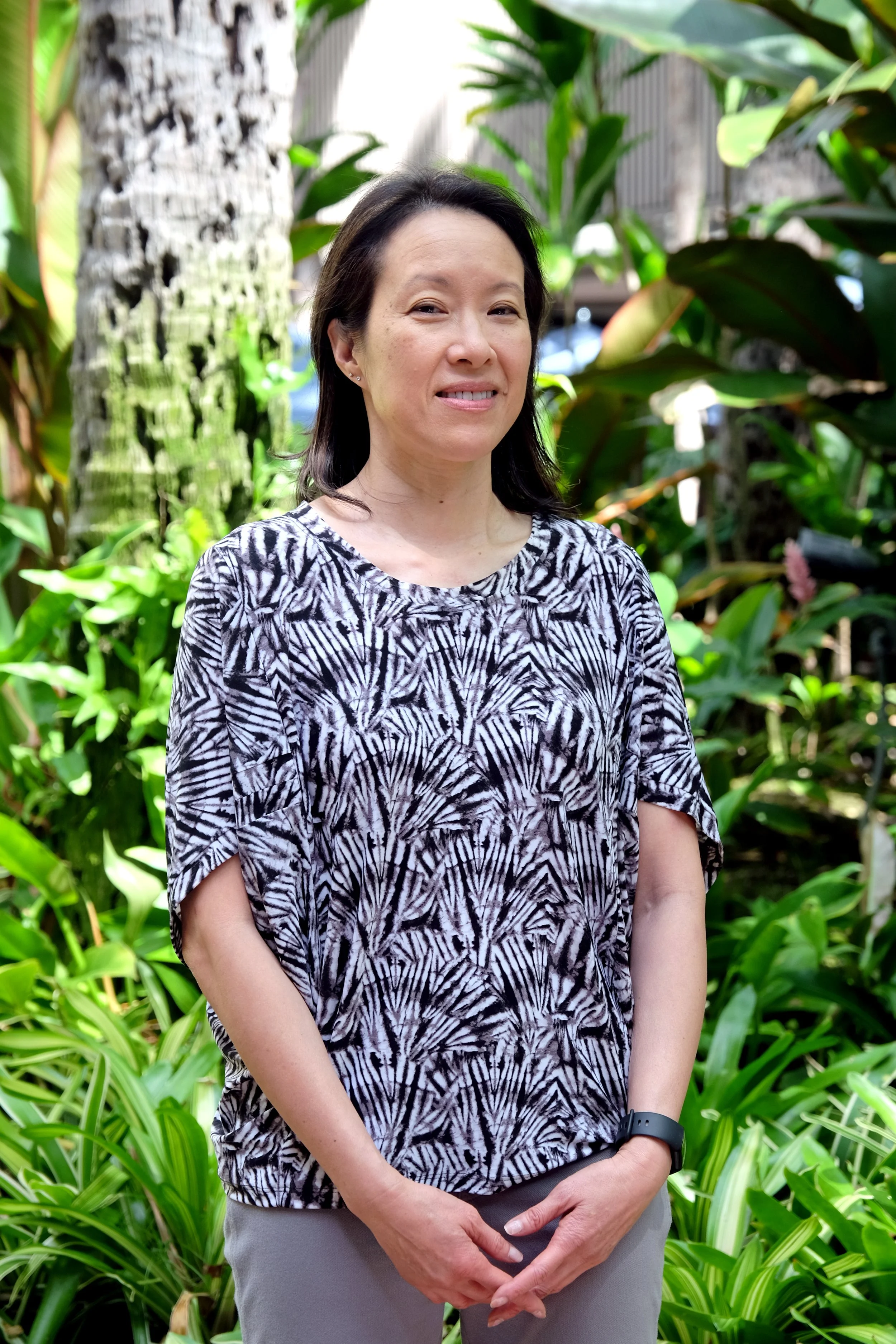
Photo: Will Caron, Hawaiʻi Appleseed
Q+A: Nicole Woo
Director of Research and Economic Policy, Hawaiʻi Children’s Action Network
“At the same time, the people who actually make the state work—hotel workers, all the other working people—they’re struggling. For me, economic justice would mean they could have just one job, time with their families, and all that.”
Interview conducted September, 2026
Hawaiʻi Appleseed (HA): What first brought you to this work?
Nicole Woo (NW): I always blame my parents. They’re Chinese immigrants, but my mom became a social worker in New York City working with children, and my dad became a public school teacher. That’s pretty unusual for Chinese immigrant parents. I grew up hearing stories about the families and students they worked with—my dad taught special ed in a school that was mostly Black and brown, low-income students, and my mom ran a daycare center in a housing project in the Bronx.
I grew up in a more middle-income neighborhood near my mom’s daycare. I taught at a dance studio there, so I had these little tiny kids, and I also volunteered at my mom’s daycare. The kids were the same—just as bright, just as smart. But I figured out that by the time they got to my dad in high school, their futures were completely set in different directions. I remember asking my parents about that, trying to understand how kids who were the same at 3 or 4 years old were going to have completely different futures. They didn’t really have an answer. They were practical people. It was just, “That’s the way it is.” So I feel like I had no choice.
I started in direct service at the New York City Coalition Against Hunger, coordinating soup kitchens and food pantries. Then Clinton welfare reform came through, and I had voted for the man—I was devastated to see how they were cutting the social safety net. So I went from direct service to wanting to fix the policies, go upstream. I moved to D.C. to work for a national anti-hunger organization, thinking I was going to fix everything.
HA: What does economic justice mean to you in Hawaiʻi right now?
NW: Every now and then I think about taking a staycation here on Oʻahu, and I look at the hotel room rates in Waikīkī and can’t believe how much people spend. And every now and then you see in the news that some tens-of-millions-of-dollars property has changed hands here. So we know there’s just unbelievable amounts of wealth sloshing around the state.
At the same time, the people who actually make the state work—hotel workers, all the other working people—they’re struggling. For me, economic justice would mean those workers and regular people no longer have to struggle to make ends meet. They could have just one job, time with their families, and all that.
HA: Does this work feel different now than it did five years ago?
NW: Five years ago was 2020–21. It feels like forever ago. We were coming out of the pandemic. There had been a lot of federal stimulus money, which prevented what we thought was going to be a disaster here in Hawaiʻi. There was also this boosted Child Tax Credit, and when you look back at it, researchers found it cut child poverty by more than half. We know what works.
Back then, I was hopeful that the boost to the Child Tax Credit would be extended. But now, five years later, things have gone in completely the opposite direction. These supports for working families are getting cut and undermined. It feels very different.
Although I have to say, I've been through a lot of these cycles, and I do have hope that the pendulum will shift in the next few years.
HA: What’s something that would bring hope in the next year?
NW: I work with Hawaiʻi Children’s Action Network, so we focus on keiki and youth here. That means we have to focus on their parents too. There are so many supports parents need to afford to live here and stay here—everything from affordable housing to child care support to paid family and medical leave.
There are a lot of great ideas, and a lot of us have been working on them for years. I hope in the next year we can make some progress on passing policies we know could help families with children afford to live here, stay here, and thrive.
HA: Who’s one person or family whose story has genuinely stayed with you?
NW: I’ve been sitting with a lot of memories today, with the anniversary of 9/11 coming up. One of my closest friends—we’ve known each other since we were infants because our moms were friends—lived a couple blocks from the World Trade Center. She has cancer now.
What stays with me is how they didn’t tell people about the air quality. They covered it up so people would go back to work. She lived right there. She could have stayed somewhere else—she could have stayed with me. I was a mile and a half away.
I was in New York for 9/11, then moved to D.C., and I visited that Thanksgiving. I stayed with her. She had a two-bedroom apartment with her boyfriend, so I was in the guest room. Everything looked fine, but I grabbed one of the shampoo bottles and the back side still had 9/11 dust on it. I could feel that grittiness.
It’s not a Hawaiʻi economic justice story, but it’s the same lesson I keep coming back to: the people with the least power are the ones who pay the price when systems fail them. That’s what drives the work.
HA: What’s something people misunderstand about the work you do?
NW: Having worked at Hawaiʻi Appleseed for five years, I think I can speak to this—and it’s similar for groups like mine. I think some people think we just want to win. We just want to pass a bill. We just want to check a box.
But the people I know who work at Appleseed really want to find solutions that work for everyone. We don’t want to pass a bill that’s not going to work, or one that’s going to make things worse. I wish legislators and opponents would give us some grace and work with us, because we really do want to talk. If there’s an issue with a policy we’re proposing, we want to figure out how to fix it. It doesn't have to be about who’s winning and who’s losing.
I remember reaching out to some of the opponents of bills we were trying to pass, and they just wouldn’t talk to us. I think that’s a misunderstanding—that we’re not just checking off wins. We really want to find solutions.
HA: What’s your hope for Hawaiʻi 20 years from now?
NW: I’m hoping that 20 years from now, the beaches in Hawaiʻi have stopped eroding. I’m hoping the hurricanes aren’t stronger than they are now. I hope the environment doesn’t get worse and actually gets better.
On the economic side, I got here 10 years ago, so I can’t speak all the way back, but my sense is that for a long time, people who could have made important decisions didn’t make difficult decisions about housing and about policies that could help families afford to live here. Now we have this crisis. I hope it’s not that they’re forced by bad things happening to make the right decisions, but that they’ll start being more proactive.
Coming to live here, I’ve learned so much about how progressive Hawaiʻi was in the past. Some of the most powerful union movements 100 years ago. The first state to ratify the Equal Rights Amendment. The first state to legalize abortion early on. Same-sex marriage. Prepaid health care, which is the basis of a lot of what we have in Obamacare. There was a time when Hawaiʻi was way out front on policies that really helped people.
I hope that the pendulum swings again—that Hawaiʻi remembers its most important priority is the people who live and work hard here.