
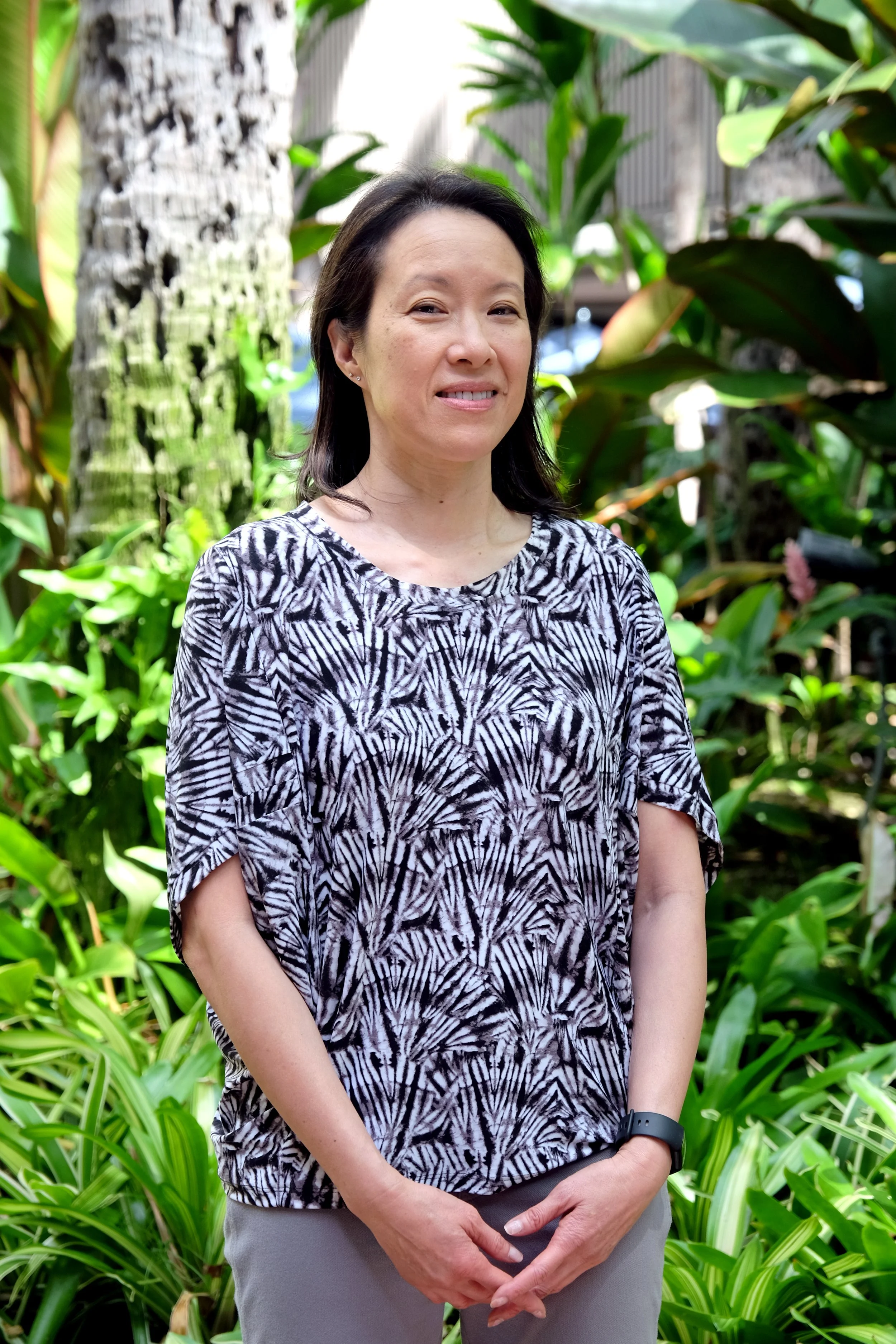
Photo: Courtesy
Q+A: Kristin Frost Albrecht
Executive Director, The Food Basket – Hawaiʻi Island’s Food Bank
“It’s been heartwarming to watch them grow from one loʻi to 18 loʻi. A lot of lives are being helped now. Their mission to help provide enough food for this island is huge.”
Interview conducted October, 2026
Hawaiʻi Appleseed (HA): What first brought you to this work?
Kristin Frost Albrecht (KA): I’ve had a strong interest in feeding people from my earliest days. I did a lot of work with nonprofits in Oregon, helping my own community. Then we had a hurricane in 2007, and suddenly everybody wondered where their food came from. That started me down this path—establishing a farmers market and a food pantry in my community, and one thing led to another. A food hub.
Then my family situation brought me to Hawaiʻi to help care for my parents. I landed at The Food Basket through a random interview, and there was a magic to it. I knew this is where I belonged. That was 2014, and I’ve been here ever since, working to create better food systems and better affordability so people can access food. It’s evolving, and it takes a long time.
Food insecurity has really risen because of all the disasters we’ve been through. We’ve got 43 percent food insecurity on Hawaiʻi Island—the highest in the state. The child rate is even worse: 62 percent of our children on this island are food insecure. Very sobering. Very humbling. So we just keep working at it.
HA: What does economic justice actually mean in Hawaiʻi right now?
KA: For me, it’s being able for every family, everyone, to afford to put a roof over their head and have enough food to eat. Very simple. And to have a job that pays them enough to do so. We’re a long ways away from that, I’m sorry to say.
HA: Does this work feel different to you than it did five years ago?
KA: I’ve always felt there was urgency in this work, and maybe I feel that even more strongly now. It’s not just urgent—it’s dire. Things are not getting better, I’m sorry to say. We have to really pull out the stops as a state at every level to change things around. It’s a really big job.
So many families are leaving. It’s really hard to afford to live here and raise your family. For people who go to the grocery store—which is just about everybody—it’s hard to avoid, and people are having to make terrible choices. With this last year of storms and government shutdowns, it’s just hitting people at every angle. SNAP, Medicaid.
HA: What’s something specific you’d want to see in the next year that would bring hope?
KA: We’re really committed to expanding and supporting agriculture across the state, but on our island especially. At the state level, we need to create policy that supports our agricultural producers in a big way. Right now, that means subsidizing them—so they can actually farm, survive these storms, and do this full-time instead of having to support themselves with another job. We have the know-how and the will of people in agriculture. They just need that support at the policy level.
We’re seeing so many farmers who’ve had thousands and thousands of dollars of damage to their infrastructure or lost crops. It’s a huge hole to dig out of, and we’re hearing some despair. We’re beyond thinking we can do this just from the nonprofit side. We need more government intervention. I know how hard this is—everybody is scrambling for money. But feeding our communities, making sure everybody has enough to eat and not relying on food from the continents—we just can’t do that anymore. These storms are telling us that.
HA: Who’s one person or family whose story has genuinely stayed with you?
KA: There are so many. One story I really love involves a kalo farmer we started purchasing from—a family that’s been in Waipi’o Valley for four or five generations. We started buying their poi, which comes in those little plastic tubes, 100 percent poi. It’s really great for emergency food programs, and the people we serve are over the moon about it.
We started with a monthly regular order, then increased it, which allowed them to increase their production. It’s been heartwarming to watch them grow from one loʻi to 18 loʻi and bring other people into the work. A lot of lives are being helped now. Their mission to help provide enough food for this island is huge.
I was also out helping with one of our distributions, and I had this young boy—he must have been 3 or 4—and I was chatting with him. I said, “Is there anything you really wish you could eat?” He grabbed his mom’s hand and said, “Can I get poi?” And we had some, which was great. I love that poi is a taste and a treat that somebody wants to eat from a very early age. Introducing our keiki to canoe crops and foods that grow well here—that aren’t as susceptible to the biosecurity issues we’re facing—is really important. And having somebody want poi? That’s a win.
HA: What’s something people misunderstand about the work you do, and the work Appleseed does?
KA: I think a lot about food literacy—people understanding the food we have here and why that’s important. I don’t think people understand how dire things are, how remote we are, and how susceptible we are to growing hunger. People hear this, but in their everyday lives, until it impacts them, they don’t really know.
It’s hard for people to see the systems at play when they’re working well, because they’re kind of invisible—or at least when they’re working well for them. As soon as it stops working well, suddenly you see all the gears and internal workings laid out. And then I think a lot of our working families—it’s not that they don’t understand, but they’re exhausted. I can’t tell you how many people we know who are working three jobs at least. That exhaustion plays in big time.
HA: What's your hope for Hawaiʻi 20 years from now?
KA: I’d love to see a state that can feed itself. And that we have enough jobs that people can make a living here with one job, not multiple jobs—that families can stay here and raise their families here. It’s a wonderful place to live. It’s magical in many ways. Enough money to have a roof over your head—all of those things are super important. We’re all working hard at that.
I also think about collaboration between government and nonprofits and local businesses. We have a ways to go to really focus on what’s truly needed and move above and beyond some of the politics involved. Appleseed does this so well—I’m always impressed. It takes a lot of courage. I’ve been thinking that ever since Appleseed sued DHS over the SNAP rates. That took a lot of courage. We’re almost at a place where I see these very heavy lifts. The urgency is undeniable. It’s going to take a lot of strength, a lot of collaboration, and collective belief that there is a better future out there.