
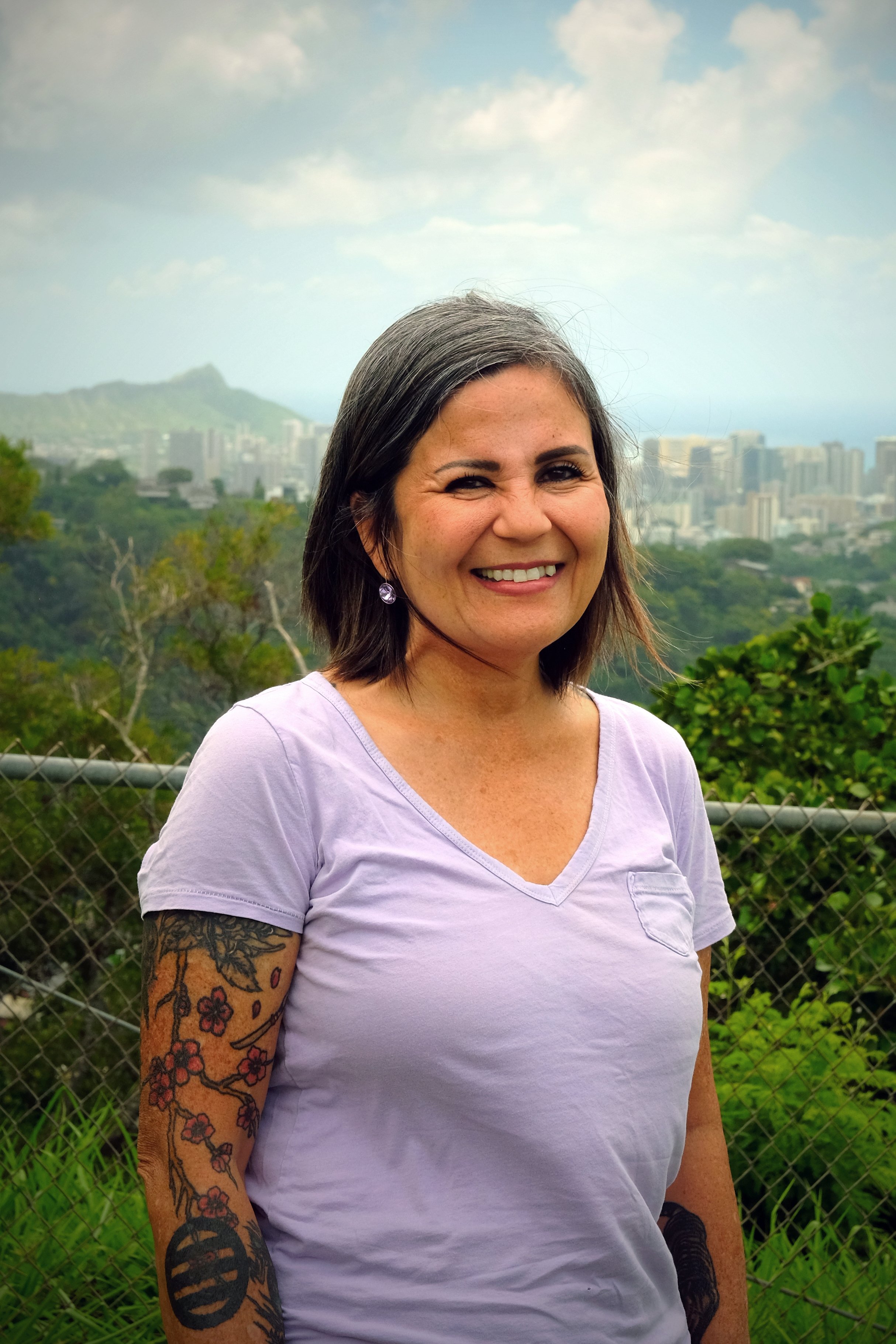
Photo: Will Caron, Hawaiʻi Appleseed
Q+A: Christy MacPherson
Director of Community Engagement, Hawaiʻi Appleseed Center for Law & Economic Justice
“Right now, people are struggling—they’re living under so much stress. And that’s why we’re seeing increases in mental health issues, violence, theft, crime. It’s all connected. Lawmakers don’t seem to understand that.”
Interview conducted September, 2026
Hawaiʻi Appleseed (HA): What first brought you to this work?
Christy MacPherson (CM): My dad. He introduced me to my mentor for a meeting. She asked me all these questions, and I remember thinking, “What the heck is she asking me all this for?” She was trying to see if I had something worth working with. I guess I was recruited. And everything else is history.
HA: What kind of questions?
CM: Relational ones. The kind you ask when you’re genuinely curious about someone. To this day, I have no problem asking people really deep questions. If they’re uncomfortable, they’ll let me know. But I’ll ask the hard questions.
HA: Can you talk about your parents and how they influenced you?
CM: Social justice is something I was just raised in. My mom’s an activist. My dad was too, before he learned organizing. Our dinner tables with my grandparents, my uncles and aunties—they were always centered around politics and social issues. Sometimes argumentative. Always engaging. I grew up going to marches and protests and cultural events. That’s just what we did.
HA: What’s the difference between being an activist and an organizer?
CM: Activism is showing up to a protest or writing a letter. It’s more individualized. Organizing is a skill—it’s about mobilizing other people to join you and building something sustainable. My mom’s an activist. She won’t do organizing, but she’ll show up. Organizers build power.
HA: What does economic justice actually mean in Hawaiʻi right now—in your own words?
CM: It’s people having the ability to live the kind of life they want. To be able to choose. Not constantly looking at their budget and cutting corners just to cover an emergency. It’s quality of life. Right now, people are struggling—they’re living under so much stress. And that’s why we’re seeing increases in mental health issues, violence, theft, crime. It's all connected. Lawmakers don’t seem to understand that.
HA: Does this work feel different now than it did five years ago?
CM: Yeah, it really does. I come from old school organizing culture, and social media has made things more challenging. People rely on it to do the work for them. But the kind of organizing I come from is made to last—the relationships are made to last. I’m learning to see social media as a tool—an introduction—rather than the work itself.
I also think our political structure is just out of whack. The way we work with lawmakers feels less and less effective. We need to change it up—add an element of surprise. It’s not just about building numbers anymore; it’s about tactics.
HA: What’s something that would bring hope in the next year?
CM: Winning on something significant. Something that really moves the needle in people’s lives. Not just a bill that passes but doesn’t do much. We need a victory to show that change is still possible, because right now it doesn't feel like it’s even in the cards.
HA: Who is someone whose story has stayed with you?
CM: A woman I worked with when I was helping homeless families. She was one of my most challenging cases—using drugs, living in a park with her son, collecting cans for money. I kept pushing her because I saw that spark of hope. Eventually, she got clean, got a full-time job, and her son—who was so smart and talented—got a better life. She thanked me years later for pushing her. That taught me you have to confront, have compassion, guide, support. And good things happen.
HA: What do people misunderstand about Appleseed’s work?
CM: People think we’re this radical policy hub. But the issues we work on aren’t radical—they’re essential. Quality of life. Basic necessities. Economic justice. If you’re against those things, I have to question your character.
I also think people don’t realize how much Appleseed has shifted toward connecting with community and letting community lead, rather than telling them what to do. That’s been a major shift in the last decade.
HA: What’s your hope for Hawaiʻi twenty years from now?
CM: That my kids and their generation are doing well. That they have a home—whatever that looks like—and they’re not constantly worried about bills. And that their mental health is better, because young people are really struggling right now. I want my sons’ generation to forget about all the expectations and live their lives in a way that feels fulfilling—while making a living doing it. And to tune out all that social media noise. A lot of it’s just trash.